Friday, September 28, 2012
River of Waters
The Río de Aguas today, living up to its name for once. In fact, the rain has been so heavy in the hills above Mojácar, the river is in flood and...look! Its good kayaking weather!
The bottom photo was sent by a friend who lives in Pueblo Laguna, a place that always gets it when it rains. See all the cars! In fact, back along the coast to Mojácar, the beach is covered with so much driftwood and mess from the riverbed that any chance of cleaning it will take some major work. When it rains it pours.
The last picture, taken with a phone, is downtown Pueblo Laguna, where the houses are currently 'very cheap'.
Wednesday, September 19, 2012
A Small Plague in the Garden
There used to be a nice Canadian show on the television about the delightful critters that live quietly in the garden. A slow and friendly voice helped us as we wandered around a giant Canadian garden looking under leaves and behind rocks. Pleasant-looking bees worked feverishly to please the cameraman as the plant-life went through its various routines: flowers, seeds and pods. Small rodents galloped aimlessly about in the undergrowth as some muted music accompanied the friendly talk. Oh! to live near a Canadian garden and to follow the dragon-flies.
Here in Mojácar, we use a Californian gardening book. It has most of our flowers and shrubs, but it is understandably light on the subject of the local fauna that flitter from bush to bush, or in the case of our latest guests, from root to root.
These are the shrews. They dig tunnels through the brick-hard dirt which features as the garden-bed in our establishment, tossing up occasional piles of earth and moving in a direct and uncompromising way towards the new hedgling I've put in (a small but one-day mighty hedge to remove the view currently offered to us by our neighbour). These shrews: topillos or musarañas, (nobody seems to know) have only been around since the Mojácar fire of three summers past. They feast on rootlets: fresh, juicy, crisp, tasty rootlets. I may not have a green finger, or is it a thumb, but even I know these fellows need to go.
To the shop on the beach, which offers me rat poison (now, that can't be right), and so on to the Ramblizo in Antas. Readers may know this store, which has everything for hunters, riders, pet-owners, prospective pet-owners, gardeners and I haven't even made it to the upstairs yet, where there are kitchen goods, televisions, fly-traps and screwdrivers. It's a sort of Farmers' Dream (with a little Something for the Housewife). Anyhow, they gave me a Jumbo-sized box of what turned out to be rat poison again. Stick a bit down the tunnel and stand back. Hmmn.
My father was known in Norfolk by his neighbours as The Eichmann of Moles. When a molehill appeared on the lawn (it was a fifty acre lawn and, as I remember, it needed a lot of mowing), my dad would stick a metal trap down the centre of the mound, with appalling results. But there were other equally grisly ways of dispatching a mole. It appears that moles are hemophiliacs and therefore, a bit of broken glass on the floor of their run will cause them to bleed to death. There are gases which can be pumped down their highways, and a horizontally placed British milk-bottle will allow them in, don't you see, but not out.
So this afternoon, I was watering and fending off the mosquitoes (I don't think they will be spraying for these pests, since the tourists aren't here and us: we've already voted). But then, I found my latest plant, filched only last week from a public seed-bed, was surrounded by a pile of earth. In went a small stub of rat-poison. Take that, you little swine.
Here in Mojácar, we use a Californian gardening book. It has most of our flowers and shrubs, but it is understandably light on the subject of the local fauna that flitter from bush to bush, or in the case of our latest guests, from root to root.
These are the shrews. They dig tunnels through the brick-hard dirt which features as the garden-bed in our establishment, tossing up occasional piles of earth and moving in a direct and uncompromising way towards the new hedgling I've put in (a small but one-day mighty hedge to remove the view currently offered to us by our neighbour). These shrews: topillos or musarañas, (nobody seems to know) have only been around since the Mojácar fire of three summers past. They feast on rootlets: fresh, juicy, crisp, tasty rootlets. I may not have a green finger, or is it a thumb, but even I know these fellows need to go.
To the shop on the beach, which offers me rat poison (now, that can't be right), and so on to the Ramblizo in Antas. Readers may know this store, which has everything for hunters, riders, pet-owners, prospective pet-owners, gardeners and I haven't even made it to the upstairs yet, where there are kitchen goods, televisions, fly-traps and screwdrivers. It's a sort of Farmers' Dream (with a little Something for the Housewife). Anyhow, they gave me a Jumbo-sized box of what turned out to be rat poison again. Stick a bit down the tunnel and stand back. Hmmn.
My father was known in Norfolk by his neighbours as The Eichmann of Moles. When a molehill appeared on the lawn (it was a fifty acre lawn and, as I remember, it needed a lot of mowing), my dad would stick a metal trap down the centre of the mound, with appalling results. But there were other equally grisly ways of dispatching a mole. It appears that moles are hemophiliacs and therefore, a bit of broken glass on the floor of their run will cause them to bleed to death. There are gases which can be pumped down their highways, and a horizontally placed British milk-bottle will allow them in, don't you see, but not out.
So this afternoon, I was watering and fending off the mosquitoes (I don't think they will be spraying for these pests, since the tourists aren't here and us: we've already voted). But then, I found my latest plant, filched only last week from a public seed-bed, was surrounded by a pile of earth. In went a small stub of rat-poison. Take that, you little swine.
Tuesday, September 04, 2012
Plug Ugly
There's an old bath up at the stables that does for a drinking basin for the horses. It started out as an old, empty and rusted out tub with the plug 'ole missing, but a trip to the ferretería on the beach soon fixed that. For a couple of euros, half an hour's work and a skinned knuckle, plus some cementing and a bit more work, the old bath had became a handy trough. Another trip down to the ferret to get a longer piece of hose (it was either that or move the bath somewhere nearer the tap) and all was well. The bath filled up, didn't leak, and the horses got their drink.
As it happens, one of the nags is a playful brute and one day, it pulled the plug out of the bath and emptied it. This means, apart from the mess, that there is no water until someone comes by and fixes the problem. It turned out to be me and, casting about for the bung, I found a half chewed bit of hard rubber tossed under some straw, chewed and perforated too.
Back to the hardware store. Can I have another plug... this size please. The plug was flattened and hard to measure. Take a 48 and a 54 said the lady, one of them will fit.
As it happened, neither did. One was too big, the other too small. The smaller one is now in our bathroom at home, having taken over from an old and manky bung we've had for thirty years. The new one, with a shiny metal back to it, has rusted already.
So, back to the shop. Look señora, you sold me the unit, so you must have a plug that fits. No comprendo, she answered. When in doubt with angry foreigners.
So, to another shop. This one is the ferretería from Hell. It's a giant and wildly overstocked place where shoppers get lost. You can sometimes hear their pathetic shrieks late at night as you drive quickly past. The quality of the merchandise is highly suspect, boxes with bits missing, old stuff made in countries that no longer exist, wooden hammers that break on the first whack... and I don't like going there without a piece of string and a guide-book.
Their plugs are down in the eighth aisle, turn left, second aisle, right and right again. I eventually discover, a little later that morning, that they don't have anything except 48s and 54s either.
I went back to the first shop. Sell me another unit please, I said, with a spare plug.
We've run out of units, she answered with a certain satisfaction, I think you bought the last one.
So, to the next door town of Turre and its ferretería.
The story about the horse, tee hee, and could I buy a unit with a spare bung, por favor.
Yes I could.
As it happens, one of the nags is a playful brute and one day, it pulled the plug out of the bath and emptied it. This means, apart from the mess, that there is no water until someone comes by and fixes the problem. It turned out to be me and, casting about for the bung, I found a half chewed bit of hard rubber tossed under some straw, chewed and perforated too.
Back to the hardware store. Can I have another plug... this size please. The plug was flattened and hard to measure. Take a 48 and a 54 said the lady, one of them will fit.
As it happened, neither did. One was too big, the other too small. The smaller one is now in our bathroom at home, having taken over from an old and manky bung we've had for thirty years. The new one, with a shiny metal back to it, has rusted already.
So, back to the shop. Look señora, you sold me the unit, so you must have a plug that fits. No comprendo, she answered. When in doubt with angry foreigners.
So, to another shop. This one is the ferretería from Hell. It's a giant and wildly overstocked place where shoppers get lost. You can sometimes hear their pathetic shrieks late at night as you drive quickly past. The quality of the merchandise is highly suspect, boxes with bits missing, old stuff made in countries that no longer exist, wooden hammers that break on the first whack... and I don't like going there without a piece of string and a guide-book.
Their plugs are down in the eighth aisle, turn left, second aisle, right and right again. I eventually discover, a little later that morning, that they don't have anything except 48s and 54s either.
I went back to the first shop. Sell me another unit please, I said, with a spare plug.
We've run out of units, she answered with a certain satisfaction, I think you bought the last one.
So, to the next door town of Turre and its ferretería.
The story about the horse, tee hee, and could I buy a unit with a spare bung, por favor.
Yes I could.
Monday, September 03, 2012
A Spoonful of Sugar
The
government of Mariano Rajoy is hoping to have been seen to be quick and eager
to reassure Brussels that Spain may be wounded and in pain, but that
the cure is already underway.
The
ordinary rate of IVA has gone up to 21% (following a rise last year by the PSOE
of 16% to 18%), school-books have gone up in price with a massive tax increase
(just in time for the school year), higher prices on public utilities have been
allowed (including the electric company, Endesa, making its prices the highest
in Europe) and even the poor funcionarios,
Spain’s three million strong public servants, have had to wave goodbye to their
Christmas bonus. The Minister of Justice is tightening the abortion rules to
strict church limits and many file-sharing sites (video pirates if you prefer)
are being closed down. Around 160 bank-sponsored evictions are being carried
out each day. The poor have not been
forgotten, with the special 400 euros handout introduced by the socialists
being returned for a further six months, although under strict new conditions.
A recent
survey asked if Rajoy should spend more attention on solving the unemployment
crisis – also the highest in Europe, with some provinces standing (or rather
‘sitting down’) at 35% - and less on trying to fix the prime rate and appease
the bankers in Brussels.
Perhaps,
indeed, with all the vinegar, Rajoy should be considering a small bonus to his
subjects, a sop to the masses, a bit of good news to treasure during this dark
autumn and winter to come.
There was a
hint of raising the speed limit on the motorways – but instead, they lowered it
on the byways, increased the police presence everywhere and, in a move designed
to send the tourist market reeling, the new head of Tráfico has recently said
that she wants to see ‘zero alcohol’ on the highway code as soon as possible.
So far, the
best the PP thinkers have come up with has been a putsch on the public
television and radio of any newscasters and interviewers thought to be
meddlesome. The good news is - they’ve put bullfighting back on.
Some opposition
politicians and intellectuals are talking of insurrection (as far as they can –
a new law has been passed making encouragement to violent protest, even on
Facebook, a crime punishable by two years).
The answer
to this, according to Cayo Lara, the General Secretary of the Izquierda Unida
(the Far Left alliance) could be to imprison a banker. ‘Spain’, he says, ‘needs
to have the image of a banker behind bars’ he told Europe Press, adding that ‘the
banking fraternity doesn’t need to walk on a bed of roses and that those
responsible for ruining many thousands of people and contributing to a
blood-bath of public resources should be held to account’.
The
Government however refuses to hold an enquiry in Parliament on the origins of
the current crisis and, apparently and despite alarming accounts of massive
public fraud, no banker appears to be at risk of losing their liberty.
On
September 25th, a protest called ‘Occupy the Parliament’ will be held in Madrid. It will be a test of how far the
public is prepared to show their impatience with the current crisis.
Monday, August 27, 2012
Bédar Fire
A brush fire broke out near Bédar on Saturday around midday, threatening
the village and burning at least 400 hectares of mountain growth. The
fire reached the edge of the village, which nestles in the sierras above
Turre and Mojácar, and then headed westwards towards some smaller
settlements. The town was evacuated on Saturday night by police order,
and many people were obliged to sleep in the sports pavilion in next door
Los Gallardos. The fire, one of three that appeared around the same time
(two smaller fires in nearby Vera and Antas) appears to have been
intentional. No word of damaged property as yet, but the fire, by noon
on Sunday, was still active in the higher hills.
Saturday, August 25, 2012
Vera Yes or Vera No?
A masterful piece of promotion from the Vera 'Oficina de Gestión Turística' to promote their fair city and supported (which must mean 'approved') by the Consejalías de Turismo, Deportes, Juventud and Cultura. The leaflet has maps, information, pictures and small children jumping up and down. But we are confused by the title page.
Does it say 'Verano' (summer) or 'Vera no'?
By Amber Napier
Does it say 'Verano' (summer) or 'Vera no'?
By Amber Napier
Wednesday, August 22, 2012
The Square with a Round Hole
I went to the presentation of the new square in Mojácar village next to the church, held a few days ago. The square is the final version of two previous plazas - the Arbellón and Frontón - which, after last year's demolition and this year's digging, might now profitably be called 'Plaza Rosmari's Baby' or perhaps, in honour of the fabled mojaquera who lost her arch a few mayors back, the 'Plaza de Luciana'.
The presentation was offered by the mayoress, with her crew of councillors standing in an orderly line behind her, to a small gathering of the Faithful. Opposition councillors were not sent an invitation and neither were various local media, including the Actualidad Almanzora who note in their write-up in the latest edition that: 'Como siempre, la versión del equipo de gobiereno no es posible reflejarla porque mantiene un boicot informativo absoluto hacía este medio, que nos priva incluso de recibir las notas de prensa municipales.' They say that they have an absolute boycott against them from the Mojácar authorities.
The underground car-park, to hold the famous 37 or 38 cars (depending on who's telling the story), won't be opened for, ah, business until next year. You know, paperwork... however, the large granite expanse above is now ready to admire, or put café tables on in an artful and refreshing manner. One has to think of the tourists. Nearby, a small wash breathes across a granite-chip wall, a fountain. Next to this is one of Rosmari's heavy plastic signs: 'On this date, Rosmari Cano opened the new plaza...'. There are quite a few of these scattered about the municipality, in a town where mayors are usually forgotten as quickly as is considered decent.
The mayorial presentation to the small group of supporters was accompanied by a video which showed in slow motion a film of the protests from last year. The opposition parties got their medicine in the speech as well. Afterwards, a tapa and a drink were offered to those present, numbering around eighty. As to the parking (in what we were told is now a pedestrianised village), how much would a single parking place cost, to defray the public outlay? Around 50,000 euros a pop. Are there any takers?
My first thought about this remarkable architectural onslaught arrived after I noticed the lift which towers politely over the proceedings. A splendid elevator that takes you from the plaza, whoosh, down to the underground car-park below. I imagined the maid Luciana, yearning for her Moorish prince, rather than throwing herself off the cliff to her death, could have just opened the metal door and pressed -01. Instead of the sad ending known to generations of Romantics, she would have descended safely and would now be living ever after with her prince. Who probably would have left her and opened a chiringuito instead.
But, that's foreigners for you.
The presentation was offered by the mayoress, with her crew of councillors standing in an orderly line behind her, to a small gathering of the Faithful. Opposition councillors were not sent an invitation and neither were various local media, including the Actualidad Almanzora who note in their write-up in the latest edition that: 'Como siempre, la versión del equipo de gobiereno no es posible reflejarla porque mantiene un boicot informativo absoluto hacía este medio, que nos priva incluso de recibir las notas de prensa municipales.' They say that they have an absolute boycott against them from the Mojácar authorities.
The mayorial presentation to the small group of supporters was accompanied by a video which showed in slow motion a film of the protests from last year. The opposition parties got their medicine in the speech as well. Afterwards, a tapa and a drink were offered to those present, numbering around eighty. As to the parking (in what we were told is now a pedestrianised village), how much would a single parking place cost, to defray the public outlay? Around 50,000 euros a pop. Are there any takers?
My first thought about this remarkable architectural onslaught arrived after I noticed the lift which towers politely over the proceedings. A splendid elevator that takes you from the plaza, whoosh, down to the underground car-park below. I imagined the maid Luciana, yearning for her Moorish prince, rather than throwing herself off the cliff to her death, could have just opened the metal door and pressed -01. Instead of the sad ending known to generations of Romantics, she would have descended safely and would now be living ever after with her prince. Who probably would have left her and opened a chiringuito instead.
But, that's foreigners for you.
Sunday, August 12, 2012
Another Almerian Road-Show
Almería's promoters are worried about the high number of homes on their books and have decided, crisis or no crisis, that it is time to get the gosh-darned Government involved in selling those homes to foreigners.
Thus, together with the national Asociación de Promotores y Constructores de España, they want the gummint to organise a 'macro road show' in foreign parts. There are, we are told by La Voz de Almería, some 25,000 viviendas for sale in this province alone.
Now, news flash for the promoters, bankers and politicians: foreigners don't buy homes or apartments in the big cities. There are no Brits living in Almería DF, Dalías or El Ejido - they would like to live in the smaller towns, villages and pedaneos in the hinterlands or on the coast. Of course, having seen the TV programs and read the newspaper articles in the British, German and Norwegian media about how the Junta de Andalucía likes to wait until a foreigner has bought his house before declaring the structure illegal and worthless as an investment (there are over 250,000 such properties in Andalucía, mainly owned by European foreigners who stupidly thought that Spain lived by the 'rule of law'), sales are decidedly sloppy. Yes, Andalucía is an excellent place to retire to, and the move is a definite win/win for all concerned, with the new residents pumping in foreign funds twelve months a year, creating jobs, repopulating dying villages and improving their surroundings; but there is a firm and powerful rejection from the environmentalist lobby - that group of city-folk who presume to know about the countryside and are as impervious to criticism as was the Spanish inquisition in its day.
The reasons offered by La Voz for the drop in sales of these 'second homes' - and presumably echoed by the building community - include 'la crisis', tax relief and encouragements which have now been removed by the Partido Popular, the rise in IVA (well done those politicians!) and the staggering 35% unemployment in Almería - all of which are small beer compared with the summary illegalisation of most foreign-owned property across the region.
In brief, Andalucía has its post-dated 'illegal homes', Murcia its valueless bank guarantees on unfinished off-plan sites and Valencia, when the times are good, its Land Grab. Don't buy in Spain.
There are many foreigners, Europeans who should have certain rights as agreed at Maastricht, yet treated as extranjeros by the Spanish authorities (I must show you my residence card one day), who would like to live in Spain. It should be the European equivalent to Florida - wealthy and comfortable. Some foreigners, attracted by Spain's vibrant and fascinating culture, would disappear into Madrid, Granada and Seville; but we are concerned here with the majority - who want sun, peace and to drink a cool glass of wine as they sit in their garden and watch the sunset.
'We must regain our judicial reputation abroad', says José Manuel Galindo, the director of the Almerian promoters and builders association with a blindness little short of breathtaking. He's got 25,000 empty homes in Almería alone - and a hell of a lot of unpaid and anxious brick-layers, carpenters, marble-workers, electricians, plumbers, painters and gardeners to look out for. Plus any number of realtors, agents, lawyers, bankers and municipal tax collectors hoping that he can pull a rabbit out of his sombrero. But he can't, because the foreign media doesn't want its readers and viewers hightailing off to Spain, and as far as the media is loyal to its consumers (rather than its customers), it doesn't like to see people being stung.
If he could get the Junta de Andalucía's department of viviendas y obras públicas to pay compensation to Helen and Len Prior for having their house in Vera summarily demolished in January 2008 (they have lived amongst the ruins ever since), then maybe that might send a signal to the Northern Europeans.
Until then... there's always Cyprus.
Thus, together with the national Asociación de Promotores y Constructores de España, they want the gummint to organise a 'macro road show' in foreign parts. There are, we are told by La Voz de Almería, some 25,000 viviendas for sale in this province alone.
Now, news flash for the promoters, bankers and politicians: foreigners don't buy homes or apartments in the big cities. There are no Brits living in Almería DF, Dalías or El Ejido - they would like to live in the smaller towns, villages and pedaneos in the hinterlands or on the coast. Of course, having seen the TV programs and read the newspaper articles in the British, German and Norwegian media about how the Junta de Andalucía likes to wait until a foreigner has bought his house before declaring the structure illegal and worthless as an investment (there are over 250,000 such properties in Andalucía, mainly owned by European foreigners who stupidly thought that Spain lived by the 'rule of law'), sales are decidedly sloppy. Yes, Andalucía is an excellent place to retire to, and the move is a definite win/win for all concerned, with the new residents pumping in foreign funds twelve months a year, creating jobs, repopulating dying villages and improving their surroundings; but there is a firm and powerful rejection from the environmentalist lobby - that group of city-folk who presume to know about the countryside and are as impervious to criticism as was the Spanish inquisition in its day.
The reasons offered by La Voz for the drop in sales of these 'second homes' - and presumably echoed by the building community - include 'la crisis', tax relief and encouragements which have now been removed by the Partido Popular, the rise in IVA (well done those politicians!) and the staggering 35% unemployment in Almería - all of which are small beer compared with the summary illegalisation of most foreign-owned property across the region.In brief, Andalucía has its post-dated 'illegal homes', Murcia its valueless bank guarantees on unfinished off-plan sites and Valencia, when the times are good, its Land Grab. Don't buy in Spain.
There are many foreigners, Europeans who should have certain rights as agreed at Maastricht, yet treated as extranjeros by the Spanish authorities (I must show you my residence card one day), who would like to live in Spain. It should be the European equivalent to Florida - wealthy and comfortable. Some foreigners, attracted by Spain's vibrant and fascinating culture, would disappear into Madrid, Granada and Seville; but we are concerned here with the majority - who want sun, peace and to drink a cool glass of wine as they sit in their garden and watch the sunset.
'We must regain our judicial reputation abroad', says José Manuel Galindo, the director of the Almerian promoters and builders association with a blindness little short of breathtaking. He's got 25,000 empty homes in Almería alone - and a hell of a lot of unpaid and anxious brick-layers, carpenters, marble-workers, electricians, plumbers, painters and gardeners to look out for. Plus any number of realtors, agents, lawyers, bankers and municipal tax collectors hoping that he can pull a rabbit out of his sombrero. But he can't, because the foreign media doesn't want its readers and viewers hightailing off to Spain, and as far as the media is loyal to its consumers (rather than its customers), it doesn't like to see people being stung.
If he could get the Junta de Andalucía's department of viviendas y obras públicas to pay compensation to Helen and Len Prior for having their house in Vera summarily demolished in January 2008 (they have lived amongst the ruins ever since), then maybe that might send a signal to the Northern Europeans.
Until then... there's always Cyprus.
Thursday, August 09, 2012
Pass the Spawns
The Almería inland town of Turre has so many Britons living there that it is often known locally as 'Inglaturre'. This large number of Brits, many who don't speak Spanish, has helped to assure the ascendency across Andalucía of the traductora de Google, a handy-dandy computer program which puts anything in Spanish into a rough approximation of English, known fiercely in political circles in next door Mojácar as the 'Dump in your Soup School of Translation'.
The quandary until the traductora came along was how to get English-speaking clients without actually having to buy them a beer or (gasp!) pay them to put something of yours into their language, or at least to correct the version as supplied to you written on the back of an envelope by Cousin Bertín, who was once in Oxford for almost three weeks.
In Andalucía, Billboards, menus, signs, booklets and even the Guardia Civil's complaint forms are all full of mistakes in the English version.
A thing that we Britons laugh at (unless we're professional translators, in which case it rather pisses us off).
The quandary until the traductora came along was how to get English-speaking clients without actually having to buy them a beer or (gasp!) pay them to put something of yours into their language, or at least to correct the version as supplied to you written on the back of an envelope by Cousin Bertín, who was once in Oxford for almost three weeks.
In Andalucía, Billboards, menus, signs, booklets and even the Guardia Civil's complaint forms are all full of mistakes in the English version.
A thing that we Britons laugh at (unless we're professional translators, in which case it rather pisses us off).
Friday, August 03, 2012
Postal Vote Square
It's not quite finished, but here are the latest pictures of Rosmari's underground car-park up behind the narrow streets of the Moorish town of Mojácar. The typical flat roofs and white paint which have long distinguished Mojácar have been dropped here in front of La Sartén for a flat area to apparently become a childrens' play-park. At two million euros. So, no extra tables and chairs for the Loro Azul and La Sartén. The strange box to the right in the top picture is - of all things - a lift. This takes you down (if you are one of the 37 car-owners) to the underground park below.
The second picture, taken from the Loro Azul's upstairs terrace, shows the decorations (before the childrens' swings and the graffiti go in). Over there to the left is Liberio's carpentry shop and apartment, which he doesn't seem to want to repair. He could open a bar there...
The Plaza doesn't seem to have a name yet. Maybe the 'Plaza Voto por Correos' (Postal Vote Square) might fit nicely.
The second picture, taken from the Loro Azul's upstairs terrace, shows the decorations (before the childrens' swings and the graffiti go in). Over there to the left is Liberio's carpentry shop and apartment, which he doesn't seem to want to repair. He could open a bar there...
The Plaza doesn't seem to have a name yet. Maybe the 'Plaza Voto por Correos' (Postal Vote Square) might fit nicely.
Wednesday, July 25, 2012
Reap what You Sow
In the
Levante Almeriense, tourism is much on people’s minds. On the one side, towns
and villages are wondering how to increase the number of visitors to their
locations, bringing in some extra dosh which will sit and stay in the shops and
hostelries run, so often, by those who have a hand in the town’s fortunes and
politics. Once you’ve seen the Alhambra, they say, why not come and see the
ruins of a 12th century Moorish cottage, unfortunately overgrown by nettles and
a sheep-dip? Money is spent and a photograph of their Worthies is taken, which
then appears in the local paper. Something has been done and locally, rural
tourism has gone up by 200% - from seven people last year to jolly nearly
fourteen this. They could try and look for people to move to their villages,
buy a house and bring in regular transfers; but the Junta de Andalucía appears
to discourage this.
Some of our
less attractive towns, Vera and Turre for example, have stretched local
credulity by seeking a popular vote on the seven wonders of their respective
communities. The only wonder is being why their bother. Other, more attractive
towns like Bédar, Lubrín and Sorbas have no hotels at all and spend nothing on
promotion. They make their money with the foreign residents, who spend twelve
months a year in their homes, satisfied and peaceful.
In Mojácar,
Sin City as it was called, when ‘sin’ meant
‘pecado’ rather than ‘without’, times
have changed. Thanks to historical anomalies, the town has more beach-bars than
anywhere in Spain. But a beach-bar shouldn’t be much
more than a temporary bar on the beach, selling cold beers and some hot
sardines cooked over a wooden fire. Salt, lemon and San Miguel. Over the years,
ours have taken roots. They are finished in concrete, wood and stainless steel,
and – far from being temporary structures – have, (for all I know) wine cellars
below ground. They are certainly there all winter. Shut of course.
So, in
Mojácar, there is the all-year resident trade, which creates jobs and keeps the
shops, bars and supermarkets turning over in the winter months, and then
there’s the summer onslaught. The local tourist board spends nothing on the
first group, but heavily on the second. Unfortunately, the promotion is poorly
handled and we are now beginning to worry (for different reasons, of course)
that the wrong sort is being
encouraged to visit the resort.
The Town
Hall has ordered bars to close an hour earlier this year – two o’clock instead of three – so the main
group of visitors, the kids, are obliged to find other fun at that hour. They
go and party in their hotels or apartments they’ve rented for a song (‘550€ a
week, one bed apartment, sleeps four’) causing sleepless nights for the
residents. That way too, they won’t get caught drinking and driving by one of
the dozens of aggressive police controls that swarm about our streets and
roundabouts.
We want
bucket and spade tourism say the chamber of commerce, who of course actually
just want the receipts.
Following
this change in attitude, the large block of 114 empty and unsold flats on
Mojácar Playa that recently became a holiday centre run by the French group
Pierre et Vacances has now run into some difficulty after the mayoress of
Mojácar has told the company to ease off on renting their apartments to kids
that just wanna have fun and to look instead for families who would be quieter
and more responsible (eating in Mojácar's restaurants rather than sat on the
sand drinking a kalimocho, or pissing against a wall, or being noisy late at night,
or breaking plants and trees...).
The young 'uns are certainly enjoying Mojácar during these summer months. Trolley-fulls of beer and hootch are wheeled out of the supermarkets and into the apartments. So, if the Pierre people don't pull up their socks, Rosmari Cano will - in the words of the Voz de Almería - close 'em down.
The thing is - when you chose cheap and cheerful tourism, you get cheap and cheerful tourists.
The young 'uns are certainly enjoying Mojácar during these summer months. Trolley-fulls of beer and hootch are wheeled out of the supermarkets and into the apartments. So, if the Pierre people don't pull up their socks, Rosmari Cano will - in the words of the Voz de Almería - close 'em down.
The thing is - when you chose cheap and cheerful tourism, you get cheap and cheerful tourists.
Monday, July 16, 2012
Turre's Main Square
A Sunday view from Turre's Tiananmen Square, which, despite its generous size, only has legal parking spaces for about six cars and a bicycle. What is it about parking and our local planners? By the time the shop owners have arrived, there's never any room left for the punters' cars. So, not much business. This may explain why the 'Calle de las Tiendas', which disappears off to the left, is headed by that fine looking yet inexplicably unfinished building in the centre of the picture. The building, proof if needed that architects are a thing of the past, has a particularly wonky look to it because the narrow lane passing it goes off at an angle.
It will no doubt remain like this for a while to come.
Tuesday, July 03, 2012
Speed Limits
The Interior Minister and the DGT have been working on new ways to cheer Spanish drivers and - as they wait to see if their French counterparts are strung up by incensed Gallic chauffeurs after that country's motorists were obliged since yesterday to carry a breathalyser kit in their sandwich-box at all times - they have for the moment contented themselves with dropping the speed limit on ordinary roads to ninety. To make it more fun, the signs are sometimes obscured and hard to find.
Now whether this speed sign on the way to Bédar reads ninety or thirty three and a third can only be discovered by driving there yourself.
Go on, it's a pretty little village, with no hotels or playa, and just the one cop.
Now whether this speed sign on the way to Bédar reads ninety or thirty three and a third can only be discovered by driving there yourself.
Go on, it's a pretty little village, with no hotels or playa, and just the one cop.
Wednesday, June 27, 2012
Dumping on the Customer: Oh Yeah!
Harping on the same subject once again - that the pueblo Spanish don't appear to want to check their traductora de Google with a native-speaker (of which Mojácar is strongly blessed) - we find that a popular beer company is paying for a promotional exercise involving fourteen local (local) restaurants with a translation to die for.
And somehow, it'll all be our fault.
Monday, June 25, 2012
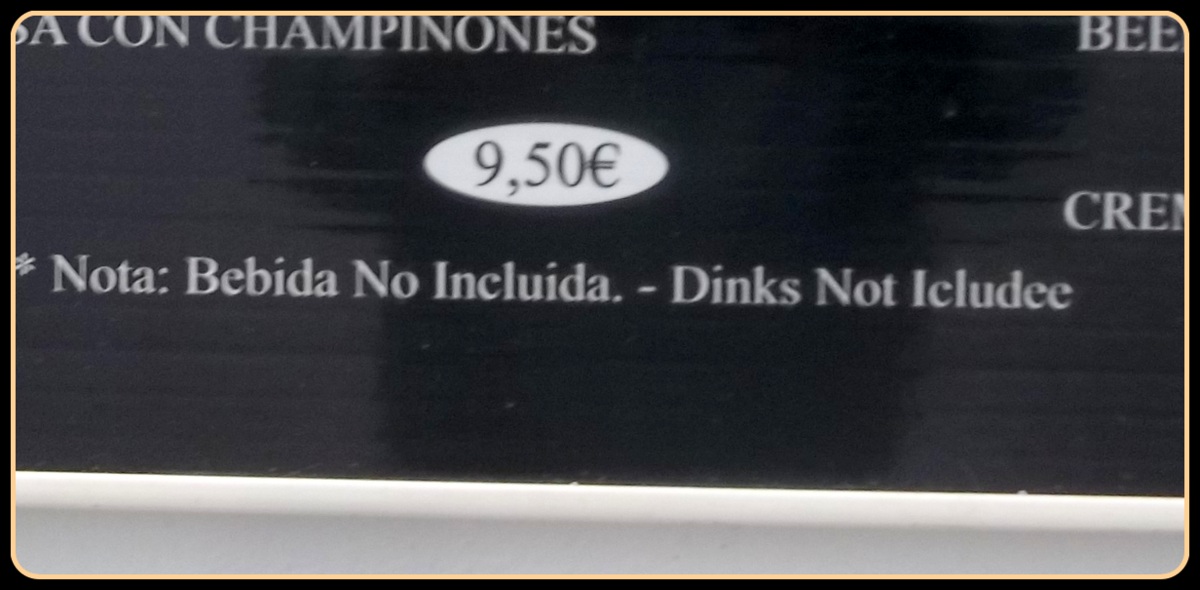
Driven to Dink
This thing about spending good cash on making an advert, a billboard, a leaflet or a campaign and not checking the spelling with one of the English-speaking people in our town (being in the majority, we aren't that hard to find), is enough to drive somebody to dink!
Sunday, June 17, 2012
Five Destinations in The Almerian Countryside
Seeking adventure, we decided on Friday to visit five 'off the beaten track' places that were advertised in the 'Mojácar and area special' that appeared in the latest Olive Press, the main English free newspaper for Andalucía.
The first was the Oro del Desierto, an olive oil manufacturer and bottler, which also holds a beautifully appointed shop/restaurant on the Tabernas end of the N340 Sorbas/Tabernas road, just past and opposite the now sadly depleted Venta del Compadre. Here we met the owner Rafael Alonso (speaks good English) who showed us around his empire and explained about the difference of the four different kinds of olives he grows on his plantation in the hills behind Sorbas. We bought a couple of bottles of olive oil for our breakfast table (on toasted Spanish bread, dribbled onto crushed tomato followed by a sprinkle of salt) and admired his menu. The restaurant, Los Albardinales, is open for lunches and, by reservation, for dinners - closed Thursdays.
Following our visit, we headed back a short distance towards Sorbas and turned off on a minor road towards Lucainena de las Torres, a pretty, white and forgotten village in the low hills behind Nijar. Here, our destination was the Venta del Museo, a well-known (in a secretive sort of way) German-run restaurant and hostal. Beautifully and imaginatively decorated, this restaurant was run for many years by HansPeter Wohler who famously had a unique wine cellar. I asked the new manager Stefan what had happened to the collection. All gone, he said sadly. Lunch here is a treat, so don't be shy.
The third place on our list was a small 'hippy' retreat, a type of rural hostal, called El Saltador and run by Claudia Scholler. From Lucainena, head towards Nijar but turn off to the left after a couple of kilometres towards Polopos. Claudia has regular exhibitions and flamenco concerts in this out-of-the-way spot - a small exhibition of the late American master Fritz Mooney paintings is currently running there. Claudia was just serving lunch to her guests so we talked for just a few minutes and promised to return. She sent us on towards Polopos on what turned out to be a stunning trip through a fantasy of mountains, gorges, ruins and desert, along a narrow road converted from a single-gauge miners' railroad. If somebody came the other way, we'd still be there today.
After arriving safely in Polopos, a one-donkey village, the road dipped along a river-bed and eventually and obligingly deposited us on the roundabout behind the Venta del Pobre petrol station and restaurant.
We crossed the motorway and headed down into the national park towards Agua Amarga, breaking off that road to head west to Fernán Pérez and on towards Cabo de Gata. Lunchtime loomed and I wanted to stop at the La Gallineta restaurant in Pozo de los Frailes (Tel 950 380 501). This is a small village just a couple of kilometres short of San José and La Gallineta, owned by Pedro from Alicante and his English-speaking son, was going to serve me dentón, a kind of deep-sea fish (apparently called 'dentex' in English) which was (as our Danish neighbour Paul Becket used to sometimes say) 'fan-flaming-tastic'.
Our fifth and final stop - it sounds like a treasure hunt - was another rural hostal, this time the Cortijo la Tenada which is located behind the miniscule village of Los Albaricoques. This small retreat is run by Umberto and is as quiet as it gets.
'Quiet' is not a word to describe the inappropriately named Campo Hermoso, where the national park suddenly switches into intense plastic farming and where the visible population appears to be a massive number of North and Central Africans peddling around on bicycles. We were lost for the first time that day, driving through endless passageways between abandoned plastic greenhouses. Finally, we found the motorway... and accelerated towards home.
The first was the Oro del Desierto, an olive oil manufacturer and bottler, which also holds a beautifully appointed shop/restaurant on the Tabernas end of the N340 Sorbas/Tabernas road, just past and opposite the now sadly depleted Venta del Compadre. Here we met the owner Rafael Alonso (speaks good English) who showed us around his empire and explained about the difference of the four different kinds of olives he grows on his plantation in the hills behind Sorbas. We bought a couple of bottles of olive oil for our breakfast table (on toasted Spanish bread, dribbled onto crushed tomato followed by a sprinkle of salt) and admired his menu. The restaurant, Los Albardinales, is open for lunches and, by reservation, for dinners - closed Thursdays.
The third place on our list was a small 'hippy' retreat, a type of rural hostal, called El Saltador and run by Claudia Scholler. From Lucainena, head towards Nijar but turn off to the left after a couple of kilometres towards Polopos. Claudia has regular exhibitions and flamenco concerts in this out-of-the-way spot - a small exhibition of the late American master Fritz Mooney paintings is currently running there. Claudia was just serving lunch to her guests so we talked for just a few minutes and promised to return. She sent us on towards Polopos on what turned out to be a stunning trip through a fantasy of mountains, gorges, ruins and desert, along a narrow road converted from a single-gauge miners' railroad. If somebody came the other way, we'd still be there today.
After arriving safely in Polopos, a one-donkey village, the road dipped along a river-bed and eventually and obligingly deposited us on the roundabout behind the Venta del Pobre petrol station and restaurant.
Our fifth and final stop - it sounds like a treasure hunt - was another rural hostal, this time the Cortijo la Tenada which is located behind the miniscule village of Los Albaricoques. This small retreat is run by Umberto and is as quiet as it gets.
'Quiet' is not a word to describe the inappropriately named Campo Hermoso, where the national park suddenly switches into intense plastic farming and where the visible population appears to be a massive number of North and Central Africans peddling around on bicycles. We were lost for the first time that day, driving through endless passageways between abandoned plastic greenhouses. Finally, we found the motorway... and accelerated towards home.
Saturday, June 16, 2012
Mojácar is Noisy Fun for The Moors and Christians
This is the scene from an upstairs window overlooking the new and not yet named square by the Church in Mojácar. The famous underground car-park. Top left: a bar and stage. Top right: a bar and stage. Lower right: a bar and stage. These correspond to three of the seven kabilas that are crammed into Mojácar over the weekend, which, together with the main act in the Plaza Nueva, strolling musicians, the musketeers (trabuqueros), the powder-monkey with his fireworks and thunderflashes plus a number of music and disco bars, are all contributing gaily to make the town decidedly noisy at present.
The only scientific way to stop noise leakage from a competitor, is to turn your own speakers up. Loud.
There are buses running all night and there's a superb procession on Sunday afternoon with over a thousand brightly dressed participants, together with yet more musicians. Bring suntan oil and cameras.
The only scientific way to stop noise leakage from a competitor, is to turn your own speakers up. Loud.
There are buses running all night and there's a superb procession on Sunday afternoon with over a thousand brightly dressed participants, together with yet more musicians. Bring suntan oil and cameras.
Monday, June 11, 2012
The Whistle-Blowers
Rajoy at the football match in Poland, waving his arms in excitement as so-and-so scores a goal. Spain draws with Italy, one one. People complaining that Rajoy should be back in Madrid, since Spain has just got its new line of credit for 100 billion euros. But there he is, with the Principe.
God, I hate football.
Here, as every four years, louts drive around with flags sticking out from the windows of their cars, Spanish flags and an occasional English one. People firing off rockets when somebody scores a goal, honking their horns, the newspapers full of the football, which is as ephemeral as yesterday's weather forecast.
So Rajoy, ungainly in his box in Warsaw, or Gdansk, jumping about as if he were a fan. Spain might be a second-rater in politics, finance and influence - but she's first rate in sports.
Meanwhile, back on the coast, a couple of our grimmer local red-top English-language newspapers have produced cut-out-n-keep centre-page spreads on the European football championships. All we need is a couple of thumbtacks and a spare bit of space in the den next to Britney and the Spice Girls.
God, I hate football.
Here, as every four years, louts drive around with flags sticking out from the windows of their cars, Spanish flags and an occasional English one. People firing off rockets when somebody scores a goal, honking their horns, the newspapers full of the football, which is as ephemeral as yesterday's weather forecast.
So Rajoy, ungainly in his box in Warsaw, or Gdansk, jumping about as if he were a fan. Spain might be a second-rater in politics, finance and influence - but she's first rate in sports.
Meanwhile, back on the coast, a couple of our grimmer local red-top English-language newspapers have produced cut-out-n-keep centre-page spreads on the European football championships. All we need is a couple of thumbtacks and a spare bit of space in the den next to Britney and the Spice Girls.
Monday, May 28, 2012
Paperwork
It was a day for paperwork. We may not like it much, but several million funcionarios must rely on us wandering in, from time to time, with satchels full of papers which they can then declare to be incomplete or, better still, en situación irregular. Oh, yes. Talk dirty.
So, to Almería. I had two things to do and an entire morning to do them in. The trip from our town is an hour and a bit, plus half an hour driving around Almería itself in ever decreasing circles to get to the first point of call, the immigration office, located whimsically enough in the Calle Marruecos. According to a paper with necessary instructions I had received from them, I was to give them a copy of my passport and silly green police A4 paper (issued by the very same office last year), plus photocopies of the above. It took about an hour, first queuing for a number, followed by me in conversation with a nice gentleman from Nigeria who wanted to sell me a Rottweiler, before I was finally called to the desk of a surly young man wearing a tee-shirt and ear-rings. I think he was angry that he hadn't got the day off like his companions at most of the other desks appeared to have done. We began. Turned out, I needed a photocopy of the list of instructions as well. I hadn't seen that one coming. Well, we got there finally, after he had waited for me to walk down the street in search of a shop with a photocopier and return with the vital document, adding it to my modest pile of papers.
I'll let you know, he said.
Then by taxi, because I had forgotten where the place was, assuming they hadn't moved it in the past year or two, on to Trafico.
There, I meant to put an old car in baja. This was to save me a massive 173.67 euros per annum being my town's circulation tax. Last week I had gone up to the town hall to see Nemesio about whipping the car in question off the town computer. I had the tax paper for this year, stamped as paid. No, won't work any longer: nowadays you have to go to Trafico, he'd said.
So, I'm in the taxi. Lots of people are putting their old cars en baja, said the driver. With the crisis, you have to cut any costs you can.
At the trafico building, I am allowed in to the room and, after taking the number from a machine, am invited to sit. Luckily, there was an interesting show on a screen in front of both me and a half dozen gleeful gentlemen in djellabahs featuring a properly dressed young woman driving a car, filling up with gas and checking her tire pressure, changing gears and daring my new friends to have anything to say about it.
My number came up.
Hello, I would like to put this car in baja, I said. She pushes papers across the desk: fill out this form, this other form, pay eight euros over there and then come back tomorrow. But I'm looking at the form. It wants the car's numberplate, which seems fair enough, and its date of registration, which doesn't. Hey, I said, I don't know the car's birthday, I hardly know my wife's birthday... and, anyway, what's this about coming back in tomorrow? I've just driven here from across the province.
Well, she answers, the linea to Madrid is down, so I can't do anything today.
So there we left it, with a final score of maybe one out of two. We'll see. Don Quijote would have understood.
So, to Almería. I had two things to do and an entire morning to do them in. The trip from our town is an hour and a bit, plus half an hour driving around Almería itself in ever decreasing circles to get to the first point of call, the immigration office, located whimsically enough in the Calle Marruecos. According to a paper with necessary instructions I had received from them, I was to give them a copy of my passport and silly green police A4 paper (issued by the very same office last year), plus photocopies of the above. It took about an hour, first queuing for a number, followed by me in conversation with a nice gentleman from Nigeria who wanted to sell me a Rottweiler, before I was finally called to the desk of a surly young man wearing a tee-shirt and ear-rings. I think he was angry that he hadn't got the day off like his companions at most of the other desks appeared to have done. We began. Turned out, I needed a photocopy of the list of instructions as well. I hadn't seen that one coming. Well, we got there finally, after he had waited for me to walk down the street in search of a shop with a photocopier and return with the vital document, adding it to my modest pile of papers.
I'll let you know, he said.
Then by taxi, because I had forgotten where the place was, assuming they hadn't moved it in the past year or two, on to Trafico.
There, I meant to put an old car in baja. This was to save me a massive 173.67 euros per annum being my town's circulation tax. Last week I had gone up to the town hall to see Nemesio about whipping the car in question off the town computer. I had the tax paper for this year, stamped as paid. No, won't work any longer: nowadays you have to go to Trafico, he'd said.
So, I'm in the taxi. Lots of people are putting their old cars en baja, said the driver. With the crisis, you have to cut any costs you can.
At the trafico building, I am allowed in to the room and, after taking the number from a machine, am invited to sit. Luckily, there was an interesting show on a screen in front of both me and a half dozen gleeful gentlemen in djellabahs featuring a properly dressed young woman driving a car, filling up with gas and checking her tire pressure, changing gears and daring my new friends to have anything to say about it.
My number came up.
Hello, I would like to put this car in baja, I said. She pushes papers across the desk: fill out this form, this other form, pay eight euros over there and then come back tomorrow. But I'm looking at the form. It wants the car's numberplate, which seems fair enough, and its date of registration, which doesn't. Hey, I said, I don't know the car's birthday, I hardly know my wife's birthday... and, anyway, what's this about coming back in tomorrow? I've just driven here from across the province.
Well, she answers, the linea to Madrid is down, so I can't do anything today.
So there we left it, with a final score of maybe one out of two. We'll see. Don Quijote would have understood.
Friday, May 25, 2012
I've Got a Fast Dog
It's always difficult to get a decent photo of a Briard - this picture isn't photoshopped or, besides boosting the colour a bit, retouched in any way. Anyhow, this is what our dog looks like while enjoying his early-morning constitutional.
Subscribe to:
Posts (Atom)