Wednesday, June 27, 2012

Dumping on the Customer: Oh Yeah!

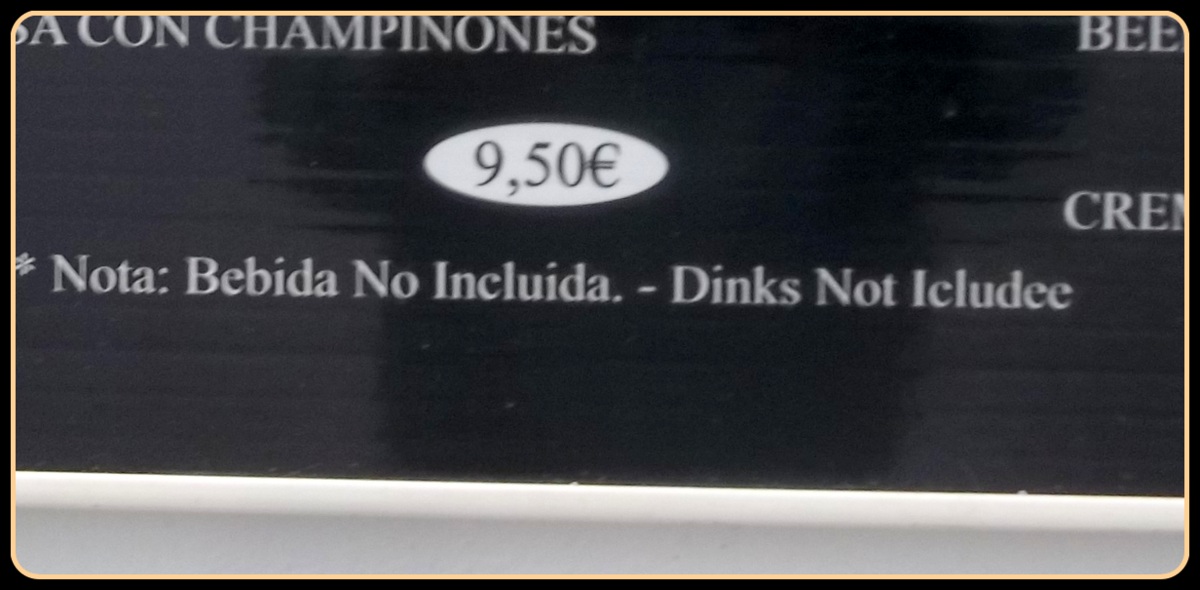
Harping on the same subject once again - that the pueblo Spanish don't appear to want to check their traductora de Google with a native-speaker (of which Mojácar is strongly blessed) - we find that a popular beer company is paying for a promotional exercise involving fourteen local (local) restaurants with a translation to die for.
And somehow, it'll all be our fault.
Monday, June 25, 2012

Driven to Dink

This thing about spending good cash on making an advert, a billboard, a leaflet or a campaign and not checking the spelling with one of the English-speaking people in our town (being in the majority, we aren't that hard to find), is enough to drive somebody to dink!

Sunday, June 17, 2012

Five Destinations in The Almerian Countryside

Seeking adventure, we decided on Friday to visit five 'off the beaten track' places that were advertised in the 'Mojácar and area special' that appeared in the latest Olive Press, the main English free newspaper for Andalucía.
The first was the Oro del Desierto, an olive oil manufacturer and bottler, which also holds a beautifully appointed shop/restaurant on the Tabernas end of the N340 Sorbas/Tabernas road, just past and opposite the now sadly depleted Venta del Compadre. Here we met the owner Rafael Alonso (speaks good English) who showed us around his empire and explained about the difference of the four different kinds of olives he grows on his plantation in the hills behind Sorbas. We bought a couple of bottles of olive oil for our breakfast table (on toasted Spanish bread, dribbled onto crushed tomato followed by a sprinkle of salt) and admired his menu. The restaurant, Los Albardinales, is open for lunches and, by reservation, for dinners - closed Thursdays.
Following our visit, we headed back a short distance towards Sorbas and turned off on a minor road towards Lucainena de las Torres, a pretty, white and forgotten village in the low hills behind Nijar. Here, our destination was the Venta del Museo, a well-known (in a secretive sort of way) German-run restaurant and hostal. Beautifully and imaginatively decorated, this restaurant was run for many years by HansPeter Wohler who famously had a unique wine cellar. I asked the new manager Stefan what had happened to the collection. All gone, he said sadly. Lunch here is a treat, so don't be shy.
The third place on our list was a small 'hippy' retreat, a type of rural hostal, called El Saltador and run by Claudia Scholler. From Lucainena, head towards Nijar but turn off to the left after a couple of kilometres towards Polopos. Claudia has regular exhibitions and flamenco concerts in this out-of-the-way spot - a small exhibition of the late American master Fritz Mooney paintings is currently running there. Claudia was just serving lunch to her guests so we talked for just a few minutes and promised to return. She sent us on towards Polopos on what turned out to be a stunning trip through a fantasy of mountains, gorges, ruins and desert, along a narrow road converted from a single-gauge miners' railroad. If somebody came the other way, we'd still be there today.
After arriving safely in Polopos, a one-donkey village, the road dipped along a river-bed and eventually and obligingly deposited us on the roundabout behind the Venta del Pobre petrol station and restaurant.
We crossed the motorway and headed down into the national park towards Agua Amarga, breaking off that road to head west to Fernán Pérez and on towards Cabo de Gata. Lunchtime loomed and I wanted to stop at the La Gallineta restaurant in Pozo de los Frailes (Tel 950 380 501). This is a small village just a couple of kilometres short of San José and La Gallineta, owned by Pedro from Alicante and his English-speaking son, was going to serve me dentón, a kind of deep-sea fish (apparently called 'dentex' in English) which was (as our Danish neighbour Paul Becket used to sometimes say) 'fan-flaming-tastic'.
Our fifth and final stop - it sounds like a treasure hunt - was another rural hostal, this time the Cortijo la Tenada which is located behind the miniscule village of Los Albaricoques. This small retreat is run by Umberto and is as quiet as it gets.
'Quiet' is not a word to describe the inappropriately named Campo Hermoso, where the national park suddenly switches into intense plastic farming and where the visible population appears to be a massive number of North and Central Africans peddling around on bicycles. We were lost for the first time that day, driving through endless passageways between abandoned plastic greenhouses. Finally, we found the motorway... and accelerated towards home.

Saturday, June 16, 2012

Mojácar is Noisy Fun for The Moors and Christians

This is the scene from an upstairs window overlooking the new and not yet named square by the Church in Mojácar. The famous underground car-park. Top left: a bar and stage. Top right: a bar and stage. Lower right: a bar and stage. These correspond to three of the seven kabilas that are crammed into Mojácar over the weekend, which, together with the main act in the Plaza Nueva, strolling musicians, the musketeers (trabuqueros), the powder-monkey with his fireworks and thunderflashes plus a number of music and disco bars, are all contributing gaily to make the town decidedly noisy at present.
The only scientific way to stop noise leakage from a competitor, is to turn your own speakers up. Loud.
There are buses running all night and there's a superb procession on Sunday afternoon with over a thousand brightly dressed participants, together with yet more musicians. Bring suntan oil and cameras. 

Monday, June 11, 2012

The Whistle-Blowers

Rajoy at the football match in Poland, waving his arms in excitement as so-and-so scores a goal. Spain draws with Italy, one one. People complaining that Rajoy should be back in Madrid, since Spain has just got its new line of credit for 100 billion euros. But there he is, with the Principe.
God, I hate football.
Here, as every four years, louts drive around with flags sticking out from the windows of their cars, Spanish flags and an occasional English one. People firing off rockets when somebody scores a goal, honking their horns, the newspapers full of the football, which is as ephemeral as yesterday's weather forecast. 
So Rajoy, ungainly in his box in Warsaw, or Gdansk, jumping about as if he were a fan. Spain might be a second-rater in politics, finance and influence - but she's first rate in sports.
Meanwhile, back on the coast, a couple of our grimmer local red-top English-language newspapers have produced cut-out-n-keep centre-page spreads on the European football championships. All we need is a couple of thumbtacks and a spare bit of space in the den next to Britney and the Spice Girls.

Monday, May 28, 2012

Paperwork

It was a day for paperwork. We may not like it much, but several million funcionarios must rely on us wandering in, from time to time, with satchels full of papers which they can then declare to be incomplete or, better still, en situación irregular. Oh, yes. Talk dirty.
So, to Almería. I had two things to do and an entire morning to do them in. The trip from our town is an hour and a bit, plus half an hour driving around Almería itself in ever decreasing circles to get to the first point of call, the immigration office, located whimsically enough in the Calle Marruecos. According to a paper with necessary instructions I had received from them, I was to give them a copy of my passport and silly green police A4 paper (issued by the very same office last year), plus photocopies of the above. It took about an hour, first queuing for a number, followed by me in conversation with a nice gentleman from Nigeria who wanted to sell me a Rottweiler, before I was finally called to the desk of a surly young man wearing a tee-shirt and ear-rings. I think he was angry that he hadn't got the day off like his companions at most of the other desks appeared to have done. We began. Turned out, I needed a photocopy of the list of instructions as well. I hadn't seen that one coming. Well, we got there finally, after he had waited for me to walk down the street in search of a shop with a photocopier and return with the vital document, adding it to my modest pile of papers.
I'll let you know, he said.
Then by taxi, because I had forgotten where the place was, assuming they hadn't moved it in the past year or two, on to Trafico.
There, I meant to put an old car in baja. This was to save me a massive 173.67 euros per annum being my town's circulation tax. Last week I had gone up to the town hall to see Nemesio about whipping the car in question off the town computer. I had the tax paper for this year, stamped as paid. No, won't work any longer: nowadays you have to go to Trafico, he'd said.
So, I'm in the taxi. Lots of people are putting their old cars en baja, said the driver. With the crisis, you have to cut any costs you can.
At the trafico building, I am allowed in to the room and, after taking the number from a machine, am invited to sit. Luckily, there was an interesting show on a screen in front of both me and a half dozen gleeful gentlemen in djellabahs featuring a properly dressed young woman driving a car, filling up with gas and checking her tire pressure, changing gears and daring my new friends to have anything to say about it.
My number came up.
Hello, I would like to put this car in baja, I said. She pushes papers across the desk: fill out this form, this other form, pay eight euros over there and then come back tomorrow. But I'm looking at the form. It wants the car's numberplate, which seems fair enough, and its date of registration, which doesn't. Hey, I said, I don't know the car's birthday, I hardly know my wife's birthday... and, anyway, what's this about coming back in tomorrow? I've just driven here from across the province.
Well, she answers, the linea to Madrid is down, so I can't do anything today.
So there we left it, with a final score of maybe one out of two. We'll see. Don Quijote would have understood. 

Friday, May 25, 2012

I've Got a Fast Dog

It's always difficult to get a decent photo of a Briard - this picture isn't photoshopped or, besides boosting the colour a bit, retouched in any way. Anyhow, this is what our dog looks like while enjoying his early-morning constitutional.

Sunday, May 20, 2012

Té con Limón

A bazaar called Té con Limón in Madrid has closed after fifteen years of business, but not before posting the following text, as a large sign, outside its doors:

     Closing Down Sale Through Desperation
     We want to thank all those who have helped us arrive at this decision:
     Thanks to corrupt politicians.
     Thanks to Spanish bipartisanship.

     Thanks to the autonomies, provincial councils, town halls, etc
     Thanks to our former leaders now enjoying their fat annuities.
     Thanks to the Employers Confederation for destroying jobs
     Thanks to the unions for doing nothing.
     Thanks for raising our taxes
     Thanks for cutting our citizens' rights.
     Thanks to politicians for their salaries, allowances and privileges.
     Thanks for injecting public money into the banks.
     Thanks for forgetting about the self-employed and small-business owners.
     Thanks to Greece for showing us what's in store.
     Thank you for allowing parasitic economic models.
     Thanks for forcing our kids to emigrate from the country.
     Thanks to all of the powerful elite to make us feel more free and for leaving us without a bean!.


Apparently, the sign proved to be something of a success and visitors to the 900m2 store 'increased by a huge amount', said the owner sadly, before he had to close the doors for ever. 
Story here

Thursday, May 17, 2012

Can't buy, Can't rent...

The Gnomo Feliz in Vera, Following the Bank Eviction May 2012
The Destruction of the Priors' Home in Vera, January 2008

Almería unemployment stands at 35 per cent,
lots of the lawyers and the politicians here are bent,
you can't buy a house here, neither can you rent;
...and they really couldn't tell you where the money went...

Friday, May 11, 2012

Business is Bad

In Turre, the pueblo just inland from Mojácar, a town of about 50% British presence, signs of the crisis are apparent. It's hard to keep afloat in Inglaturre.

Tuesday, May 08, 2012

Immigrants and Ex-pats


There are two types of foreigner living in Spain long-term: those who came to work and those who came to live. They are - specific exceptions aside - the immigrants and the self-styled ex-pats. To me, an immigrant moves to a new country to improve his lifestyle – and that of his family – and to seek his fortune. No doubt he will work hard, learn (as best he can) the language and be proud of his children becoming 'nationals'. He will not seek to be a 'second class citizen' (even if the local people treat him as one). An ex-pat on the other hand seems to want to stay as he is, only displaced into another culture. Perhaps learn a bit but always talk about and contrast things with 'home'. He may look down upon the locals by condescension to them – while loudly treating them not as his equals, but his betters ('after all, it's their country', ‘we’re guests here’…etc).
Perhaps there're other types - 'colonials' (who seek to exploit their neighbours before disappearing back 'home'), 'emigrés' (comfortable with themselves, but never going back), business executives (in matching shorts, jacket and tie), snowbirds, guiris, ingleses (regardless of where they come from), whenwees, hippies, bums and bikers... and then there are those who fully embrace the Spanish way of life, find a Spanish lover and disappear smartly into the woodwork.
Let’s call them all ‘Europeans’, with honourable additions from the USA, Australia and so on, and a blurry qualification for the Eastern Europeans, who might be more comfortable as inmigrantes.
Sometimes I think of the Europeans living in Spain as a group of people a million and a half strong. That’s more than the entire population of the cities of Málaga, Córdoba, Almería and Alicante combined. Yet, beyond (apparently) all being readers of a white-bread weekly free newspaper, there’s no cohesion, no unity and no identity. Not apparently a group after all. Our few famous companions are known for things they did before they moved here – whether robbing the Glasgow train in 1966, acting in a few movies, being a gun-runner or a bank manager, a pop star or a racer – yet no one has raised our game while being a fully-fledged resident in Spain beyond a few who seem to have found a calling by ripping off their fellow Britons. I can think of a few luminaries that might buck this statement, rather like proving the rule: Michael Robinson (sports commentator), Henry Kamen (historian), Jon Clarke (newspaperman), Len and Helen Prior (unwilling political victims), Maurice Boland (radio presenter), Chris Stewart (writer) or Chuck Svoboda (property rights agitator), but we really need a top-notch champion I think, someone with whom we can identify and, vicariously be proud of  – Guirilandia’s version of Arnie or that footballer with the underwear adverts and the tattoos.
Until we do, we shall remain as a faintly embarrassing blip on Spain’s history, which, like the Visigoths, will leave no trace when we pass. Our main energy here seems to be spent on saving abandoned dogs or messily feeding wild cats. We neither seek nor are invited to participate, to join in. If it wasn’t for the money that we pump through the local Caja de Ahorros, we’d be rounded up and told to scarper. Frankly, the authorities don’t care a fig for us – we have now even lost our residency and ID cards. When necessary or commercially interesting, notices or billboards will as likely be in Ingrish as in English (since 1970, across Almería: ‘this establishement has complaint forms if the customer does so request it’) and we are being written out of local history. See the latest edition of Mojácar’s bi-lingual tourist magazine for example which, in 84 pages, manages to make no mention of us whatsoever. In Mojácar, we eat nothing but ajo colorado and pelotas.
Despite being millions in numbers, past and present, scattered mainly in meaty lumps along the coast or in the islands, we currently have no streets, barrios, buildings or memorials to honour us beyond the Calle Doctor Fleming (Alexander Fleming discovered the use of penicillin, but never visited Spain) and the Calle O’Donnell (Leopoldo O’Donnell, a Spanish general with an Irish name) both in Madrid, and then a few brandy companies in Jerez with historic British names from Spanish families. Well, there’s always Gibraltar.
Sometimes Spain allows a foreigner to take instant nationality – for ‘sporting’ reasons, perhaps – we remember the German skier Johann Mühlegg who skied as a Spaniard in the 2002 Winter Olympics… until he was busted for ‘doping’. Yes, well, perhaps the less said on both sides about him the better…
Our town was dying in the mid sixties. It was a small yet pretty Almerian burg called Mojácar with no surviving agriculture. It was poorly communicated and in as much rubble as new build. There was one bar in the village and three restaurants on the beach, yet a Parador hotel had just opened and the Town Hall was gamely giving away property to anyone prepared to invest in it. At that time, there were only a few hundred people living here and there is no doubt that the artists, bohemians, poets, settlers and visionaries who moved here because they loved the place all managed to turn around the local fortunes. Today, with more británicos than mojaqueros, and with the entire local economy springing from foreign pensions, capital and original outlay, the municipality has successfully managed to avoid any and all reference to the forasteros – the settlers. Our money yes, by all means - but not our partnership. On both sides, a lack of will to integrate leads to a divided and unequal union, with the foreigners feeling like battered wives. If you sell enough houses to ingleses, you should profitably start to blend. Yet, the local story of two long-time bar-owners, Ramón and Gordon, bears retelling:
‘Gordon’, says Ramón, ‘you’ve not been in my bar for a couple of weeks for your morning brandy, are you all right?’ ‘Ramón’, says Gordon, ‘you’ve not been in my bar ever’.
Here in Mojácar - a town with today about 40% local, 10% Spanish and the rest a mixture of Brits, Romanians, Ecuadorians and Chinese (I know, with a sprinkling of another fifty nationalities) - it's hard to lump all the foreigners together as either one thing or another. Some are here to live and spend their money, others here to make money and go away again and others... probably waiting for instructions from Beijing.
The answer is for both sides – locals and settlers – to integrate, the one into the other. Mojácar is hardly 'Spain'.
After all, they sell us houses. We become residents. Then, we - and they - begin to learn about the other. We, because Spain is a fascinating place where we have chosen to live, and they, because they sold us a home, allowing us into their community. Changing their community.
One day perhaps, the local people will be as proud of Mojácar as we are.
Foreigners, at least those I’ve identified as Europeans, or non-Spanish Europeans if you prefer, although non-local Spaniards have similar problems to our own, live in ghettoes – so goes the Spanish reasoning. Perhaps the old saw about the Spaniards who went to work in Germany in the 1950s and sent their money home applies in people’s minds to the guiris. If Ramón goes to their bars or restaurants, he won’t be understood, he won’t get a menu in Spanish, and any money they take from Ramón and his mates will be sent to England with the next post. Well, guilty of the first two, but not the third: it all stays here.
Spain has a number of large capital cities, vibrant with money, offices, departments, companies, cathedrals and power. On the other hand, our town, and all our towns, are small and unimportant places. The capital city for the ingleses is probably Marbella, with Estepona, Fuengirola, Mijas, Mojácar, Albox, Torrevieja, Altea, Jávea, Calpe, Denia and Ibiza rounding out the foreigners’ main ports-of-call. These towns between them don’t have much in the way of presence, with small-time leaders, miserable budgets and oft-ignorant councils, but they are what we have. 
In Spain, there are an estimated 5,640,000 foreigners. With open borders with France and Portugal, tourists staying over, undocumented boat-people, the majority of ex-pats refusing to get on the local padrón and so on, the authorities can only guess at a figure, but that’s the one they like. There is another kind of foreigner that the same authorities inexplicably like a lot more, and that’s the turista. They may not leave much money here individually, but, last year, 56.7 million tourists, including 13.6 million Britons, spent at least one night in Spain. Apparently.
The problem is, of course, that foreign residents don’t particularly spend time or money in Spanish resort hotels and it’s the managers of those establishments who are the considered experts on tourism in Spain. One resident spends in twelve months a lot more than one tourist manages in 4.2 days, or whatever the current average visit is. Let us suggest a chubby monthly allowance or pension spent on clothes, restaurants, petrol, travel, a maid and an electricity bill. There’ll be a house and a car bought from foreign funds as well. Compare this with a tourist who has paid for his holiday in some agency in London and who… if he doesn’t enjoy himself… will choose Portugal next year.
Unlike ‘Residential Tourism’, as the Spanish authorities gamely label our community, a sector on which nothing is spent, beyond (according to bar-room politicians) something massive on the health service, proper ‘Tourism’ is worth a ministry and a huge billionaire budget. Last year’s figures for tourism show 622 million euros spent in 2011 by the Government, plus a similarly massive amount from the autonomies and local authorities.
Answer this - how much does your town hall spend on the foreign residents, and who is the local councillor in charge of us?
We are told we need to integrate, what we need is do is to participate.

Saturday, April 28, 2012

Andalucía to Form a 'Progressive' Government


While the finer details remain unclear, the PSOE and the IU have agreed to form a government 'of maximum stability' for Andalucía for the next four years after a key vote by 6,000 IU party members agreed last Tuesday to support the plan. Reacting to the news, 'a radical government is very bad for Andalucía' said the leader of the party with the most seats, Javier Arenas, leader of the Andalucian PP, who agrees with José Bono (the Socialist ex President of Congress) that the PSOE should have pacted instead with the PP.
Such a pact between the PSOE and the PP was always going to be unlikely. The remaining alternatives would have been a minority government of the PP or the support by the IU of the PSOE candidature for president of the autonomy but without entering into a coalition. The IU coordinator Diego Valderas has supported a full partnership, while the thorn-in-the-side Juan Manuel Sánchez Gordillo, mayor of Marinaleda and now Andalucian parliamentarian, is strongly against any alliance which, he says, would spell the end of IU – ‘We must emphasize our anti-capitalist character and not climb into the sinking ship of the PSOE’.
Thus, with the support of the IU, the candidature of José Antonio Griñán as president of the Junta de Andalucía in the presidential debates on the May 2nd and 3rd new parliamentary session, followed by the investiture is now assured. In deliberations leading up to this situation, the PSOE had agreed to the ‘minimum conditions’ of the IU (the ‘Izquierda Unida Los Verdes-Convocatoria por Andalucía’ to give it its full name - a loose coalition of far-left groups dominated by the Partido Comunista de España). These are the departure of those civil servants in the Junta de Andalucía connected to the estimated 700 million euro ERE fraud (the Ex-Councillor for Employment was jailed without bail on Monday for his part in the scandal); the creation of a ‘public bank for Andalucía’ to manage seed money for small and medium businesses; the prohibition of evictions by foreclosures of the banks (a petition will need to be sent to the Central Government in Madrid, which has the power to implement or otherwise this); a basic income for all Andalucian families and the offer of four months of public scat-work for the unemployed. Furthermore, agreements have been reached to increase taxes, introduce fresh wealth taxes, inheritance and gift taxes, and to implement an environmental and tax-fraud watch.
So, it remains merely to see which departments of the new government will come under the IU. My guess - they'll take the department of the environment (watch out foreign home-owners with ‘illegal’ dwellings) and some other major department. 

Later (From The Entertainer Online):  The cake - or is it a pie? - has now been carved up between the IU and the PSOE in the new Andalucian Government. The junior partner Izquierda Unida to take control of public works and housing (watch out 'illegal property' owners) and - of all things - tourism. Diego Valderas (IU) will become the vice-president of José Antonio Griñán's Junta de Andalucía.

Friday, April 20, 2012

Ten Years Ago

My picture is a copy of the very first issue of a newspaper. Actually, it's the first issue of the newspaper with a New Name, which appeared exactly ten years ago this week. Oddly, the previous name of the same newspaper is visible on the lower right side of the upper front page. The numeration and one euro price were both quickly dropped, and the new weekly took on the issue-number of its previous incarnation. Ten Years Ago.

Several Days Later: Oddly enough, no mention of the Tenth Anniversary in the pages of the Euro Weekly.  I wonder why?

Sunday, April 15, 2012

Dog Days in Albox

Today's Voz de Almería has an article in it about some British women. As often happens, it makes them look, and by extension all of us, slightly foolish. The ladies come from Albox and appear to have managed to miss most of life's attractions in Spain (which, it goes without saying, explains why they ended up in Albox). Their thing - is about dogs. Abandoned, raddled, mangy and hungry.
I imagine the Spanish must wonder about these Brits who have come to live here. They appear to show no interest in getting to know the culture and the language, travel, history, the food and the drink (beyond cerveza and wine in a carton), the politics and the social life of the Spaniards, their family and their education. Not for them the traditions, handicrafts, misas,
matanzas and toreo. The only thing that appears to interest these funny new neighbours (so must think the Spanish) is their extraordinary hang-up on charity... and not even on human charities: the nuns, the poor, the disabled and the weak. Just the dogs and cats.
The thing about animals is simple: you can talk to them in English. They won't mind.
There was a time a few years back when the entire corporation of a town hall in Alicante was arrested for the usual fraud so common in those small towns with too many builders, rural land and eager clients, and just one councilor escaped, making him suddenly the acting mayor. This worthy was an Englishman (cynically stuck on the lista to make up the numbers and get a few extra votes for the party in question from the extranjeros). His department in the ayuntamiento was 'doggies and moggies' and he spoke not a word of Spanish. On hearing the thrust of the eight-hundred page report, the Judge, once someone had slapped him hard on the back a few times finally managing to dislodge a lump of tostada con tomate from his tubes, ordered the arrested to be sent back to their town hall. 'ASAfuckingP', added the beak, thus breaking a judicial tradition that has lasted centuries in
Spain.
The local dog charity in Mojácar, whose job is essentially to look after Spanish abandoned dogs, reportedly spent 145,000 euros last year - which all came in contribution from the extranjeros. Mostly items sold in a charity-store for a euro or two. Not only the dogs and cats benefited from this British largesse, the owner of the shop got a bloody good rent as well. The local mayoress has now ceded a new shop for the charity. No doubt for charitable reasons.
What is it about the local dogs here that ignites our cold British passion? Poisoned, garroted, abandoned, tortured and starved?
So the ladies in Albox. One of them, who gets the headline, has thirty three dogs in her home. Just imagine that for a moment. The report begins by huffily pointing out that the British 'if they don't respect animals more than we Spanish do, at least approach them in a different and more organised way'. Whatever that means. Well, we don't string them up in the campo with just a sausage roll full of poison for company.
Then we learn that the lady in question must leave for
England for an operation and may be delayed or perhaps not return. Cue the 33 dogs. Someone apparently wants to buy the house (cleaned and dog-free) and the dogs could all be sent to Holland with the money, where they will all live in the lap of canine luxury - no doubt comfortably near to a cosmetic factory. But that's just me talking. Don't the Dutch have their own strays... why would they want so many Spanish ones? And why do they prefer those little ratonero dogs with pop-eyes?
The problem is, of course, simple: 'the Spanish don't castrate their dogs', says the second lady to the journalist.
Through an interpreter.
'The Spanish neighbours give us their spare puppies', say the ladies indignantly, 'or abandon them on our step and scarper, or else they just toss them into the garbage'.
The article ends with a plea from the by-now converted hack not to buy a dog, but to adopt one.
Of course, and here's a thought: if they can't sell them, the breeders can always throw their spare puppies into the skip.

Friday, April 13, 2012

The Alliance of Civilizations

Spain has long maintained a relationship with Arab countries, through its proximity to North Africa, its many centuries under ‘Moorish’ dominion and, more recently, Franco’s reliance on Moroccan forces during the early years of the Spanish Civil War. Saddam Hussein’s shotgun, famously fired in provocation against the West from his terrace just before the first Gulf War, was given to him by Franco during Saddam’s state visit to Spain in 1974 (along with a medal, the Gran Cruz de la Real Orden de Isabel la Católica). Saddam replied by presenting Spain with two full tankers during the oil crisis of the same year. This cosiness with the Arab world stumbled with José María Aznar’s very visible alliance with Bush and Blair following the summit meeting in the Azores in 2003.

Following on from the changes in Spain’s relations with Arab countries, socialist leader José Luis Rodríguez Zapatero proposed the Alliance of Civilizations at the 59th General Assembly of the United Nations in 2005. It was co-sponsored by the Turks. The initiative sought to galvanize international action against extremism through the forging of international, intercultural and inter-religious dialogue and cooperation with an emphasis on defusing tensions between the Western and Islamic worlds. By July of that year, the Spanish government had approved a million euros spending money to the new agency, earmarked another twenty million for a headquarters in Barcelona and, above all, Zapatero’s initiative was playing well to the galleries back home in Spain. Spain had taken a shot at becoming the moral leader of the world, although it was sadly obvious that Zapatero was punching outside of his class.

One can almost imagine a flying saucer landing in a field somewhere. ‘Take me to the chairman of the Alliance of Civilizations’ says a small green individual holding a ray gun.

The historian Henry Kaman was one of the critics of the Alliance. In 2004 he wrote: ‘Presumably the intention is not to export the decadent western cultural concepts such as democracy, women's rights, freedom of expression and freedom of religion or sexual tolerance. If Zapatero does not intend to delve into these issues, does he then seek to further develop concepts such as dictatorship, control of the press and the denial of sexual freedoms?’.

By the end of 2006, a report from the ‘high level group’ chosen by the United Nations to outline recommendations and practical solutions on how the Western and Islamic societies could solve mutual misconceptions and misunderstandings was issued. According to the report, ‘politics, not religion, is at the heart of growing Muslim-Western divide’.

In 2011, Spain’s contribution to the Alliance was down to 800,000 euros and the Secretary of State for Foreign Affairs, Gonzalo de Benito, notes that this year’s payout will be even smaller ‘since there is no alternative’ but ‘will still be a significant amount’.

A Spanish right wing outlet called Periodista Digital recently stated: ‘It appears that the personal adventure in which Zapatero obsessively immersed himself will now disappear after many millions wasted, much time lost and countless absurd and senseless projects that went nowhere and which no one will remember’.

One gets the feeling that Spain may enjoy the reflected glory of being the originator of such a fine plan, yet now finds that there are other more important fish to fry.

Thursday, April 12, 2012

Animo in Almería

Equinotherapy or ‘equine facilitated therapy’ is used in Northern European countries as ‘riding for the disabled’.

More properly, riding for the disabled is a way by which the gait of a horse can be incorporated to help a rider who has little or no control of their lower limbs. This could come through an accident, or a congenital condition. Many people, disabled in some way, have found that they can improve their life through either some therapeutic program with a horse, which could be anything from being placed on the back of an animal, surrounded by side-walkers, a leader and a number of medical experts – to just learning to ride for its own pleasure. A young girl with polio famously once learnt to ride and she went on to win the Silver at the Helsinki Olympics in 1952 in Dressage proving that people with disabilities can participate in sports – this long before the introduction of the Paralympics in 1960.

Long-term local resident Barbara Napier worked as a young woman in California with disabled children and, betimes, enjoyed her hobby of horseback riding. The two disciplines were always going to come together. She was a board member, for a number of years, on the Federation of Riding for the disabled International (now re-named as the HETI) and represented Spain.

On Sundays, Barbara and I drive to a stable outside the city of Almería. There, we join a group of friends – including a riding instructress, a physiotherapist and a psychologist – and work with some special needs children. This is true hippotherapy, with a growing number of disabled children attending each week: children with cerebral palsy, autism, genetic disorders, some hemiplegics and quadriplegics. Barbara and her friends and volunteers have recently resuscitated ‘Animo’, Spain’s first animal assisted therapy charity, started by Barbara in 1986 (and based then in Mojácar) until her health made it impossible to continue some ten years ago.

Barbara has almost completed a book about her experiences over the past ten years, it’s called ‘Riding For My Life’ and it details how a regular course on horseback (with and under expert tutelage) can save one’s life by slowing down or reversing sickness or extreme cures like chemotherapy.


Animo is a nationally registered charity and Barbara’s personal webpage can be found at animospain.blogspot.com

Saturday, April 07, 2012

Disabled Parking

I sometimes write about how parking could be a bit easier if the authorities only planned for a few more places than those absolutely necessary for the staff. You know, for customers. To keep the never over-generous quota of parking spaces as scarce as possible, we have any number of boxes, trees, kioscos, dustbins, bottle banks, skips, electric poles, zebra crossings and whatever else (which is why we all park on roundabouts here), but this is the first time I've ever seen a disabled parking - or two - put to such good and practical use.
The picture comes from Puerto Rey (Vera Playa).

Wednesday, April 04, 2012

The Beginnings

The first edition of The Entertainer - a free weekly newspaper for Almería, came out on 4th April back in 1985. It was one of the first English-language newspapers around, preceded by Guidepost (started in the fifties), Lookout, The Iberian Daily Sun, The Costa Blanca News, Sur in English and, closer to home, The Talisman. The first edition was produced by Mike Connolly, Sue, Pauline and Alan. None of them had any experience in making newspapers (the adverts were at the top of the page) and the printers, La Voz de Almería, had to make up each page in their antiquated printing press, by re-typing each and every piece (two Spanish girls with zero English), laying it out (sometimes in dis-order) and making up the photoliths.
The Chief of Police in those days, whose main job was to make sure that foreigners didn't get work-permits, caused the whole project to be a year late and finally relented only when Mike found another foreigner with a work-permit (for a donkey taxi, but let's not split hairs) to act as editor. This was Barbara, my wife. A director was provided - the only rule was that he had to be a Spaniard - and paid to do nothing. In fact, no one ever met him at all.
I was approached to 'put some money in' round about the fourth edition of the paper, when it became clear that something needed to be done (to me, that is, rather than to the paper).
Mike and his two friends, Keith and David, had a local band called The Flying Vultures. There would be pictures of them in old back numbers, but between the fire of 2010, plus some willful vandalism in 1999, there aren't many copies left, although the Diputación de Almería has a complete set, and used one as a full-page illustration in its exhibition and subsequent book on Almería's press.
The Entertainer eventually went to three weekly English editions, Costa de Almería, Costa Blanca (1986) and Costa del Sol (1987), plus, as 'Entertainer En Español', two irregular editions for Mojácar and Altea.
In 1999, it passed from my control - but that's another story.

Wednesday, March 28, 2012

This Whole Thing About Parking

Down at the Parque Comercial in our town of Mojácar, there are three stories full to bursting with shops, bars, restaurants and offices. The notary, three or four lawyers, a dentist, a doctor, six bars (I think), a couple of restaurants, tickytack souvenirs, fancy shops, boutiques, three telephone shops, a couple of radio stations, an internet shop, a book-shop, a tattooist and a bank. A large furniture shop and a giant supermarket. A lottery and a beggar. Right next door, there's a second shopping precinct with more bars, a slot machine place, the post office with 1500 post boxes, the Euro weakly office and who knows what all else. The two malls rely on one small parking area surrounding the first of them. By around ten in the morning, when the staff are all in attendance in their various places of business, there is no room for customers to park. This is called 'bad design'. It happens. To exacerbate things further, there are a number of things taking up the few parking spaces (everybody already ignores the yellow lines). These are the bins and skips. Together, they inconvenience some ten cars or so, who will either park nearby, or will go to Garrucha which has a better selection anyway.
So how is it that Mojácar, with 72Km2 of space, an average of about 100 inhabitants per square kilometre, one person per hectare, manages to plan its parking so badly? Narrow residential streets festooned with parked cars making them all one-way (at best). A range of hotels and a golf course with an obligation to drive one way, right through the whole entire urbanisation, as the designers apparently forgot entirely about traffic and the width of roads. They finally had to remove half of the grass along the front just to add an extra parking area.
A village with a spanking new parking lot used as a market on Wednesdays. The Fuente - where another market runs on Sundays, with cars clawing onto the cliff beside the road down towards the beach. There's a roundabout at the Fuente which defies description; so people park on it. On the Playa again, a thin two lane blacktop runs, over innumerable traffic mounds, from Garrucha to the Hotel Best Indalo (I hope never to see the Hotel Worst Indalo), a distance of eight or ten kilometres of chock-full traffic during the summer, mostly looking for a parking space (while watching out for the traffic police).
When you can park - in a cramped spot which as often as not was never designed for that use - you may find that you will have to 'get out of the other door', climb over the gear shift, then walk to your destination.
It's fun though - especially now, when things are quiet.

Saturday, March 17, 2012

A Small Problem With Bugs

One exhausted Swallow arrived today from Africa and perched on a pole near our gate. It may be just the first of what appears to be rather a late arrival by the rest of the Gang, or perhaps - things being what they are - the only one that made it across the Mediterranean without ending up as pot luck somewhere.
At any rate, there's no rest for the wicked, and there are a whole lot of mosquitoes - three different varieties of them - to feast upon. So, Little Swallow, get off your feathered backside and get busy.
We are being eaten to death!