Sunday, August 21, 2011

Bédar 1966

Bédar is a small white village in the high hills of the Sierra de los Filabres, overlooking the wide plain of Los Gallardos, Antas and Turre which is rimmed on the other side by the concurrence of a few descending mountains, the final one covered by the white cubed houses of Mojácar, with the Mediterranean Sea beyond. Bédar was a mining village, peopled in its day by the Moors, and re-discovered by the British in the 1880s when they set about opening up a number of hills between Águilas and Bédar looking for iron, copper, silver and other minerals.

By 1966, when we drove up the dusty track to the cracked and sun-bleached village, overlooking the empty mining buildings abandoned forty years before, there was just a few people left, hanging on with some small agricultural work or merely abandoned and living on smaller pensions while their lungs slowly subsided under the ravages of emphysema.

There was just the one bar, run by Pedro, an old man with a large chin who shuffled about in his carpet slippers and spoke a few words of broken English. That first time my parents and I went up there and had lunch, a paella possibly spiced with cat, washed down by glasses of Green Fish (a popular kind of Spanish gin, made in Murcia) with warm Fanta orange. The mayor happened by and, as far as my father could make out, introduced him to his hermano who may have sold him a line of village houses for 60 pounds. ‘I’ve either bought a house off somebody called Herman,’ my father admitted to his friends in Mojácar later that day, ‘or I had a very expensive lunch in that village up there’, gesturing vaguely towards the hills.

There were a few foreigners living in Bédar at the time, including a Dutchman and his Moroccan wife. The Dutchman collared my father the next time he braved the dusty track up to the small village. ‘You don’t want to live in this place’, he said, ‘there’s this mad Dutchman who has a house here and doesn’t like Englishmen’. ‘How interesting’, said my father, ordering another round of gin, ‘and what a curious accent. Where are you from?’

An elderly British poet called John Roberts lived in a house around the back of the village, in an area known as the Gypsy Quarter, with his mother. At the time of buying his place, he had neglected to buy off all of the family owners, inheritors in equal parts from some old miner, long taken to his reward. This meant that Roberts shared his house not only with his mum, long time suffering from dementia, but with a truculent couple who weren’t clear if they were gypsies or not, but knew that they didn’t like foreigners.

Howard the American hippie lived in the surviving wing of a ruin further round to the left. He smoked dope and lived off provisions he obtained from friends close to the American Forces PX in Madrid. He certainly carried a better brand of gin in his kitchen.

A British couple, retired as I remember from a rubber plantation in Malaya, lived somewhere below Pedro’s bar. The Rawlins said that they liked the tranquillity and the views. Mr Rawlins painted this picture of the church seen from the east (our three ruined houses were just out of view on the right) and gave it to my father with the following message written on the back:

To my friend Bill Napier, on the occasion of his birthday, 20 January 1969. B.R.’


For Jack

Thursday, August 18, 2011

Mojácar Editorialised

Having struggled through the highlights of the Sol Times and the Weenie, I was just preparing to leave the café when the distributor for the local Spanish freebie 'Actualidad Almanzora' showed up. Not as many pages as the other two, but at least the articles are generally interesting (and always about local issues, with no regurgitated news, waffle or tripe).
The page three opinion piece by Savaronola is always worth reading. It's a proper article rather than fifty words lifted from the Daily Mail and this issue deals with Mojácar's woeful attempt at tourism. I'm going to paraphrase his thrust below:

Mayor Jacinto started the ball rolling in the mid sixties with 'residential tourism', where people buy a house, fix it up, buy a car, kitchen goods, furniture, and then keep the local bars and shops busy the year round. This brings in continuous funds to the community and also - to stretch a point - brings in a certain amount of civic pride. The new residents want gardens, clean streets and some culture: theatre, concerts, exhibitions and so on.
But, warns Savaronola, in Mojácar, a few local people, uncultured but drowning in greed, looked for short-term profit and, having wrestled control of the town hall, they soon changed the town's direction towards apartment building (higher profits, although lower full-time occupancy), multiple 'pile 'em high, sell 'em cheap' hotels and a savage drop in the area's reputation abroad. They got their stash ok, those few - giving Mojácar the distinction of having the highest per capita wealth in the whole of Andalucía - if rather unevenly divided, but they never bothered much with improving their knowledge and culture.
Which is why we have padel-tennis competitions, a white-elephant football stadium, hotels at 32 euros with bed and three meals in the middle of August, several dying or dead hotels reduced to hulks (Moresco for example), overflowing sewage systems vented into the sea, and a reputation across Spain for botellónes and stag night parties.
Unsurprisingly, Jacinto's dream (he got us a Parador Hotel) has been betrayed by smaller men.
The editorial compares Mojácar to some other small coastal wonders, like Positano, Capri, Portofino, La Rochelle, Dubrovnik, Santorini, Rhodes and so on, all towns where there is no 'crisis' to worry about, and laments that we were herded into a crashed and ruined Mad Max film-set instead.
So, as we continue to allow our leaders to betray us, with the casco viejo of Mojácar as the next victim, we can turn away our faces from culture, civic pride and harmony, and simply try to sell-up before the whole place collapses in shame and despondency.
When those few miserable mojaqueros, the ones who ruined this area simply to stuff their mattresses with oodles of cash, come to buy our houses and businesses at 10c in the dollar, and we are all cut loose again, where on earth will we go?

Strong stuff? You should read the original!

Wednesday, August 17, 2011

Pizza in the Pueblo

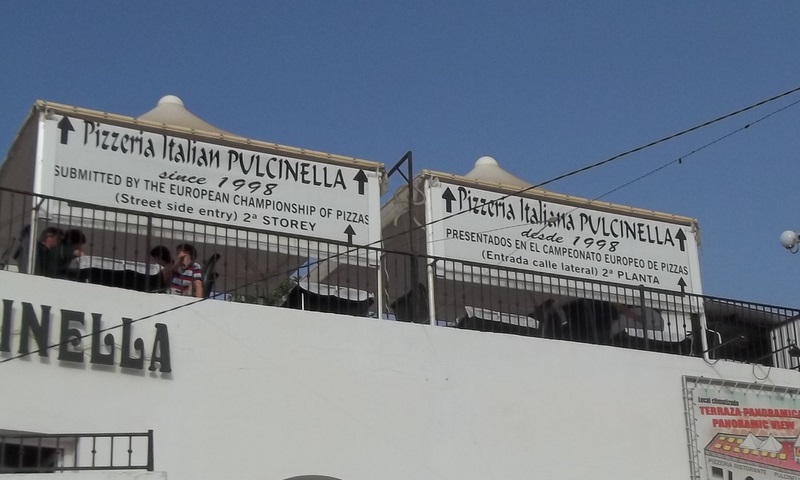
We had dinner in the Pulcinella the other night: four adults and two small kids. Basic spaghetti and pizza. The roof-terrace was packed and business must be good. They have a chap down in the street who approaches you as you arrive in the Plaza Nueva to send you upstairs. They also have a large sign in Spanish overlooking the Square, with a second, roughly translated into English. It would more likely read: 'Presented at the European Pizza Championships' (rather than submitted by).
Like many businesses here, they may not wish to consider employing a Briton for their occasional English posters and menus, but they seem happy enough when the shoe is on the other foot.

Wednesday, August 10, 2011

Making an Entrance

Here's the thing. When you have parked your car in the 'Campo de Fútbol', you must then walk up the Avenida de Paris to get to the centre of Mojácar. You will be sharing this narrow bit of pavement with everybody else, coming and going.
It's not quite one metre wide.

Saturday, August 06, 2011

Plague

In our small corner of enchantment, we are accustomed to occasional swells and troughs in the local population of varmints. An English-language newspaper recently mentioned the plague of flies which had swarmed out of nowhere, covering the outside in unbelievable numbers. Yet, by the time the report came out, the mass of flies had gone, returning to the usual status quo, which is a nuisance rather than a serious bother. Where did they all go to? Unlike the Chinese, who were reputedly told to kill a hundred a day, no doubt on pain of having their own wings pulled off, we manage to avoid keeping tally, relying on an aerosol spray to do the job.

I once bought a trap for flies, a plastic pack crowned with a hook and a cardboard landing area and with a small lump of damp rhinoceros shit secreted in the bowels of the package. A sure-fly success with the moscas. Within days I had about a kilo of dead and rotting flies in my swollen bag, hanging in the arbour. I had to bury the whole stinking mess at the bottom of the garden. A few grasshoppers came along to mourn.

One summer we have a plague of mosquitoes; another time – as this year – there don’t seem to be any. We may have locusts, a plague of them stripped Mojácar in 1906 causing a catastrophic famine here, or it may be a simple swelling in the population of fleas, or scorpions, or mice. This comes about either because the particular thing which eats them happens to be in a decline that year, or because the particular thing which the plague eats, happens to be in abundance. Nature will eventually balance things out, saving the environmentalists or the household bottle of insecticide the trouble. Our current problem with the palm tree beetle is that, because it comes from foreign parts, there is no local creature that likes to snack on it. Give it time.

At the moment, in our neighbourhood, we are troubled by ants. They are those little ones which like sweet things and, as we found out yesterday, they have a particular regard for Sugar Puffs. A long line of them crossed the floor of the kitchen, headed for the larder. Meanwhile, a rather more obvious line of pieces of cereal was jauntily marching along the other way, out the door and down a hole on the terrace.

We are also currently blessed with woodlice: also apparently known as ‘roly polies’. The Spanish ones are nevertheless rarely able to roll into a ball, and prefer to lie on their backs with all of their legs waving futilely in the air as they wait for someone, unknowingly, to pass by and grant them release from this vale of tears. ‘Crunch, crunch yuck!’ as one of the kids said with disgust last time we had the problem with this particularly pointless pest, around twenty-five years ago.

But plagues are always a short-term problem, controlled by the natural rhythm of the seasons. With a little patience on our part, we know that even the tourists will soon be gone and we will once again be able to enjoy our evenings without being obliged to wear some repellent.

Saturday, July 30, 2011

Miguel Angel Gallery

My picture shows Félix Clemente Gerez, currently exhibiting at the Miguel Angel Gallery on Mojácar Playa, posing with visiting American artist Lynette Lombard. The exhibition continues through August 30th and is of a very high quality.

Saturday, July 23, 2011

Sex Talk

In a country like Spain, where there are brothels on the outskirts of most towns - large bars or hotels with names like ‘Club Los Angeles’ decorated outside with bright coloured lights, sex is no big deal. So, the girls inside might be drugged and under a 24-hour watch. They’ll have their passports kept by the brothel owners and they will have to perform a number of times a day to pay for their room. The police will not usually intercede and the city fathers – as often as not enthusiastic customers during the early evening – will turn a blind eye.

Almería is said to have over a hundred of these jolly clubs, with one of the nearest for Mojácar party-goers located on the outskirts of Vera slap-bang next to a snack bar with the rather unfortunate name of ‘Come, Come’ (it means ‘Eat, Eat’ in Spanish, nothing tawdry here. Move on people). Actually, there are some puticlubs nearer to home, usually apartments or villas hired by strange people from foreign parts, who, now and again, get arrested or deported.

The usual brothel has a number of girls floating around, in various stages of dishabille, bothering or chatting you up (you decide) as you order an overpriced drink from the waiter and nod politely at the mayor sat on the next barstool but one. In fact, many Spaniards use these larger places more for a ‘slap and tickle’ than a fully fledged ‘poke, rattle and roll’ upstairs for a reasonable price (it used to be sixty euros plus a shilling for the maid, last time I asked).

Sex used to be dodgy in the old days of Franco, although Spain has always had its cat houses and its putas. Now, of course, most of the fallen women are foreigners, particularly Romanians (the government has just taken away their rights to get any more honest work) and South Americans. Well, everybody likes something a little bit different.

We have sex workers, tarts or what have you; boys in hot pants and transvestites too; all cruising up and down the streets in certain areas, or in the town park, or on the highway. Now the Catalonians want them to wear fluorescent jackets so as not to be run over. That will be fun – makes them easier to spot, anyway.

Sex is also in evidence in shops and petrol stations, where the XXX videos are on the shelf next to the sales-clerk (and often next to a sellotaped picture of the girl with her boyfriend smiling innocently at the camera). How on earth do you sell those things, I asked the girl at the Mojácar gas station. Well, we have a number of customers who don’t want to miss any on them, she laughed.

The videos are frank and extremely self evident. ‘Let’s Fuck’ would be a rather humdrum title for one of them these days.

No one seems to mind.

We have Internet sex of all sizes, types and description, which is either viewed or not, depending on the inclination of the surfer. We have sex on TV, especially after midnight where – if the translator is working – you get to learn a lot of specialist French or Russian, and if not, your domination of the Spanish word aaarrghh improves no end. There will be adverts galore as well.

But now the bluestockings in the Government, aghast at any sexual inequality, want to put an end to all this fucking. Stage One is to pull prostitute’s adverts from the classified pages of the newspapers. Here’s the kind of thing they mean: ‘Mulata transformist, Miranda, new stunning 23cms. Loaded milk bottle. Private. Discretion. Very feminine. I dress as a woman for you…’ (culled from this week’s Weenie).

The proposal, creaking through the Govt, is to change the General Advertising Law - ‘La Ley General de Publicidad’ - to prohibit adverts ‘for sexual favours and for clubs dedicated to prostitution’ in newspapers and their digital editions, if readership is not (somehow) limited to 18 years or older.

Children, put down that paper at once – read the Beano, whydontcha!

Newspapers, of course, thrive on advertising – especially (and rather obviously) free newspapers. So this rule is going to attract some unfavourable press.

Prostitution, according to El País, is worth about 50 million euros a day in Spain. They say they get that figure from the Asociación de Clubs de Alterne. The Spanish Brotherhood of Brothel-keepers, fine people all. The same newspaper fails, unfortunately, to tell its readers how much the naughty adverts are worth to them on a daily basis, but the Euro Weekly’s Costa del Sol edition for this week has, on P.89, five small display adverts and four columns of classifieds dedicated to ‘XXX Relaxation’.

All this fuss comes from the fertile mind of the new Secretary of State for Equality, a chip of a thing called Laura Seara, who says that she is limiting the new rule to the press, but hopes to amplify it to the Internet and the TV, but ‘that will depend on Congress’.

So, is Spain going to end up like Nebraska? I hope not.

Thursday, July 21, 2011

A Short Drive in the Car

Spectacles, testicles, wallet and watch, combined and in pantomime, appear to be a way of remembering how to cross oneself successfully. For me, they are a simple mnemonic to remember to leave the house properly equipped. As age creeps up upon me, I find I forget things. Like not doing up my flies or forgetting to brush my hair, or coming out without my glasses. However, there is nothing more irritating than driving down to the shops only to find that I had left my wallet at home. And while it is useful to know what time it is, and therefore if the shops are open or not, I depart from the list by not wearing or indeed owning a watch. One day, when they invent watches that tell us what year it is, then maybe I’ll reconsider.

So, my four stations of the cross have descended into three: zipper, not that this is really my immediate concern - unless of course I am entertaining - spectacles and wallet.

Unfortunately, a knot in a handkerchief won’t do. Firstly, because I would have to remember to carry a hankie, and secondly, because my list of vital things to remember before I leave the property turns out to be rather longer than the t, s and two double-yous mentioned above.

I need two pairs of glasses, one for reading and the other to keep the sun out of my eyes. These sun-glasses, usually originally belonging to somebody else, often tend towards being bent, scratched or hopelessly unfashionable, which explains how I ended up with them; but they are useful in the summer, especially if I find I need a short nap while talking to the vicar.

I like to carry a mobile phone. Mine has a short battery life – a couple of hours or so – and is rarely charged when I am. This makes it an optional item on my list. Keys of course: car-keys, house and that strange one on the key-ring that no one remembers where it came from. I must carry an ID, which these days, and thanks to the polizie, mean both a passport and a letter from immigration saying that they care. So much easier than the old Residents Card which I carried about with me for forty years. They’ll be making us wear a blue triangle embroidered on our shirt next thing we know.

My pockets are filling up. I’ve brushed my hair and had a pee. Shut the dogs away and checked that the door is locked. I’ve got the plastic shopping bag out of the kitchen (no sense in wasting three céntimos), turned the water off in the garden (hah!), put the chicken away in its cage, eaten its egg, checked my pockets again and added the coupon from the supermarket, a pen, a small camera… and am now ready.

But wait, I’ve forgotten where I had planned to go.

Monday, July 18, 2011

Recharging in Granada

Granada is such an astonishingly beautiful city. Contrasted with the City of Almería, a dump which had its only time in the sun in the early thirteenth century, Granada regains one's faith in the history and culture of Spain. It's not far from where we live, perhaps two and a half hours - supposing we don't stop in Guadix or Purullena (the troglodyte town where they sell pottery) - and it's a manageable size at something under 250,000 souls. But, what's there to see? Suffice to translate the sign above, which reads roughly as:
Give him some coins, Woman
Because there can never be in this life
Anything as hard to bear
as being without sight in Granada.
I'd leave it there, since the best thing is to rush out, now, and buy tickets (or a tank of gas) for Granada and see for yourself, only, I had one more small thing to say, and it needed a second picture.
It's this; they really do seem to care for their city. The streets are clean. Pedestrian streets are for walking around in (and not dodging cars, or having them double parked) and there is a sense of pride evident in the people there.
This is not Almería.

We stayed in the Hotel Victoria NH which is central and comfortable.

Monday, July 11, 2011

The Fire, Remembered

The brush-fire that burnt 2500 hectares of land in Mojácar two years ago has now been all but forgotten. Several houses were lost, some cars blew up, many trees and gardens went in a moment, animals died and, once again, our town had got itself onto the Front Pages for all the wrong reasons. It wasn’t that the Town Hall hadn’t seen the fire coming, although another fire had burnt much of next door Turre’s Cortijo Cabrera only one week previously, it was their lack of useful reaction which should have peeved the local population.

I say ‘should have’ – people here put up with a lot. There’s no room here for complainers. Not if they ever want to see a job again, at the very least. Anyhow, Mojácar is apparently the richest town per capita (if a trifle undivided) in the whole of Andalucía.

Rather than declare a ‘State of Emergency’, our Mayoress was advised to let a visit by the surprise new (and unelected) President of the Junta de Andalucía José Antonio Griñán, come to see his new possessions, turn into a political opportunity to help our local tourism rather than our locals. Griñán, carefully driven ‘the long way’ to Mojácar Playa from Turre, where the schoolchildren had been lined up to sing him something straight out of Chairman Mao’s Little Red Song-Book, missed the burnt-out hinterland of Mojácar. No soot, dead trees or the smell of charred animals for our leader, but rather a plea to help our hotels (run mainly by Catalonian businessmen and with a staff overwhelmingly drawn from Ecuador) while sipping a sherry at the Parador. Following the meeting, the Andalucian Media, which receives 200,000 euros a day of public funds in ‘institutional advertising’, was duly told to run a few adverts for Mojácar tourism.

And that was that.

Here at my home, we lost a number of trees; in fact, their dried-out trunks are still falling in the high-winds (two fell earlier this week), and a few outbuildings. The garage lost its roof and the swimming pool its pump and some of the façade. I’m not complaining – the main house survived.

A surge blew all of our electric equipment. I rang the Sevillana and was given the modern version of the ‘Act of God’ excuse, that the surge was ‘fortuito’ and therefore not their problem. Accidents are so often ‘fortuitous’ these days, don’t you think? Does anyone have a CD player, or a spare amplifier?

The water pipes burnt during the fire, but the swimming pool held enough sooty water to help with the buckets. The roots of some trees burnt for days, and a bucket of water down a smoking hole would elicit a loud steamy whoosh.

The local fauna all died. Almost all were burnt to death, including some small birds we saw, as the fire hit, that flew off with burning wings. Not an image to forget. Other animals, our lazy tree-rats, the wild tortoises, the rabbits and voles all died. The wild boar may have escaped, but there are few foxes around these days. I remember, just two days after the fire, as we were beginning the job of cleaning up the house and charred garden, hearing the hunters out with their shotguns, in case any bird might have survived the cataclysm and was unable to hide behind the naked trees. Bang. Bang.

We had seen the smoke approaching in the high wind. A police car had fired its sirens – ‘run, run now!’ and, with the dog and a single picture wrenched off the wall by the door, we had fled the scene. We had met up with some house owners in the riverbed and watched as the hill between our house and the shocked group had suddenly glowed red. We learnt afterwards that one of our neighbours was just about to get into her car to escape the fire when the vehicle abruptly exploded, burning her legs and arms. She was forced to run back inside her house as the fire, borne on an incredibly strong wind, rushed against her home and around the walls, igniting what could be burnt, leaving everything else to smoke and soot. We found our shocked neighbour later and took her to the medical centre on the beach. A dozen fire-engines arrived that afternoon and worked until late in the evening. It was good to see them. We slept on the beach and drank tea.

The President of our autonomous Region wasn’t the only person who never visited our barrio to see the fire damage. The Mayoress never came by either. Not to do anything much, but to at least look indignant and shocked as we showed her the smoking ruins. I think we could blame the first fire, which was obviously not extinguished properly, and the ‘environmentalists’ who were campaigning at the time to save the dead underbrush, as it provided cover for our local wild tortoises.

What tortoises?

We were asked to report our losses to an office on the beach, itemised and with photographic evidence. A few months later, a letter arrived from Madrid. In the event of my house being entirely and completely destroyed by some act of nature, the Government of the Nation, it said, would be pleased to extend 15,120 euros to build me a new home. Kind of them, we thought, but luckily our house survived (if a trifle scorched).

Wild fires are regular occurrences in Spain during the summer, although this was the first one in Mojácar for twenty years. It was big enough to receive some press coverage. Even our local English-language ‘newspaper’ laconically reported that a British television personality of small standing had been staying on the beach during a fire but was unharmed. Well, it’s not The News of the World…

So, two years on. The fire cost me a few hundred euros in cleaning up and hiring skips for dead branches and other material, but, as the main damage – several hundred trees destroyed, the stables and store-room contents lost, electrical goods fried and a few domestic birds killed:

Well, put that down to experience.

Monday, June 27, 2011

Lunchtime Blues

There’s something queer about the food these days. You go to a restaurant to eat and half of the menu is designed for some kind of wedding feast. It’s all got fancy-dancy for some reason. Perhaps the Michelin Man is seated at table number seven. What’s wrong with ‘sat’?

In the good ol’ days, food was food. No cream doodah then, no fennel sauces or roasted swedes. Simple stuff. A salad was lettuce, sliced onions and tomatoes with a heavy and oily aliño; now it’s got enough different kind of vegetables rattling around the plate to make a rabbit blanch. The main course used to be a plate of what one hoped were mutton chops (or were they perhaps goat?) or slices of pork (known collectively in our area by the foreign contingent as ‘crotchmeat’) or perhaps a plate of chicken knuckles with chips.

How to prepare chicken knuckles. Take one chicken, have at it with an axe, then drop result into a sartén with plenty of oil and garlic. Fry to taste. Riquísimo.

All the best crotcheramas (as we called them) could manage this simple fare, and with a bottle of really quite nasty wine, the whole thing, plus pan, came to around sixty Pesetas a head. Now, what’s wrong with that?

There was no menu and no price list. If you didn’t know what you wanted, or couldn’t understand the waiter, you wandered into the kitchen and pointed.

In those days, if we wanted a decent roast, we’d have to drive to the nearest butcher. He was a blood-spattered German trading six hours down the coast in the Calle San Miguel, Torremolinos’ high street. We’d fill up the plastic freezer box, spend the night on the piss, and head home the following day.

The twenty or so who made up the foreign community in the village in those days would be waiting for us on our doorstep when we returned. One of them was a retired air vice-marshal with a plummy accent called ‘Tabs’. My parents had left the door ajar one particular evening and had gone round the corner to the first and only foreign bar for a nip while the roast roasted. Tabs, on his way up the hill for a pink gin, smelt the rich smell of the roast waftin’ on the evening air and stopped by the house to invite himself to dinner. He went in and found no one around, so he checked inside the oven – as one does - to have a look at his potential dinner. Satisfied, he carried on to the pub for a large one and to obtain an invitation from my mother, in which he was successful.

Now our oven was one of those old Butano three burner ones with a lid and a slight wobble. When the hungry party returned an hour later to check on the roast’s progress my mother found that Tabs’ tour of inspection had, by briefly opening the oven door, put out the gas. Tabs later recalled that ‘no one had ever talked to him like that before’.

The milk in those days was undrinkable. It came in two litre glass bottles with a thin neck. There was a slightly blue cast to it due to the fact that the manufacturer had substituted the cream for pork grease and added formaldehyde to keep it stable. This baby could sit in the sun all day. Tea, if we could get it, came in teabags brought out from England loose in people’s luggage, wrapped around the socks. Eggs and chips were the standby at home, and cocido in the restaurant in the square. Tabs would insist on the plates being warmed, without much success from the kitchen-wallah, so he would usually place his plate under his shirt for a few minutes to do the job. ‘Under trying circumstances’, he would say, ‘one tries to keep up appearances’.

Another dish of the time remains to this day a favourite of mine, although it is now extremely hard to find. You see, it’s too cheap. This is ‘Huevos a la Flamenca’, a small earthen dish with ham or some kind of donkey-sausage served with peas, peppers and a fried egg. The whole, cooked in tomato paste. I happened across one the other day outside Granada: delicious!

Food, back in those days, was scarce and no one was going to mess around with sauces. Actually, come to think of it, it may have been because you couldn’t get cream. Eggs, tomatoes, potatoes, peppers, salchichón, chicken and pork was about your lot. The local grocers, known in a gesture of Spanglish relations as ‘The Foodings’, had a few tins on the shelves plus ‘Spanish’ bread, truly awful chocolate, some rather nasty looking sardines and a rack of wine in returnable bottles (two Pesetas back). They’ve still got the chocolate. Credit was extended to favoured customers; a dried lima bean went into your jar for each Duro owed. This system was eventually overturned – literally – by an escaped chicken that broke into the store one night. Reportedly, it ate most of the evidence.

Tapas, even more than today, were the solution. You used to get a bloody good tapa in Andalucia with your quinto or your tinto. A piece of magra, lean pork, with some chips and bread. Two fried cordoñíz eggs on toast. A ham, cheese and alioli cherigan. A small plate of whitebait... a fat chunk of tortilla de guisantes... home made potato crisps (when was the last time?)... a few of those would set you up nicely.

So these days it’s all la-di-dah. The menu’s in English (and Spanish, and French, and Italian, and German...), the food is all poncy, the wine list is exhaustive (and exorbitant), the postres all come from those fine people at Frigo and, worst of all, You Can’t Get Huevos A La Flamenca.

Monday, June 13, 2011

Requiem for Dr Galindo

We have a village doctor called Dr Galindo. He is the old-style kind of doctor who looks after his patients. He may be on the ball with the latest developments in medicine or not: it doesn't matter, because he's a good man with knowledge and understanding.
Like the famous and much-loved Don Diego who died earlier this year after looking out for Mojácar for a lifetime.
Last year, word came that Galindo was being moved by the Servicio Andaluz de Salud and that a new doctor was to take over. We started a petition to keep Galindo and got 800 signatures. We passed them on to the mayoress who said she would see what she could do. But, as always, far-away paper-pushers triumphed and the new doctor, straight out of school, duly arrived to take over. She was very young and insecure, and would often send her patients on to specialists at the Huercal Overa hospital.
Everyone wanted Galindo back.
So, word came that he was at the Centro Médico on the beach. My wife, who has been ill for a long time, decided to 'change' to the beach to continue with Galindo's treatment.
Then, just after registering down there, we were informed that the young woman had given up in the village and that Galindo had returned... to be there for at least a year. However, despite the strength of our petition and rules that you can choose your doctor, my wife was told that she would have to stay on the beach for a minimum of three months before she could return to the village.
We can't afford 'private insurance' any more, after being stiffed by some fraudsters a few years ago, so a good doctor who understands B's condition is important.
So today, we passed by the village centre. Can we see the doctor? No, you are registered on the beach and anyway, he isn't here any more. We now have a new medic.
So, where's Galindo?
We aren't allowed to tell you that.

Tuesday, May 24, 2011

Politics Killed the Goose

Those of us who wanted, voted on Sunday in our local town. The local people voted with trepidation, since a vote for the wrong party-leader will mean four years without any projects, work or favours for them or their families. The non-locals - those who were on the voting-list - voted with enthusiasm or with hesitancy; they voted with conviction or they voted doubtfully and, from those who were sent home to get their passports, they voted with a dash of anger. Some thought they could vote, only to find they couldn't. Others, as usual, didn't bother to come along at all.
Our town is an exceptional and beautiful place ruined by thirty years of 'democratic' elections, where mayors and their teams have exploited the pueblo for their own ends, turning Mojácar from a moribund municipality in the 1950s with less than 600 inhabitants to the richest town per capita in the entire region of Andalucía only fifty years later.
Not that the wealth is very evenly spread.
The Town Hall, unlike any other I've ever visited, has no photographic memorial to past administrations. No oil paintings of previous mayors. In fact, I can understand their point - since Jacinto Alarcón, the old mayor who famously 'gave away' properties to outsiders in the early sixties, there's been no one in the Town Hall worth honouring. Here, it's all about greed. We may have the highest proportion of misers in Spain, I don't know: no one has made a study. Our wealthy local class certainly doesn't spread it around. You won't see any privately funded public buildings or even a park bench with a brass plaque on it, donations from the Rich and the Good. Here, the various multimillionaires (some of whom whimsically claim to be socialists) keep their money safe and unspent. Mojácar is to be sacked and despoiled. It's the rule.
In our town, there have been a long list of cynical projects designed to mine the public purse, from useless and ill-considered buildings to pointless stadia. Many having already fulfilled their purpose before the first brick was laid. Much of our town has been knocked flat, in exchange for poorly designed monstrosities which, in these straightened times, are hard to sell or rent. On the beach, vast numbers of small noddy houses and minuscule apartments lie empty: you make more money per metre on petite dwellings than larger homes, you make nothing on parking lots or wider roads.
During those fifty years of massive growth, Mojácar inevitably watered down its local population of lordlings. While many returned from their uncomfortable exiles in other lands, attracted by the new wealth flowing into their pueblo, and considering their bits of land and properties, inevitably a new type of settler was filling up the town, the 'forasteros': the outsiders.
These were divided into the not-from-around-here Spaniards (who knew the ropes), the rich foreigners with rights (the northern Europeans), the poor foreigners with rights (i.e. los rumanos) and the poor foreigners without rights (the sudamericanos).
Some of us having, since 1999, the vote. Although, Spain being Spain, we had to ask for it. In triplicate.
In our town, the forasteros knew that they were here because it was a great place to live, better than wherever it was we came from. We were dismayed by change, by poor planning and by being exploited by the locals, secure in their power. We were more than them, yet we remained without any say in the future of our community. We were divided, tricked and unloved. The rents were raised as the customers fell: and no local person would drink in our bars or buy from our shops.
So now, despite its wealth, Mojácar is once again dying. There's no enthusiasm or poetry left here anymore. Everything is for sale. There's little reason to try and keep the dream alive. The forasteros must leave. Without us, there will be no work, no income, no community. And thanks to our 'hosts', there won't even be much to remember us by. Like the Visigoths, we shall soon be forgotten.
In a few years from now, even the local people will have to board up their properties and move away, once again, to Hamburg and Lyons in search of work. We need another Jacinto, not a RosMari.

Saturday, May 14, 2011

Plastic Bags

I was at the counter in the supermarket this afternoon, waiting to pay for my few and modest provisions, when I was reminded, yet again, that I had forgotten to bring a shopping bag with me. There was one in the car, but with my packets and cans and tins and bottles and vacuum-packed goods all waiting on the check-out tray, I had to bow to conformity and common sense and buy a plastic bag for a nominal couple of céntimos. They don't give them away for free any more, in solidarity with Mother Earth. How could I possibly complain about such a thing?
This whole plastic bag thing is an important gesture towards the environment. We must be true to our unborn future generations. We have been using plastic for years in ways which are an abomination and no doubt our land-fills are full of untold millions of tons of the stuff. I thank our leaders for showing us the way.
Of course, in the old days, we didn't have throw-away razors (with five or more blades for a really close shave: thanks Gillette), or disposable lighters. We washed and returned our beer bottles and left the milk bottles outside for the milkman. Alright, maybe it wasn't exactly milk here, but they used to wink gamely at you and call it 'leche'. Corks were made from an amusing thing called 'cork' which comes from a 'tree'. Goods came in a wrapper rather than lost in an unnecessarily large presentation box. A butcher chopped up your bits of meat, rather than the cooler-counters piled high with Styrofoam trays of sliced viands, vacuum-packed to last.
Fruit juice came in a fruit. Meat was wrapped in paper. Many items for baby were washable and re-usable and you could bring your own container to fill with oil. Water was just water and not a whole shelf of different brands all in their own uniquely-shaped bottles. I shan't go on since I'm sure you get my point, but consider this:
If the new rule on plastic bags are a small step back from the insanity of our throw-away culture - then why don't they give us our groceries in paper bags, like they do in America?

Monday, May 09, 2011

The Foreign Vote

It has taken a while to get as far as the title in last Sunday's Voz de Almería, which hardly needs translation. The story says that there are 7,500 Britons able to vote across Almería and elsewhere lists some of the candidates, giving honorary British status to Astrid Schröder and others. The picture is a presentation of Ciudadanos Europeos, which is fielding candidates in Arboleas and Mojácar.
The very Spanish Constitution itself had to be changed to allow Europeans to vote in local elections in Spain - to vote and to be voted for, or, as the Constitution puts it 'active and passive suffrage'.
Since 1999, Mojácar has been one of the leading towns for 'European' participation, with several candidates including myself floating around on various lists, and even - to date - two councillors: Matthew Shatford and Albert Schröter (no relation to Astrid). Neither managed a full term in government. In these elections of 2011, the town has two party leaders and a generous number of other candidates who were born in Northern Europe, in fact, with the exception of the PSOE, all the other parties have a foreign presence of greater or lesser extent. Even the PP has managed to cram a single Briton into their list safely near the tail at Nº 9 where they won't be any threat, but might make a difference.
Oddly, only two towns in Almería have taken the plunge: Mojácar with its aspirations to improve culturally and Arboleas, beset with terrible problems of what the Junta de Andalucía refers to with some satisfaction as 'viviendas ilegales' - illegal homes. Both towns have a lively interest in local politics and, in both these towns, the foreign vote will make a difference.
Not so elsewhere across the province, for with a few exceptions - Jim Simpson in Zurgena, Joanne Tissington in Albox and Lois Benson in Bédar - the majority of towns with a foreign element have managed to safely ignore the problem for another four years. Perhaps it's our fault.

Monday, May 02, 2011

A Question of Trust

We've been looking at old newspaper stories about Barbara's work with the disabled here in Mojácar. She started an association called Animo which helped children with physical, mental and sensory problems, by animal assisted therapy: in short, by riding on horseback. She ran the association with around 40 volunteers - many with RDA experience - from around 1988 until the early 2000s, when her health got bad (from an accident related to the charity work). She has now started it up again and has a blogsite here. Besides the charity work (with no support from the Mojácar town hall), annual horse fairs and donkey baseball-games for around eight years, Barbara helped improve life for about fifty 'students'.
I have also worked in something pretty close to a charity - putting out a free weekly paper between 1985 and 1999. The Entertainer was meant to help inform Britons about life in Spain, and to try and support and protect them as possible. I have lived here for a long time and know a lot about this country. Over the years I have produced or edited in all over 2500 newspaper editions, including 200 in Spanish. Eventually I sold the paper - although I was never paid and am now being sued by the 'buyers' for placing some tart remarks about them on the Internet.
Were we both wrong to trust people?

Sunday, May 01, 2011

Sevillanas

See the outfits! The shoes! These little girls are going onto the stage with their dance mistress to show us some 'sevillanas', a type of white-bread flamenco preferred by the Spanish, safe from the anarchy of the gypsies original, passionate and exciting music - a bit like The Archies playing the blues.

Thursday, April 21, 2011

Semana Santa

As we know, Semana Santa, Holy Week, is a long and agreeable holiday. We spend it on the beach or in the bars. A few of us might dress up in purple and perhaps even go to mass. But for most of us, it's a welcome week off work and a chance to relax.
Might even meet someone.

Sunday, April 17, 2011

The Opportunity for Change

We are in the days of the 'pre-campaign', as defined by the rules which were quietly changed this past January. You can't put up your posters yet - although there are several in Mojácar for the delightfully named UM party, covered by tarpaulins to uphold the law, but just as effective for anyone who lives here and saw them in their glory for a month or two. 'Capacity', they say. 'Oh yes we can'...
Meanwhile, the main parties in the country, the national ones, have their opportunity. They will be on the television with their business as usual, their scandals and mutual accusations (carefully not mentioning anyone else, since, like most countries, we have the politics sewn up in a two-party system). Then, there are the 'routine' meetings when the party leader or a minister (or equivalent) is chewing a microphone in public, talking, naturally, about state affairs... not the upcoming local elections - that wouldn't be right. There are autonomous elections in many parts of Spain as well, where the non-Spanish Europeans are not invited to vote, but thankfully, Andalucía is spared that. Here, our autonomous elections are held with the national ones, in the hope that the eternally ruling PSOE-A gets in again. Since the autonomy is ruled and run from far-off Seville, it won't make much difference here anyway.
In the towns, the smaller parties must wait. We gossip and plot our modest campaigns as the larger parties look over their war-chests and order their billboards and teeshirts from Madrid. It's the calm before the storm. The mayors may have handled the voting list, but we shall get copies of them next week.
But what does this advert from nolesvotes mean? Don't vote for the establishment. It's about the institutionalised corruption in Spain, the sell-out to Hollywood ('Ley Sinde'), the 'war' on Libya (with Spanish munitions flying on both sides), the five million unemployed, the protection of the bankers, the alternation (and mutual protection) of the two parties, plus the CiU in Catalonia. 'Without your support', says the association, 'the big parties have nothing'.
Here in Mojácar, with the PSOE in collapse, the peril for our town comes from the local PP, who have not only mismanaged and affronted our citizens for the past four years, on their return to power, they are planning to eviscerate the square beside the church, making a pointless underground car-park for residents: a park for 37 cars. Will the workmen stop as they dig through 4,000 years of history as treasures from the past are unearthed? They didn't the last time with Gabriel, when ruins and graves were found in the Plaza Parterre, neither the time before with Bartolo while chewing up the surrounds by the Castillo. And all for what? Several million euros of scarce Town Hall money misspent. This party builds 'Padel Tennis' courts on the beach at a premium, without there being any demand or interest. The football stadium wasn't cheap either, even though we don't have a team yet. The Art Museum, switched expediently to a gallery earlier this month, has now been closed.
It's time for a change. Choose a party that reflects the make-up of your community, a party with a proper mixture of Spanish and 'European' residents. A Town Hall should at least reflect the make-up of its citizens and should, like the nation above it, be responsible to them - not to self perpetuation and outside interests.

Wednesday, April 13, 2011

Spell Me Right, Por Favor

If I am faced with a word or name I'm not familiar with, I copy it out carefully. I expect most of us do. However, foreign names are considered slightly frightening by many Spaniards. Too many letters or not enough. In today's newspaper, Helen Prior becomes Hellen. Even a simple John becomes Jhon or even Jhonathan. There was once a brand of Spanish denims called Jhon Jeans. I may have an old pair somewhere. My dad was called William, or rather more often, at least in print, Willian. My own name is pretty simple, but even after being here for 45 years, people can get it wrong. There's a mention of me in a book published by the diputación de Almería, about how I ran a newspaper in this province during fifteen years. So much for posterity, they've spelled my name wrong.
Perhaps this explains why everyone is called Pepe or Paco. In fact, when I was a kid, the local people used to call me Pipo.
I guess it's all to do with concern over the spelling.