Spain has always had an interest in milk, even if, until recently, you couldn’t find a cold glass of it anywhere.
The old milk was a definite bluish colour and came in a 1.5l glass bottle with a short and narrow neck and a metal cramp, like a coke bottle. This stuff could sit in the sun for weeks without losing its taste and often did. The blue colour came, apocryphally, from the formaldehyde that kept the mixture quiet. It didn’t taste good, which probably explains why breakfast cereal came late to Spain.
Pour that stuff over your Frosties – the milk would eat ‘em up before you could….
Later UHT milks from different companies, now in the tetrabrik box, became acceptable for coffees and so on. An English tea-bag, smuggled out in the carry-on luggage by someone coming-to-stay, would be pretty badly shaken by being diluted by this stuff, but you can get used to anything. Nowadays, we even have sippin’ milk in the supermarkets. Tastes pretty good, too.
While milk has never been considered a serious drink (despite the best efforts of some of the producers to tell us different in the usual kids adverts), it has certainly spawned a whole slew of versions. We have milk with vitamins, milk with calcium, skimmed milk, partially skimmed milk, milk with royal jelly, milk with acidophilus (a handy bacteria apparently found in drool), milks with Omega three, phosphorus, folic b and fibre, specially flavoured chocolate, vanilla and strawberry milks, rice milk and soya veggy milk. All competing for your attention on the shelf. How many times have you brought home the ‘wrong’ one? Bertha, what the hell’s this stuff?
The hardest one of the entire lot to find on the shelf of the supermarket seems to be ‘full bog-standard milk’. It’s like ordering Vanilla in an Italian ice cream shop.
In point of fact, I doubt any of those UHT milks (with additives or indeed subtractatives) ever loitered under a cow. Certainly Mrs Rambeau’s pet calf, Petit Suisse, refused point blank to drink one particular brand, the Valencian-produced ‘Leche Ram’, a sort of ‘can’t believe it’s not milk’ product. I see it’s since gone pear-shaped. Perhaps the calf knew something.
At the same time, yoghurt has done just fine. I think I first tried yoghurts here in Spain as a child. The Danone people (a company from Barcelona), were putting out their early flavours by the time I first arrived here in 1966 (they actually started in 1919, selling the stuff in farmacias) and apart from the plain one (add jam and sugar), there was at least a strawberry one going strong. A strapping young fellow called Danon, after whom the product was named, died the other day at the impressive age of 102, so the stuff can’t be all that bad for you.
Forget dithering between the strawberry and the banana varieties: in these modern times, there are an untold number of flavours clogging up the nation’s cold-shelves, with anything that grew on a tree or a stalk being processed into a yoghurt cup. You can now even get ‘Greek yoghurt’ (thicker than the usual stuff). Currently in three flavours and sales, by all accounts, growing through the roof.
Spain is not, with this notable exception, very kind to Greece, preferring for some odd reason to pretend that it doesn’t exist (try and find a Greek restaurant, a pair of crapcatchers or a decent bottle of ouzo).
Together with yoghurt, another milk-based little number on the shelves is guajada, rennet made from sheep’s milk. It comes in a little stone pot. With a squirt of honey, it’s pretty good in an ‘ummm, this tastes healthy’ sort of way.
Ice Cream
Spain triumphs with its ice creams. The main area for ‘artesanal’ ices is the interior of Alicante and Valencia provinces, notably Jijona (also famous for its nougat). Across the country, heladerías dot the main streets and offer dozens of alternative flavours. They (thank goodness) are all licensed, so you can always put a shot of whisky on top of your tart. In fact, tarta al guisgüi is one of the best and most august of Spain’s postres, together with the traditional old block of hard ice-cream with two or three flavours (vanilla, strawberry and chocolate) that you make a sticky sandwich out of. In regular Spanish bars across the nation, there is usually a deep freeze full of cornets and lollies together with one of those large cardboard signs on the wall above advertising the different flavours, shapes and styles of ice cream, available or not.
In the milky dessert range, we find the crema catalana (a custardy thing with a crunchy topping of burnt sugar), arroz con leche (an oversweet rice pudding), the natilla (another custardy thing) and the ubiquitous flan, the crème caramel. Then, there’s leche frita, or ‘fried milk’ – it comes in caramel covered chewy lumps – to try as well.
The cheeses available in the past used to either be that dreadful Dutch bola – a large red ball of tasteless dry queso, or a thin slice of cream cheese in silver foil from those fine people at (I hope appropriately called) The Laughing Cow, or the remarkably good Manchego, made from a mixture of milks from goat, cow and sheep. No doubt in the old days topped up with a drop of formaldehyde. More recently, we can add blue cheese, processed slices of industrial pseudo-queso, babybelle and cheddar, plus a few shy home-made Spanish cheeses from the north (Idiazabal for example) edging onto the shelves.
The butter used to come in a sturdy round can from Morocco. Probably started out as camel’s milk. You needed a tin-opener to gain entry. Which explains why we still mainly use margarines for our pieces of toast.
Before the fridge came along, and those fat blue bottles of Puleva were still being used for arcane cooking reasons, Spaniards would often put condensed milk (which I think came from Holland) in their coffee. They still do, and as a ‘bonbón’, one of over a hundred different types of café you can order from the bar, your ‘black n’ white’ coffee will give you a pretty good kick-start in the morning.
Sunday, July 12, 2009


Thursday, July 09, 2009
No Straight Lines

There’s an exhibition of sculptures by Bruce Cameron, a Londoner who now lives in Oria in north eastern Almería, in the nearby town of Olula del Río. Olula del Río (there’s an Olula del Campo nearby) turns out to be a bit of a dump, although it has one of th
 e most astonishing art museums, the Museo Casa Ibañez, where the exhibition is being held. Bruce is a spry 70 year old and has been working with wood, ceramics and metal – here driftwood from a 1987 flood in Dorset – since his first exhibition in 1975.
The exhibition is being held in the Museo Casa Ibañez, which is a large private museum owned by Andrés García Ibañez who, as the pictures here show, can’t half paint! He has an international following and favours grotesque portraits of curas, policias and politicos (and sometimes royalty as here) together with delicate portraits of women. The twelve room museum also houses a collection of XIX and XX Century Spanish art, including Sorolla, Villegas and Fortuny.


 In the presentation (first picture above) Bruce is on the left. The woman, second from left, is the councillor for culture from the diputación de Almería (the county council). On the right is Andrés García Ibañez, who in his speech, noted that the public authorities spend almost nothing on culture and the arts. García Ibañez actually covers most of the cost of the museum himself.
The exhibition and museum are open to the public evenings from 7.00pm - 9.00pm Tuesday through Sunday. Mornings (with a guide) call 950 441 000 (español).
Monday, July 06, 2009
Wall of Sound
It was a noisy week, between the fiestas from our village, starting at 11.30pm the other Friday and running through to the Sunday evening, and those celebrated in the town next door, which managed to raise five nights of music and party-time from the Saturday until the final bonfires of San Juan the following Wednesday, whence, I must add, our village returned to the fray, hung-over but defiant.
We had undergone the Moors and Christians bash, an annual tradition stretching back all the way to 1988 when someone thought of a merry way to attract some extra tourism, and to loose off the town-hall’s collection of fireworks while getting everyone to dress up as Moors (granny’s night-shirt), or Christians (old army clothes).
Or rather, it was the time to rent some expensive and amazing costumes from those places in Alicante that stock the different outfits and to try not to get beer or pinchito-juice all over them. It was a chance to remember, or indeed to re-invent, the story of Mojácar’s fall to the invaders in 1488.
The town was taken by the idea and enthusiastically divided itself up into supporters of the two faiths. The socialists donned Moorish garb and the conservatives went with the Christian outfits. The town’s under-employed pyro-technician, who until then had scampered about on the church’s roof on New Year’s Eve, blasting powder off to celebrate the occasion, or during the fiestas in August blowing tens of thousands of euros in thunder-flashes and other delights of the ancient art of keeping everyone awake, was naturally ecstatic. Moors and Christians means flashes, crashes, explosions, bombs, booms and bangs. Powder under the fingernails as he and his acolytes fire great chains of fireworks that will light up the sky (traditionally from the glowing nub of a cigar), or launch those ear-splitting rockets so beloved by fiesta-goers in Andalucía.
There are six bands or record-thumping lunatic DJs in the six barracks plus another band in the main square during this particular fiesta, together with the disco-bars with their terraces and open windows. More explosions. In all, a cacophony of sound that shrivels the soul. In Andalucía – or probably for that matter in the rest of Spain – a party that begins at 10.30pm, or half past one in the morning, won’t stop until ‘late’ – which usually means ‘sometime the following afternoon’.
That was on the right hand. On the left, Garrucha was enjoying its five-day run up to San Juan (the fireworks and bonfire on the beach with a sandy and agreeably raw sardine as the excuse - another modern festival designed, once again, more for the visitors and their fat purses than for the residents). Five days of ‘battle of the DJs’. Our house is located somewhere equidistant between these two towns, in an area described by the previous owner as ‘quiet and bucolic’.
So, I had to stay in with the windows closed and a clattering fan from that strange shop on the beach attempting to cool things down, tormented by some erratic but persistent explosions and the bass-beat from a hundred discos passing easily through the doors and down the chimney; the dogs going nuts, barking and throwing themselves at the door or whimpering under the bed as I curled up on the soaking mattress munching sleeping pills, or then there was the Plan B: a breathless walk up to the main square following the ‘if you can’t beat them’ philosophy. What's a person going to do?
The idea of Phil Spector’s ‘wall of sound’ must have come from a fiesta. It’s to keep the spirits away. Or, if your spirits come in a bottle, then judiciously mixed and drained repeatedly. Only the Spanish can claim a ‘hangover’ as a reasonable excuse to miss the following day’s work.
Down in the Bar
Now, I’m the type who can normally hear a pin drop – well, a fairly large pin, a rolling pin for example – but once there at the bar having pantomimed for a beer, with music coming from one side, a specially loud coffee grinder in action on the other, several televisions with different football matches going on, or a bullfight, together with a dozen different conversations typically held in high bellows, roars of motorbikes outside and a few explosions across the street to help wash things down, I find that my directional hearing is starting to falter, either that or I always end up having my drink with someone like Whispering Dave.
Have you ever grinned, nodded, grimaced and twitched at somebody in a loud bar without having a clue as to what is being said? This is, in fact, a popular pastime (despite the raised voices) and, to encourage this, bars have tile floors, hard surfaces, and walls and ceiling with as little decoration (which might in some way ‘eat’ or deflect the sound) as possible. Since everyone knows that the only interesting person in a bar is oneself, it’s not worth wasting too much time attempting to listen to other people’s views. Anyway, there’s a really good show about fireworks just started up on one of the tellies.
It is said that Spain is the second noisiest country in the world, after Japan. The only reason that Japan manages to be noisier, and this is something which Spain feels is a bit unfair, is because of the paper walls used in construction by Japanese builders and promoters. An intriguing idea indeed: the Murcians are said to be making tests. That and people shouting ‘banzai’ at odd hours. It all adds up.
But we have much to be proud of. The children here are encouraged to stay up late and really let rip with their lungs. Most of the people dancing in the square the other night at three in the morning when I got there were under nine. A small child’s bellow, given full and frank encouragement, is a wonder to behold and it is here, as the kids attempt to accompany the over-dressed singer’s stellar version of ‘Pajaritos por aquí’, that the citizens of the world’s second noisiest country begin to lose their hearing – and, come to think of it, their taste in music.
Which is why, to truly communicate in Spain, one needs to gesticulate heavily. It helps the flow.
The cinemas – especially the summer open-air ones with their open bars and loud conversation – are good places for guests to this country to learn the language and catch up with incipient hearing loss. Lip-reading doesn’t work, since the characters on the screen have been dubbed. They’re also probably saying something more interesting than the original script-writers ever imagined anyway.
I’m not complaining, having now lost most of my hearing from living here so long, I suppose that I would feel completely isolated in Switzerland, where everybody whispers.
To really get the best out of Spain, you must speak up!
We had undergone the Moors and Christians bash, an annual tradition stretching back all the way to 1988 when someone thought of a merry way to attract some extra tourism, and to loose off the town-hall’s collection of fireworks while getting everyone to dress up as Moors (granny’s night-shirt), or Christians (old army clothes).
Or rather, it was the time to rent some expensive and amazing costumes from those places in Alicante that stock the different outfits and to try not to get beer or pinchito-juice all over them. It was a chance to remember, or indeed to re-invent, the story of Mojácar’s fall to the invaders in 1488.
The town was taken by the idea and enthusiastically divided itself up into supporters of the two faiths. The socialists donned Moorish garb and the conservatives went with the Christian outfits. The town’s under-employed pyro-technician, who until then had scampered about on the church’s roof on New Year’s Eve, blasting powder off to celebrate the occasion, or during the fiestas in August blowing tens of thousands of euros in thunder-flashes and other delights of the ancient art of keeping everyone awake, was naturally ecstatic. Moors and Christians means flashes, crashes, explosions, bombs, booms and bangs. Powder under the fingernails as he and his acolytes fire great chains of fireworks that will light up the sky (traditionally from the glowing nub of a cigar), or launch those ear-splitting rockets so beloved by fiesta-goers in Andalucía.
There are six bands or record-thumping lunatic DJs in the six barracks plus another band in the main square during this particular fiesta, together with the disco-bars with their terraces and open windows. More explosions. In all, a cacophony of sound that shrivels the soul. In Andalucía – or probably for that matter in the rest of Spain – a party that begins at 10.30pm, or half past one in the morning, won’t stop until ‘late’ – which usually means ‘sometime the following afternoon’.
That was on the right hand. On the left, Garrucha was enjoying its five-day run up to San Juan (the fireworks and bonfire on the beach with a sandy and agreeably raw sardine as the excuse - another modern festival designed, once again, more for the visitors and their fat purses than for the residents). Five days of ‘battle of the DJs’. Our house is located somewhere equidistant between these two towns, in an area described by the previous owner as ‘quiet and bucolic’.
So, I had to stay in with the windows closed and a clattering fan from that strange shop on the beach attempting to cool things down, tormented by some erratic but persistent explosions and the bass-beat from a hundred discos passing easily through the doors and down the chimney; the dogs going nuts, barking and throwing themselves at the door or whimpering under the bed as I curled up on the soaking mattress munching sleeping pills, or then there was the Plan B: a breathless walk up to the main square following the ‘if you can’t beat them’ philosophy. What's a person going to do?
The idea of Phil Spector’s ‘wall of sound’ must have come from a fiesta. It’s to keep the spirits away. Or, if your spirits come in a bottle, then judiciously mixed and drained repeatedly. Only the Spanish can claim a ‘hangover’ as a reasonable excuse to miss the following day’s work.
Down in the Bar
Now, I’m the type who can normally hear a pin drop – well, a fairly large pin, a rolling pin for example – but once there at the bar having pantomimed for a beer, with music coming from one side, a specially loud coffee grinder in action on the other, several televisions with different football matches going on, or a bullfight, together with a dozen different conversations typically held in high bellows, roars of motorbikes outside and a few explosions across the street to help wash things down, I find that my directional hearing is starting to falter, either that or I always end up having my drink with someone like Whispering Dave.
Have you ever grinned, nodded, grimaced and twitched at somebody in a loud bar without having a clue as to what is being said? This is, in fact, a popular pastime (despite the raised voices) and, to encourage this, bars have tile floors, hard surfaces, and walls and ceiling with as little decoration (which might in some way ‘eat’ or deflect the sound) as possible. Since everyone knows that the only interesting person in a bar is oneself, it’s not worth wasting too much time attempting to listen to other people’s views. Anyway, there’s a really good show about fireworks just started up on one of the tellies.
It is said that Spain is the second noisiest country in the world, after Japan. The only reason that Japan manages to be noisier, and this is something which Spain feels is a bit unfair, is because of the paper walls used in construction by Japanese builders and promoters. An intriguing idea indeed: the Murcians are said to be making tests. That and people shouting ‘banzai’ at odd hours. It all adds up.
But we have much to be proud of. The children here are encouraged to stay up late and really let rip with their lungs. Most of the people dancing in the square the other night at three in the morning when I got there were under nine. A small child’s bellow, given full and frank encouragement, is a wonder to behold and it is here, as the kids attempt to accompany the over-dressed singer’s stellar version of ‘Pajaritos por aquí’, that the citizens of the world’s second noisiest country begin to lose their hearing – and, come to think of it, their taste in music.
Which is why, to truly communicate in Spain, one needs to gesticulate heavily. It helps the flow.
The cinemas – especially the summer open-air ones with their open bars and loud conversation – are good places for guests to this country to learn the language and catch up with incipient hearing loss. Lip-reading doesn’t work, since the characters on the screen have been dubbed. They’re also probably saying something more interesting than the original script-writers ever imagined anyway.
I’m not complaining, having now lost most of my hearing from living here so long, I suppose that I would feel completely isolated in Switzerland, where everybody whispers.
To really get the best out of Spain, you must speak up!
Friday, July 03, 2009
Sticky n' Steamy
It's hot here in Southern Spain. The electricity bill has just gone up (again) and we can't afford, and don't have, aircon in the house. So, we get up early and we have a good siesta during the afternoon. We drink lots of fluids, including cold beers, and move slowly, except when transfering ourselves from one piece of shade to another. We are in Orange Alert, although, contemplating the tourists on the beach yesterday, I think it should be better known as 'Pink Alert'.
So, early each morning, before the day starts in earnest, I check the Internet. Just like you do. I see the Spanish news sites, I answer my e-mails and I check the forums, blogs and other interesing sites about Spain - all available on my The Entertainer Online, updated daily.
Dang, wouldya look at that - suckered in on an advert!
So, early each morning, before the day starts in earnest, I check the Internet. Just like you do. I see the Spanish news sites, I answer my e-mails and I check the forums, blogs and other interesing sites about Spain - all available on my The Entertainer Online, updated daily.
Dang, wouldya look at that - suckered in on an advert!
Friday, June 26, 2009
Don't Let Them Eat Cake
Do you remember ‘the Twinkie Defence’? This was the story of some mad bastard who ran into the mayor of San Francisco’s office many years ago and shot several people to death, including Hizzonor. The Californian police, failing for once to shoot the ‘alleged perpetrator of this heinous and unprovoked attack', carted him off to clink where, no doubt, he was treated to ‘advanced interrogation techniques’. All correctly administrated and in the nicest possible way.
Well, the pesky defence lawyers got hold of him and discovered that he had ingested a couple of cup cakes before bursting through the doors of City Hall. Their defence was based on this simple meal – the sugar in the cup cakes (or ‘Twinkies’ as the Americans call them) had gone to his head.
Imagine what he might have done if he had eaten an entire box of them.
Here in Spain, cakes are to be seen and admired, but never, ever eaten. They vary from the ones made out of (some white stuff that looks like) confectioner’s cream, with sugar added, some extra squirty stuff from a can, some more sugar, and some sugar. The better ones have a glass of sticky rum splashed over them to make them scrumptious (I’m beginning to sound like the Sol Times). No, I’m kidding. They’re horrible.
We had to buy one the other day for a child’s birthday. ‘Hapy Birhtday to Jonhathon’ was lovingly picked out in vermillion paste across the top of this monster. Luckily Jonhathon isn’t much of a reader and failed to notice the errata. He nevertheless picked up a valuable lesson after finishing his second piece of the confection.
Always sit near the door.
At home, we disagree about cakes. I like a fruit cake prepared several months before, stuffed with cherries and whatever else it is they put in those things and covered with marzipan and icing; while my wife prefers something dry and chocolaty with a wisp of sickly ‘frosting’ dabbed on top. She’s American of course.
But the Andalucians. OMG. The best place to start with local cakes is at the Bédar fiesta where you can admire a range of er, sweet things usually covered in enthusiastic if incautious wasps. These marvels of the cakemakers' art are usually designed more for show than for tell. They will be old, hard and stuffed with ‘angel hair’, also known as sugared pumpkin mush. The icing will remind the gourmet of the stuff the Turre barber uses after finishing your haircut – sets like cement, crackly at first but later turning into powder. The entire cake, built to both look good and to last, should never be eaten on an empty stomach.
There is a local version of a Christmas cake; it’s made with bread-flower and small chewy bits which turn out to be chicharrón – pig’s crackling. These are mixed in with some other bits of angelica and other dried fruit. Which leads to a question for the ‘Ask the Reader’ page. What does fresh angelica look like? The Christmas cakes also follow the dangerous British custom with the sixpence by putting a small metal virgin somewhere in the mix. A fashion no doubt invented by dentists.
Sweetmeats
Andalucía, under the control of the Moors for many centuries, enjoys something a bit heavier than a sponge cake covered with silver crunchy things. The usual fillings (which in Morocco or the Middle East can be quite delicious) include dates, nuts, dried fruit and lashings of honey. One of those babies and the Twinkie Murderer would have settled for a good sleep.
But the most likely place to find a cake is with one’s breakfast. We have ‘Napolitanos’ which are buns filled (or rather ‘spray-painted’) with ‘cream’ or ‘chocolate’. They vary from warm and good to dry, old and rancid. You can dip them in your coffee – sometimes, indeed, you are obliged to. The most popular bun is the ‘Madalena’ which is a simple and rather tasteless sponge scone. Well, spongy anyway. It comes in a plastic sack. The ‘Cruasán’ is the Spanish croissant, made with pork fat rather than butter. Not very good as a rule, especially when it’s been on the cake-shelf for a couple of days. There are a few brand-name cakes in plastic packets, chocolate Swiss-roll types of things, including an frightening looking pink one called a ‘Pantera Rosa’ which I both imagine and hope is banned in the Greater San Francisco area. Lastly, the ever-popular and industrial doughnut, the ‘Donut’, which comes in assorted flavours and a truly alarming collection of chemicals, food additives, colourings, flavourings, preservatives and conservatives. Personally, I love ‘em.
As our area has enthusiastically grasped the nettle of the Twenty-first Century, where you can no longer find a simple salad on the menu, or pig n’ chips without an endless complication of sauce and adornment (I had slices of strawberry surrounding my lamb chops the other evening in a Mojácar hostelry), so, too, our coffee shops have improved in the cake department. We have Italian, French and British cakes, scones, pies and doughnuts which are a far cry from the Bédar fiestas. Places where these are served are usually heavily patrolled by diabetic sparrows, anxious to die at an early age in a blissful sugar-rush.
Many alcoholics, when they give up the demon drink, are said to turn to sweets. Cakes, ice cream (delicious in Spain), chocolates and sticky things in plastic cups. I wonder if they have an effect. Did George Bush turn from booze to Twinkies – and was the War on Terror the unhappy result?
Well, the pesky defence lawyers got hold of him and discovered that he had ingested a couple of cup cakes before bursting through the doors of City Hall. Their defence was based on this simple meal – the sugar in the cup cakes (or ‘Twinkies’ as the Americans call them) had gone to his head.
Imagine what he might have done if he had eaten an entire box of them.
Here in Spain, cakes are to be seen and admired, but never, ever eaten. They vary from the ones made out of (some white stuff that looks like) confectioner’s cream, with sugar added, some extra squirty stuff from a can, some more sugar, and some sugar. The better ones have a glass of sticky rum splashed over them to make them scrumptious (I’m beginning to sound like the Sol Times). No, I’m kidding. They’re horrible.
We had to buy one the other day for a child’s birthday. ‘Hapy Birhtday to Jonhathon’ was lovingly picked out in vermillion paste across the top of this monster. Luckily Jonhathon isn’t much of a reader and failed to notice the errata. He nevertheless picked up a valuable lesson after finishing his second piece of the confection.
Always sit near the door.
At home, we disagree about cakes. I like a fruit cake prepared several months before, stuffed with cherries and whatever else it is they put in those things and covered with marzipan and icing; while my wife prefers something dry and chocolaty with a wisp of sickly ‘frosting’ dabbed on top. She’s American of course.
But the Andalucians. OMG. The best place to start with local cakes is at the Bédar fiesta where you can admire a range of er, sweet things usually covered in enthusiastic if incautious wasps. These marvels of the cakemakers' art are usually designed more for show than for tell. They will be old, hard and stuffed with ‘angel hair’, also known as sugared pumpkin mush. The icing will remind the gourmet of the stuff the Turre barber uses after finishing your haircut – sets like cement, crackly at first but later turning into powder. The entire cake, built to both look good and to last, should never be eaten on an empty stomach.

There is a local version of a Christmas cake; it’s made with bread-flower and small chewy bits which turn out to be chicharrón – pig’s crackling. These are mixed in with some other bits of angelica and other dried fruit. Which leads to a question for the ‘Ask the Reader’ page. What does fresh angelica look like? The Christmas cakes also follow the dangerous British custom with the sixpence by putting a small metal virgin somewhere in the mix. A fashion no doubt invented by dentists.
Sweetmeats
Andalucía, under the control of the Moors for many centuries, enjoys something a bit heavier than a sponge cake covered with silver crunchy things. The usual fillings (which in Morocco or the Middle East can be quite delicious) include dates, nuts, dried fruit and lashings of honey. One of those babies and the Twinkie Murderer would have settled for a good sleep.
But the most likely place to find a cake is with one’s breakfast. We have ‘Napolitanos’ which are buns filled (or rather ‘spray-painted’) with ‘cream’ or ‘chocolate’. They vary from warm and good to dry, old and rancid. You can dip them in your coffee – sometimes, indeed, you are obliged to. The most popular bun is the ‘Madalena’ which is a simple and rather tasteless sponge scone. Well, spongy anyway. It comes in a plastic sack. The ‘Cruasán’ is the Spanish croissant, made with pork fat rather than butter. Not very good as a rule, especially when it’s been on the cake-shelf for a couple of days. There are a few brand-name cakes in plastic packets, chocolate Swiss-roll types of things, including an frightening looking pink one called a ‘Pantera Rosa’ which I both imagine and hope is banned in the Greater San Francisco area. Lastly, the ever-popular and industrial doughnut, the ‘Donut’, which comes in assorted flavours and a truly alarming collection of chemicals, food additives, colourings, flavourings, preservatives and conservatives. Personally, I love ‘em.
As our area has enthusiastically grasped the nettle of the Twenty-first Century, where you can no longer find a simple salad on the menu, or pig n’ chips without an endless complication of sauce and adornment (I had slices of strawberry surrounding my lamb chops the other evening in a Mojácar hostelry), so, too, our coffee shops have improved in the cake department. We have Italian, French and British cakes, scones, pies and doughnuts which are a far cry from the Bédar fiestas. Places where these are served are usually heavily patrolled by diabetic sparrows, anxious to die at an early age in a blissful sugar-rush.
Many alcoholics, when they give up the demon drink, are said to turn to sweets. Cakes, ice cream (delicious in Spain), chocolates and sticky things in plastic cups. I wonder if they have an effect. Did George Bush turn from booze to Twinkies – and was the War on Terror the unhappy result?
Sunday, June 21, 2009
The Club Taurino Mojácar

The other day, the British Bullfight Club, more properly the ‘Club Taurino Mojácar’, gave a talk at the Vera Bullring. I was joining in to see the building, which stands sentinel on the edge of the city. A rather large crowd was inside playing with the wheelbarrow/bull’s head thingy as I arrived. Shrieks and photographs. It turned out to be a busload from the Imserso old people’s club. From Barcelona or somewhere. The Spanish are great believers in having a jolly time when on their hols. Waiting round the corner near the statue of Juan Belmonte, a bullfighter who gave his last fight before retirement here in Vera (apparently amongst other places), was the rump of the Club Taurino, decked out in shorts and sunhats. The president of the Vera bullfight appreciation club - where there’s a bullring there’s a peña - wearing a wondrous expression on his face (the Vera club is easily eclipsed in numbers by the Mojácar CT), said a few words about how we were all invited for a glass of fino, just as soon as the builders were out of his club, which was undergoing repairs. Mike Hathaway, head, and with his wife Audrey, organisers of the various activities of the club, took over the microphone as we trooped in. Here is where the main gate is, that’s the infirmary and the chapel and so on. There’s a capote (yellow and purple cloak used for bullfights) – see how heavy it is. We all paused to try and lift it. Those matadors have strong arms!
Inside as you enter through the main gate through the gloom and up some stairs passing under one of two arches into the stands of the main arena, as your eyes suddenly adjust to the bright light, you find yourself in a piece of emotion and history. Mike knows a lot about his subject and, by now sat on a cement bench overlooking the plaza, continued with his talk
I’ve always liked bullrings, even the Vera one which is apparently ‘third class’ (to do with its size, not its character). The Vera plaza de toros starred in the final scenes of Antonioni’s ‘The Passenger’ when Jack Nicholson, who has taken the passport of a dead man, lies dying in his room in a grotty hostal, ‘built’ for the occasion just outside the bullring.
I left Mike and his group of aficcionados and disappeared into a nearby bar. It was getting very hot in the bullring, where the primary colours of blue and yellow were waiting to be joined by the red. Sometime in September.
The CTM has an event every Thursday, which is to be commended. There are around 140 members which is quite astonishing, and the club is apparently the only ‘English’ taurine peña in the business, apart from one in London – the Club Taurino de Londres and another in New York
Trip to Huescar

Several weeks after the visit to the Vera bullring, Ángel Medina – the councillor for tourism in Mojácar, organised a trip to Huescar, a small town in Granada, for a tour around the pueblo, lunch, local product-tasting, some serious boozing and a bullfight.
Around 55 of us took the early morning coach-trip and, by 11.30, we had arrived in the town and had wandered into the nearest bar for a coffee. A guide from the tourist office called Juan would take us around the sites, the new and old parts of the town (Christian and Moorish, you could say), through some exotic town-gardens, down narrow touch-both-walls streets and into some impressive buildings, including the ‘Little Cathedral of Toledo, in Granada’, the Iglesia Colegiata de Santa María la Mayor – a church which until recently, was under the tutelage of the Bishop of Toledo. It had taken 250 years to build, starting in 1600 as a gothic church and ending up with renaissance influences. The tour through this church was given by Brother Carlos, a missionary from the ‘Heraldos del Evangelio’, dressed magnificently and supremely knowledgeable on the church and who appeared to be fortuitously between trips to the heathen.
Lunch followed in a large restaurant on the edge of the town, a joint clearly prepared for coach-parties. Most of us had the local speciality – a haunch of lamb. Delicious. We were taken by bus to the tourist office to try and buy local produce, including mead (well, it’s been a while for me. Not since school, I think). Then to the bullring, a modern but arrestingly beautiful plaza de toros in the middle of a quiet street, with just a small entrance to mark its position.
 The bulls were ‘novilladas’ – two and three year olds – and the matadors were young fellows, between sixteen and eighteen. We had a large sign announcing our club which we had tied to the rail, opposite the Canal Sur cameras. Well, it’s not every day a party of slightly pink Britons descends on a small-town bullfight.
To find out more about the club, go to www.club-taurino-mojacar.com.
Wednesday, June 17, 2009
Nicked
Who needs to employ some foreign SOB when we've got those clever programs on the Internet to help with translations, or better still, Young Bertín, who once spent two weeks in Bristol?
Whaddya mean, we look like stupid rubes? We're the Guardia Civil!
Whaddya mean, we look like stupid rubes? We're the Guardia Civil!

Monday, June 15, 2009
Hot Spain
Man it’s hot. The soaring temperatures here in Spain have made it almost impossible to move, yet impossible to sleep either. The bed is soaked and I’ve wrapped a towel around the pillow. I’ve got the fan on – which wobbles alarmingly and blows dust and a noisy breeze over my recumbent figure.
Parts of the country are in ‘orange alert’, which essentially means 40ºC and up. Seville, Cordoba and Jaén are always the hottest bits, with the appropriately named Extremadura and indeed most of the rest of the country not far behind. Madrid in the summer, with the added heat from the breathless streets and avenues, is almost impossible. By August, everyone has left and the city belongs to the tourists.
Right here, just a few kilometres from the Mediterranean, it’s still relatively cool according to the experts. We are probably just hovering in a laughably unimpressive ‘yellow alert’ or something.
There’s no air/con in the car, but the window works. I drive with as much of me sticking out of that window as I can manage, pulling myself back inside on blind corners like a careful turtle in a pool full of ecologists.
The answer is to buy a cave. They are more or less the same temperature all the year round. That is to say, warm in the winter, cool in the summer. The old ones have fleas, but the modern ones are spiffy enough, as long as you don’t mind narrow rooms and no windows. You also apparently don’t pay ‘rates’ on them as they occupy no surface ground. Better yet, if another child or a long-lost relative suddenly joins the family, you just get out the spade and start digging. When Global Warming really begins to bite, I’m away to a cueva.
But right now, it’s a cold shower and a nice cup of tea. Piping hot, two sugars.
Parts of the country are in ‘orange alert’, which essentially means 40ºC and up. Seville, Cordoba and Jaén are always the hottest bits, with the appropriately named Extremadura and indeed most of the rest of the country not far behind. Madrid in the summer, with the added heat from the breathless streets and avenues, is almost impossible. By August, everyone has left and the city belongs to the tourists.
Right here, just a few kilometres from the Mediterranean, it’s still relatively cool according to the experts. We are probably just hovering in a laughably unimpressive ‘yellow alert’ or something.
There’s no air/con in the car, but the window works. I drive with as much of me sticking out of that window as I can manage, pulling myself back inside on blind corners like a careful turtle in a pool full of ecologists.
The answer is to buy a cave. They are more or less the same temperature all the year round. That is to say, warm in the winter, cool in the summer. The old ones have fleas, but the modern ones are spiffy enough, as long as you don’t mind narrow rooms and no windows. You also apparently don’t pay ‘rates’ on them as they occupy no surface ground. Better yet, if another child or a long-lost relative suddenly joins the family, you just get out the spade and start digging. When Global Warming really begins to bite, I’m away to a cueva.
But right now, it’s a cold shower and a nice cup of tea. Piping hot, two sugars.
Sunday, June 07, 2009
Four Wheels on my Wagon
Have you seen the latest offer from the government to get that smile back on your face while the economy lurches forward into the famous if somewhat clichéed Land of the Green Shoots? Simple. You take yourself along to the dealership and choose a new coche. I’d take the blue one, but each to his own. Just say to the chap with the huge smile and the gentle smell of too-much Brylcreem that you’d like to buy that one over there and watch his smile falter slightly as you toss him the keys to your old rattletrap. As long as it’s ten years old or more (apparently the average age of cars in Almería is an impressive fourteen), he’ll have to take it in part exchange, knocking, between one thing and another, two thousand euros off the price of the new one.
Now there’s a deal.
A deal I shan’t be picking up on, personally. You see, I don’t think much to new cars. They lose a third of their value the moment you get them out of the showroom, and somebody is sure to put a ding in it within a few days. Which won’t help the resale value either. However, if you intend to keep it for the next fourteen years, then a ding or two won’t matter much. My current transport is covered in them, together with a small and rather curious type of purple moss growing out of the rubber around the windscreen.
I’ve only ever once bought a new car here. It was a SEAT 1450 Whizzer which retailed at the magic price of 500,004 pesetas. I learnt that day that our friends the local businesses aren’t always great salesmen. I went in and pointed at the car, waved a check-book and said gimme. A man with a flared suit and half a pint of Varón Dandy dabbed behind his ears sauntered over and, to my surprise, told me I’d be much happier with a Renault 4 which, by a happy coincidence, their competitor sold just across the street. I had never seen this kind of salesmanship before and insisted, even making a joke about the extra four pesetas. I should have listened; the car was a lemon of the first order. I eventually gave it to an ex girlfriend. Come to think of it, they went rather well together.
Normally, I’ll buy old crocks. They are usually overpriced and the ashtrays are always full, but they’ll do nicely around here. No one steals them and they won’t have heated seats, swivelling headlights or navigation systems – so useful when you are driving to Garrucha – but they will generally do the trick and if the dog is sick on the back seat, hey, well who’s gonna care?
One car I bought off a dealer was an old Mercedes, like the one that Lady Di was in on her fateful drive through the Paris tunnel. That thing weighed several tons and I am sure that, at 120 kph, if a Fiat Uno were to hit it going the other way, there wouldn’t be anything left of the Italian car bigger than a piece of dust. So much for conspiracies. I had bought the car sight unseen – it was during the days when I ran a newspaper and this was a reputable advertiser from Alicante – and, to be frank, I had expected something a bit smaller (and, after the number plate fell off one time) a bit less imported. Still, it went pretty well for a few years.
And it did have those all-important heated seats, which tended to switch themselves on at odd moments.
The fastest car I ever owned – or ever drove for that matter - was an old Italian car fitted with a six litre Chrysler engine that I saw in a shop window in Madrid and immediately bought. It was in reasonably good condition even if it didn’t have much in the way of brakes. I drove it down to Mojácar scoring several speed records. This car was very fast and could beat the limit while still in first gear. Not much use, but fun to own. A young neighbour tried to fix the brakes and ended up trashing the speedometer – which rather took the pleasure out of driving it around. I eventually sold it for a song to some collector and it’s apparently now all fixed up and worth a fortune. But can you drive it down the playa for a beer? You see? Useless!
The finest cars ever made were the Citröens. The old ‘dos caballos’ 2CV was a splendid car made out of bits from a sewing machine. It would do 0-60 in about twenty minutes and, instead of interior-sprung seats (to say nothing of heated ones) it would have two deck chairs in the front held on by rubber bands. Between them and the suspension (more rubber bands) going round a corner in one was always going to be fun. It also had the push/pull gear stick which disappeared into the dashboard and changing gear was rather like stirring soup with somebody else’s arm. The Guardia Civil were kitted out with a special police version of the 2CV – it had a spare engine in the boot. I’m not kidding, there’s still one in Cuevas.
The best Citröen that I had was the GS. It had the clever suspension which rose up and down at the touch of a lever, useful when on ‘high’ for crossing rocky streams; and for settling firmly on the ground when parked on a yellow line, making it impossible to tow. Once I was thundering along the beach in this one that I had been given by somebody who had left for a better life in Canada. Playing with the knob and bouncing up and down. I was just overtaking another car when – bang – the bonnet of mine suddenly sprang open from the lock on the front and, caught by the wind, it curved over the windscreen and roof with a crunch. Blinded at 80kph! I stuck my head out of the side-window and kept on going. Anything else might have been dangerous. The other driver’s jaw fell open in horror as he contemplated this scene in the left lane alongside him and he ended up in the sand. It didn’t seem like the moment to stop and offer to lend a hand.
I later bought another bonnet from the desguace – in a different colour, just in case – and kept the car for another year. Now who would want to swap a thing like that for a new Veedub, that doesn’t even have an ashtray?
Now there’s a deal.
A deal I shan’t be picking up on, personally. You see, I don’t think much to new cars. They lose a third of their value the moment you get them out of the showroom, and somebody is sure to put a ding in it within a few days. Which won’t help the resale value either. However, if you intend to keep it for the next fourteen years, then a ding or two won’t matter much. My current transport is covered in them, together with a small and rather curious type of purple moss growing out of the rubber around the windscreen.
I’ve only ever once bought a new car here. It was a SEAT 1450 Whizzer which retailed at the magic price of 500,004 pesetas. I learnt that day that our friends the local businesses aren’t always great salesmen. I went in and pointed at the car, waved a check-book and said gimme. A man with a flared suit and half a pint of Varón Dandy dabbed behind his ears sauntered over and, to my surprise, told me I’d be much happier with a Renault 4 which, by a happy coincidence, their competitor sold just across the street. I had never seen this kind of salesmanship before and insisted, even making a joke about the extra four pesetas. I should have listened; the car was a lemon of the first order. I eventually gave it to an ex girlfriend. Come to think of it, they went rather well together.
Normally, I’ll buy old crocks. They are usually overpriced and the ashtrays are always full, but they’ll do nicely around here. No one steals them and they won’t have heated seats, swivelling headlights or navigation systems – so useful when you are driving to Garrucha – but they will generally do the trick and if the dog is sick on the back seat, hey, well who’s gonna care?
One car I bought off a dealer was an old Mercedes, like the one that Lady Di was in on her fateful drive through the Paris tunnel. That thing weighed several tons and I am sure that, at 120 kph, if a Fiat Uno were to hit it going the other way, there wouldn’t be anything left of the Italian car bigger than a piece of dust. So much for conspiracies. I had bought the car sight unseen – it was during the days when I ran a newspaper and this was a reputable advertiser from Alicante – and, to be frank, I had expected something a bit smaller (and, after the number plate fell off one time) a bit less imported. Still, it went pretty well for a few years.
And it did have those all-important heated seats, which tended to switch themselves on at odd moments.
The fastest car I ever owned – or ever drove for that matter - was an old Italian car fitted with a six litre Chrysler engine that I saw in a shop window in Madrid and immediately bought. It was in reasonably good condition even if it didn’t have much in the way of brakes. I drove it down to Mojácar scoring several speed records. This car was very fast and could beat the limit while still in first gear. Not much use, but fun to own. A young neighbour tried to fix the brakes and ended up trashing the speedometer – which rather took the pleasure out of driving it around. I eventually sold it for a song to some collector and it’s apparently now all fixed up and worth a fortune. But can you drive it down the playa for a beer? You see? Useless!
The finest cars ever made were the Citröens. The old ‘dos caballos’ 2CV was a splendid car made out of bits from a sewing machine. It would do 0-60 in about twenty minutes and, instead of interior-sprung seats (to say nothing of heated ones) it would have two deck chairs in the front held on by rubber bands. Between them and the suspension (more rubber bands) going round a corner in one was always going to be fun. It also had the push/pull gear stick which disappeared into the dashboard and changing gear was rather like stirring soup with somebody else’s arm. The Guardia Civil were kitted out with a special police version of the 2CV – it had a spare engine in the boot. I’m not kidding, there’s still one in Cuevas.
The best Citröen that I had was the GS. It had the clever suspension which rose up and down at the touch of a lever, useful when on ‘high’ for crossing rocky streams; and for settling firmly on the ground when parked on a yellow line, making it impossible to tow. Once I was thundering along the beach in this one that I had been given by somebody who had left for a better life in Canada. Playing with the knob and bouncing up and down. I was just overtaking another car when – bang – the bonnet of mine suddenly sprang open from the lock on the front and, caught by the wind, it curved over the windscreen and roof with a crunch. Blinded at 80kph! I stuck my head out of the side-window and kept on going. Anything else might have been dangerous. The other driver’s jaw fell open in horror as he contemplated this scene in the left lane alongside him and he ended up in the sand. It didn’t seem like the moment to stop and offer to lend a hand.
I later bought another bonnet from the desguace – in a different colour, just in case – and kept the car for another year. Now who would want to swap a thing like that for a new Veedub, that doesn’t even have an ashtray?
Wednesday, June 03, 2009
How to Vote
If you are living in Spain, over 18, non-Spanish European and have asked for the right to vote (that's around 350,000 people) and were wondering how to - then this one's for you.
The European Elections are this Sunday 7th June and the polling station is nearby. If you live in Mojácar, it's at the school (up in the Campo de Fútbol behind the pueblo). Indeed, in most other villages it'll be in the school as well. In Mojácar, there are four polling stations, A - M and N - Z, 'pueblo' and 'playa' kind of thing, so check with the lists outside to be sure which room to use.

To vote, you go into your room and go behind the curtain to choose the ticket from one of the 36 different parties running in Spain and you fold one of the 'papeletas', unmarked, inside the envelope. Spain is just one constuency for the European elections, so you have the same choice of papeletas as someone in Bilbao (although, of course, the Bilbao ones will be written in two different languages, Spanish and Basque).
Take the completed vote to the table and show your (photographic) ID. Your Residents Card or passport and silly unfoldable green A4 letter from the ministry will do nicely.
Go and have a beer at the bar round the corner - Ramón's in Mojácar - and feel justifiably proud to have participated.
The European Elections are this Sunday 7th June and the polling station is nearby. If you live in Mojácar, it's at the school (up in the Campo de Fútbol behind the pueblo). Indeed, in most other villages it'll be in the school as well. In Mojácar, there are four polling stations, A - M and N - Z, 'pueblo' and 'playa' kind of thing, so check with the lists outside to be sure which room to use.

To vote, you go into your room and go behind the curtain to choose the ticket from one of the 36 different parties running in Spain and you fold one of the 'papeletas', unmarked, inside the envelope. Spain is just one constuency for the European elections, so you have the same choice of papeletas as someone in Bilbao (although, of course, the Bilbao ones will be written in two different languages, Spanish and Basque).
Take the completed vote to the table and show your (photographic) ID. Your Residents Card or passport and silly unfoldable green A4 letter from the ministry will do nicely.
Go and have a beer at the bar round the corner - Ramón's in Mojácar - and feel justifiably proud to have participated.
Saturday, May 30, 2009
Round Table on Property Abuse

A meeting was held today at the Best Hotel in Mojácar to discuss the 'illegal homes', 'land grab', town hall corruption and other ills as described in the Auken Report (recently approved in the European parliament in Brussels). Around 450 people came, almost all British property owners from various areas including Albox and Cantoria in the Almerian interior, as well as some groups from Murcia, Alicante, the Axarquía and the Costa del Sol.
The Greens (Grupo Ecologista del Mediterraneo) were also at the meeting - bravely putting up with and answering some tricky questions. Star guests were David Hammerstein (MEP) who explained the power of the European Parliament and Commission and Sean O'Curneen CDL head-of-list candidate and expat.
Who spoke very elegantly.
The meeting was organised by the AULAN with the AUN (Anti-Abusos - ¡No!) who had brought several Euro-MPs over to Spain in the past (Michael Cashman et al) because of the property fraud problems which have done much to trash Spain's reputation abroad. The AUN representative was Jacqueline Cotterill who is deputy mayor of a town in Alicante and Nº 4 on the list of the CDL.
The Priors (whose home was bulldozed down in January 2008 and have been living in a garage ever since) were also present.
They have lots of spare time now.
Some other groups to mention: the Ecologístas en Acción, Citizens Advocacy, Cantoria Residents Association, SOHA, AVEP and the Camposol Residents Association.
Various serious speakers, including Helen Baker (AUAN - the group based around Albox) and Concha Arraez (Levante Sostenible from Bédar) and the irrepressible Christine Fergusson from the Floor discussed the problems regarding the lack of a sensible reaction and policy from the authorities about the huge numbers of (wealthy) Northern Europeans who have decided to live here, and how much this must be costing Spain. The 'Decalogue' - a list of ten demands to the Spanish authorities regarding the rights of home-owners - was also presented and discussed by the different groups. It was agreed that a working party would be constituted between the various groups to work on the Decalogue and approve the final version of the same.

I closed the session with remarks about how the Spanish don't need to attend this kind of meeting (almost no one showed) as they know all about us foreigners from reading El País. For example, we Brits like to buy illegal houses and save a few bob. For example, we all want to go home to England where we have our empty houses waiting for us. For example, there are 330,000 Brits living in Spain (the Foreign Office reckons 750,000 to one million). Indeed, if you want to know about the phenomenon of the two million Northern Europeans living in Spain (for some reason known as 'turísmo residencial'), you don't need to ask any extranjero since we, of course, wouldn't have any idea.
Just read El País.
Thanks to all who attended, and to Alan Sykes who handed four different microphones without missing a beat.
Exciting times.

Pictures by John Bowling.
Press Release from AULAN.
MASS MEETING IN MOJACAR BETWEEN ECOLOGISTS AND BRITISH CITIZENS.
This Saturday a large meeting took place in Mojacar organized by the association campaigning against urban abuses known as "Abusos Urbanísticos Almeriense Levante - No!" (AULAN). The Auken report (which harshly criticised urban and environmental abuse affecting the province of Almeria and other parts of Spain) was discussed in a roundtable meeting between the environmentalists and associations of affected foreigners. Some 500 people from the different municipalities of Almeria attended, including those from the Valle del Almanzora and Levante Almeriense.
Special guest was David Hammerstein Green Party MEP and member of the Petitions Committee of the European Parliament, known for his interventions in Europe in favour of an investigation into urban and environmental issues in Spain. The Auken report was prepared and approved by the aforementioned committee, and was subsequently approved by the European Parliament by an overwhelming majority, despite opposition from the MEP of the PSOE and the PP. The report was harshly critical of Spanish urban planning and even proposed the freezing of structural funds for Spain.
At the roundtable were representatives of Ecologists in Action; the AUAN, an association known for their efforts in support of urban regularisation in the Almanzora Valley; AUN from Valencia, represented by Jacqui Cotteril, a member of Parcent town council; Levante Sostenible from Bedar and the AULAN.
In the audience there were also representative from groups in Almeria: Cantoria Residents Association; AVEP from Bedar; SOHA and Citizens Advocacy from Malaga and Camposol Residents Association from Murcia.
Sean O’Curneen Cañas, European election candidate and head of the list for the Centro Democrático Liberal (CDL) spoke at the end of the meeting.
After an Exchange of views the participants were in broad agreement on the following points, based to a large part on the Auken report:
1. COMMISSION OF INVESTIGATION: A national commission of investigation be established, with representatives of the administration and citizens’ groups (including those for the protection of homeowners’ rights and the ecologists), to investigate the existing grave planning and environmental problems, to draw up a report on the causes of said problems and their possible solutions, as well as recommendations for the future.
2. ARBITRATION: The creation of a special administrative commission that includes a provincial public ombudsman, advised by independent investigation services, including representatives from the administration and from citizens’ groups (including those for the defence of individual property owners and ecology groups), and with arbitration powers in relation to disputes concerning these problems, available to affected parties free of charge.
3. RESPONSIBILITY: The liability of developers, the administration and pertinent third parties, for having given rise to the grave planning and environmental problems which exist, must be made enforceable and real. Any process of regularisation should, as far as possible, include binding agreements (including adequate guarantees) between those who have caused the irregularities and the administration, and these must include the opportune measures so that those who caused the irregularities compensate for the damage caused.
4. PRINCIPLES TO BE TAKEN INTO ACCOUNT: The following principles should be recognized and reflected in urban law.
In urban development priority must be given to the true needs of the cities and towns affected, sustainability from an environmental point of view and the need to preserve the historical and cultural identity of the affected areas.
The need for full compliance with community law and fundamental rights, including the European Convention for the Protection of Human Rights and Fundamental Freedoms and case law of the European Court of Human Rights.
In the case of demolition of property acquired in good faith by citizens real, effective and prior compensation must be guaranteed. Such compensation must be made prior to any loss and at proper rates and conforming to the case law of the Court of Justice and the European Court of Human Rights.
The legitimate right of purchasers to property acquired legally must be recognised and criteria established for the application of Art. 33 of the Spanish Constitution with respect to public and social interest in order to prevent and prohibit the infringement of people’s property rights by decisions of local and regional authorities;
5. TRANSPARENCY AND PARTICIPATION: Notice of any planning or environmental proceedings should be communicated individually to all those affected, directly or indirectly; as well as publicised widely; publication in the relevant Bulletins not being sufficient. The possibility of electronic access (Internet) to planning and environmental documents in the process of being approved or approved be ensured. Information in the Cadastral and Land Registry must coincide, and the Land Registry must include graphical information. It must be ensured that the information on the land registry includes information about the status of the property with respect to urban regulations as well as environmental and cultural restrictions or similar.
6. JUDICIAL SYSTEM: There is an urgent need to reform the judicial system to avoid the lack of effective rights before the courts; shortening of the real length of proceedings; computerizing and providing adequate resources.
7. ESTATE AGENTS: Should 1) be licensed or have passed an examination of sufficient knowledge and capacity; 2) have adequate insurance to cover all civil liabilities; 3) be clearly regulated in their activities.
8. PROMOTERS & CONSTRUCTORS: These must be subject to bonds, guarantees or insurance to cover possible liabilities to third parties (including to buyers), and to the administration; for possible planning or environmental breaches or infractions; and proof that such guarantees are in place must be a pre-requisite to present and manage any planning instrument.
9. PROTOCOL: An obligatory protocol for the buying and selling of real estate should be established for the benefit of the consumer, setting out the precise steps and standardised procedures , similar to those in other EU member states (for example the United Kingdom).
They (the participants) agreed to establish a working group, to establish the final version of a Decalogue of measures required to solve the problems that have occurred and to ensure that they do not happen again.
Mojácar, 30 Mayo 2009
info@aulan.es
www.aulan.es
Tuesday, May 26, 2009
A Brush, a Pen and a Chisel
There is a remarkable mountain just by where I live. It looks artificial. It appears to have sculpted sides leading up to a flat summit. It’s known as ‘Old Mojácar’ or ‘Mojácar la Vieja’ and there are those that say it is the first version of the white cubist settlement that twenty thousand drinks later and half a kilometre to the south would briefly become known as Almería’s leading tourist city – until it was left behind by bad planning and corrupt politics in the mid eighties.
The table-topped mountain, located for some reason in ‘the Valley of the Pyramids’ (who thinks these things up?) is too steep to have ever been a village (‘I’ll just climb across the street and borrow a cup of sugar from Mrs Ughh’) and it would never have been defensible against pirates, corsairs and fifth-century al Qaida warriors and suicide bombers (which I can tell you in those days were pretty ineffectual). There’s not much point in living half way up a stand-alone mountain because, if the defences are breached, where ya gonna run to?
It must have had some other purpose: perhaps it was a religious centre of some sort, a kind of local version of Stonehenge. It certainly looks artificial; as if it was purposely built (they appear to have had rather better craftsmen in those days). If you climb to the top (crossing our land at three shillings each, children half price) you will find the flattened summit has a gigantic tank cut out of it, about five metres deep and appearing to look like an old water reservoir. But how would you fill it? There’s no spring that we know of, unless an earthquake closed it off at some point. There are signs of damage round the back of the mount apparently caused by a heavy tremor in fifteen hundred and something AD. The tank on the top of Old Mojácar is said to be Phoenician but the graffitis thoughtfully painted inside it come from the twenty-first century. You can sit on the edge of the top, with the open cargo hold in front of you, and imagine yourself on a stone barge, sailing the sky.
The mountain has been occasionally excavated, or perhaps ‘expoliated’ or even ‘sacked’, by amateur treasure hunters over the centuries. There are still lots of shards of old pottery and brick lying around among the terrace stones; together with a few of the surviving local tortoises (most were killed in the fire set in Cortijo Grande a few years back). But the large gold figurines which inevitably litter these kinds of places have all been collected and sold to the Yanks.
The process of a place-name comes from the ease of use and the imposition of the conqueror. The hill was named ‘Holy Mountain’ by the Romans, or ‘Mons Sacra’. The Moors changed the name to ‘Muxacra’ which the Christians were to pronounce later as ‘Mojácar’.
A local historian, Juan Grima, says that Mojácar has had several sites, but always in the sierras where, as he logically points out, one could always scarper in times of crisis, and where there was always a spring of fresh water available. The corsairs, you see, didn’t like to hang about for a siege so they would generally try somewhere more easy along the coast.
The cretin who painted his doodles in the mysterious old tank on the top of Old Mojácar is just one of many artists who have come here, attracted by the light, the views and the inspiration in the bottom of a bottle of cheap brandy. The first artist we know of, if not by name, was the one who put up the little stick figures with a rainbow – or whatever it is – originally called in Spanish ‘the little Mojácar man’ but much later known as ‘the Indalo’.
The Indalo
The Indalo, the name rather than the figure, was popularised by a group of artists in the nineteen fifties who settled Mojácar – or at least dropped by on weekends – called the ‘Indalianos’. The name comes from Indalecio, the first Spanish bishop, who happened to come from Urci (apparently now Benahadux) in Almería. Another suggestion, from the colourfully named ‘Flaming Turd’ (I found him on a forum called ‘Conan Completist’) suggests that during an early drinking session, while still casting about for a name for their school, one of the original group of artists noticed that a doll perched on the bar next to a bottle of really quite reasonably priced brandy, apparently distilled in a shed in Murcia, had a similar face to another member, whose name was Indalecio (in point of fact, a fairly common Almerian name). You had to have been there.
Me, I think that the name was lovingly chipped into the wall just under the cave painting in Velez Blanco. With a hammer and chisel bought from an ancestor of López.
After the Indalianos had disgustedly left Mojácar in about 1960 (undone by the march of progress in the shape of the town’s first – and for some time the only – street light), Mojácar’s artistic fortunes declined slightly until Paul Becket arrived a couple of years later, followed by Fritz Mooney, Mompó, Coronado, Roberto Puig, Juan Guirado, Brandybel, Alfredo Pirís, Félix Clemente, Luz Marquez, Peter Honey, Tony Hawker, Jean-Marc Faure, Marisol Stirling, Penny Colman and Isabelle Raths. And that’s just the ones from my collection.
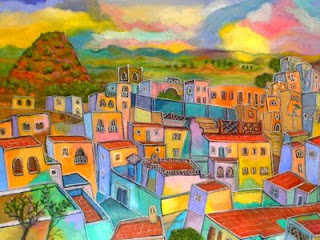 Plus a whole lot more of unusually fine painters, sculptors and so on who have come to live in this area attracted by the light, the views and the aforementioned brandy, now sadly much increased in price.
With them came the wannabes. The flip-side of the coin. The exhibitionists. The graffitists. Usually as young and callow as they are free of any suggestion of talent, they despoil and ruin anything they can. In some towns they are fined, in others, ignored.
Mojácar meanwhile continues to welcome artists (especially rich ones, it goes without saying). There is a municipal gallery and, soon, an art museum to honour the town’s recent resurgence. We also have the Delfos Gallery (with an excellent selection of paintings) and the Fundación Valparaiso. Regular exhibitions are put on at the Hotel Puntazo on the playa. Other groups, exhibitions, galleries and so on exist hereabouts, such as the Gallarte group in Los Gallardos. In Arboleas, there’s the remarkable Pedro Gilabert museum. The inland marble town of Macael is home to sculptors and hosts an annual prize exhibition. In Cuevas, the castle houses a magnificent collection of twentieth century Spanish art (Museo de Arte Contemporaneo Antonio Manuel Campoy).
And no doubt outside, on the castle walls, someone has painted with a magic marker or a spray can the lovely phrase ‘Herbert woz here’.
Painting: Isabelle Raths Webpage.
The table-topped mountain, located for some reason in ‘the Valley of the Pyramids’ (who thinks these things up?) is too steep to have ever been a village (‘I’ll just climb across the street and borrow a cup of sugar from Mrs Ughh’) and it would never have been defensible against pirates, corsairs and fifth-century al Qaida warriors and suicide bombers (which I can tell you in those days were pretty ineffectual). There’s not much point in living half way up a stand-alone mountain because, if the defences are breached, where ya gonna run to?
It must have had some other purpose: perhaps it was a religious centre of some sort, a kind of local version of Stonehenge. It certainly looks artificial; as if it was purposely built (they appear to have had rather better craftsmen in those days). If you climb to the top (crossing our land at three shillings each, children half price) you will find the flattened summit has a gigantic tank cut out of it, about five metres deep and appearing to look like an old water reservoir. But how would you fill it? There’s no spring that we know of, unless an earthquake closed it off at some point. There are signs of damage round the back of the mount apparently caused by a heavy tremor in fifteen hundred and something AD. The tank on the top of Old Mojácar is said to be Phoenician but the graffitis thoughtfully painted inside it come from the twenty-first century. You can sit on the edge of the top, with the open cargo hold in front of you, and imagine yourself on a stone barge, sailing the sky.
The mountain has been occasionally excavated, or perhaps ‘expoliated’ or even ‘sacked’, by amateur treasure hunters over the centuries. There are still lots of shards of old pottery and brick lying around among the terrace stones; together with a few of the surviving local tortoises (most were killed in the fire set in Cortijo Grande a few years back). But the large gold figurines which inevitably litter these kinds of places have all been collected and sold to the Yanks.
The process of a place-name comes from the ease of use and the imposition of the conqueror. The hill was named ‘Holy Mountain’ by the Romans, or ‘Mons Sacra’. The Moors changed the name to ‘Muxacra’ which the Christians were to pronounce later as ‘Mojácar’.
A local historian, Juan Grima, says that Mojácar has had several sites, but always in the sierras where, as he logically points out, one could always scarper in times of crisis, and where there was always a spring of fresh water available. The corsairs, you see, didn’t like to hang about for a siege so they would generally try somewhere more easy along the coast.
The cretin who painted his doodles in the mysterious old tank on the top of Old Mojácar is just one of many artists who have come here, attracted by the light, the views and the inspiration in the bottom of a bottle of cheap brandy. The first artist we know of, if not by name, was the one who put up the little stick figures with a rainbow – or whatever it is – originally called in Spanish ‘the little Mojácar man’ but much later known as ‘the Indalo’.
The Indalo
The Indalo, the name rather than the figure, was popularised by a group of artists in the nineteen fifties who settled Mojácar – or at least dropped by on weekends – called the ‘Indalianos’. The name comes from Indalecio, the first Spanish bishop, who happened to come from Urci (apparently now Benahadux) in Almería. Another suggestion, from the colourfully named ‘Flaming Turd’ (I found him on a forum called ‘Conan Completist’) suggests that during an early drinking session, while still casting about for a name for their school, one of the original group of artists noticed that a doll perched on the bar next to a bottle of really quite reasonably priced brandy, apparently distilled in a shed in Murcia, had a similar face to another member, whose name was Indalecio (in point of fact, a fairly common Almerian name). You had to have been there.
Me, I think that the name was lovingly chipped into the wall just under the cave painting in Velez Blanco. With a hammer and chisel bought from an ancestor of López.
After the Indalianos had disgustedly left Mojácar in about 1960 (undone by the march of progress in the shape of the town’s first – and for some time the only – street light), Mojácar’s artistic fortunes declined slightly until Paul Becket arrived a couple of years later, followed by Fritz Mooney, Mompó, Coronado, Roberto Puig, Juan Guirado, Brandybel, Alfredo Pirís, Félix Clemente, Luz Marquez, Peter Honey, Tony Hawker, Jean-Marc Faure, Marisol Stirling, Penny Colman and Isabelle Raths. And that’s just the ones from my collection.
 Plus a whole lot more of unusually fine painters, sculptors and so on who have come to live in this area attracted by the light, the views and the aforementioned brandy, now sadly much increased in price.
With them came the wannabes. The flip-side of the coin. The exhibitionists. The graffitists. Usually as young and callow as they are free of any suggestion of talent, they despoil and ruin anything they can. In some towns they are fined, in others, ignored.
Mojácar meanwhile continues to welcome artists (especially rich ones, it goes without saying). There is a municipal gallery and, soon, an art museum to honour the town’s recent resurgence. We also have the Delfos Gallery (with an excellent selection of paintings) and the Fundación Valparaiso. Regular exhibitions are put on at the Hotel Puntazo on the playa. Other groups, exhibitions, galleries and so on exist hereabouts, such as the Gallarte group in Los Gallardos. In Arboleas, there’s the remarkable Pedro Gilabert museum. The inland marble town of Macael is home to sculptors and hosts an annual prize exhibition. In Cuevas, the castle houses a magnificent collection of twentieth century Spanish art (Museo de Arte Contemporaneo Antonio Manuel Campoy).
And no doubt outside, on the castle walls, someone has painted with a magic marker or a spray can the lovely phrase ‘Herbert woz here’.
Painting: Isabelle Raths Webpage.
Thursday, May 21, 2009
The Real Story of Gibraltar
In the old days of a century ago, the atlases used to show a lot of pink. This was the British Empire which stretched from Henley to Hong Kong, via Australia, India, most of North America, large chunks of Africa, bits of the South Pacific, oh, and Gibraltar.
A hundred years later, the pink has shrunk to just a ghost of its former glory. There’s not much more than Pitcairn Island, Ascension Island, Diego García (no relation), Rockall, a pizza-slice of the Antarctic decided by some geographer in Greenwich, the Malvinas (where we damn’ well showed ‘em), Bédar, the Scilly Isles and the old part of Benidorm after six in the evening.
And, of course, the brightest jewel in our crown, Gibraltar.
Gib didn’t start off British. It wasn’t discovered by an Old Etonian with a rucksack and a boat-load of natives and, in a sense, it’s only ours because we asked Spain nicely when the patatas fritas were down in 1713 after the Spanish War of Succession, a conflict designed to stop the proposed union of France and Spain in 1700. The war was in essence an early attempt to control the international balance of power. Gibraltar, some pirate gold, together with a few new paintings for the National Portrait Gallery, were the rewards for the British involvement.
The treaty was knocked together by some pesky lawyers. It starts with ‘The Catholic King does hereby, for himself, his heirs and successors, yield to the Crown of Great Britain the full and entire propriety of the town and castle of Gibraltar, together with the port, fortifications, and forts thereunto belonging; and he gives up the said propriety to be held and enjoyed absolutely with all manner of right for ever, without any exception or impediment whatsoever’. No mention of an airport, a Marks and Spencers or an off-shore banking scam. But, all things considered, it was pretty much tied up in legal knots for ever.
But the lawyers couldn’t leave it there. They added a bit to keep up appearances and, well, to stand on principle.
‘And Her Britannic Majesty, at the request of the Catholic King, does consent and agree, that no leave shall be given under any pretence whatsoever, either to Jews or Moors, to reside or have their dwellings in the said town of Gibraltar.’
A bit like not letting gypsies overnight in Mojácar (which may still be on the books: it certainly was prior to Franco’s passing).
So Britain got Gibraltar and, for a while, it was a useful place to own. With a few huge guns pointed out to sea from your network of caves, you control the mouth of the Mediterranean. It was also considered as a nice little earner for Britain long before the international association of usurers and bankers showed up with their cash-boxes and sealing wax. In the mid nineteenth century, Gibraltar used to smuggle goods over to Spain (still does, come to think of it). In those days, the main product was tobacco. There was a time when fully one quarter of all baccy smoked in Spain had come into the bay in Estepona at the dead of night. The Spanish government of the day complained to their British counterpart and the governor of Gibraltar was invited to drop by Westminster pronto. ‘Smuggling has to stop’, said the minister, ‘it’s not on, old chap’. The governor disagreed, explaining how the smuggling was saving the British Treasury a fortune in aid to the Colony. The point was carried and the British Government decreed that Gibraltar would be legally empowered to continue with its activities as a smuggler.
Which just goes to show that you should never get between a politician’s money and his principles.
The Gates
Spain has been chasing after Gibraltar ever since it signed the Treaty. Talk about bad losers. According to their point of view, it used to belong to Spain, therefore it does now. A bit like, could I have my house in Vera back – the one I sold a few years ago? You see, it used to be mine! And before that, it used to belong to somebody else. The people living there now…? Well, that’s not my problem is it?
Franco was particularly keen on the Gibraltar Español thing. You’ll find a street in Almería with that name, by the way.
In the second half of the 1960s, the prime minister of Britain, an old Marxist cretin called Wilson, decided that tourists could only take fifty pounds a year out of the UK and that this must be recorded in the back of one’s passport. Even in 1967, fifty quid didn’t buy you too much, so there was a lively smuggling service going on for those of us who had fled England in search of a civilized life-style in Foreign Parts (which involved a lot of cheap drinking). We used to use the services of an Indian called Bullshand, who ran a nick-nack shop in the Gibraltar Main Street and would take an English cheque, leaving you the pesetas, less a modest commission, in a place called Jack’s Bar in Estepona (with just the faintest whiff of tobacco in every envelope). Everyone – except for the absurd Harold Wilson – was happy with this arrangement, which meant a trip down to Gibraltar every few months and the chance to stock up on tea-bags.
Then Franco locked the Spanish side of the frontier. Every day at dawn, the British soldiers would march out, tootle their trumpets and shout strange instructions to each other ‘Abaaht turn Sarnt Major’ and so on, and solemnly open their side of the border with a large iron key. A few feet away, the Spanish border guards would nonchalantly light up their Ducados and leave their gates firmly shut and bolted. A few people who were on the wrong side – one way of another – would gather and shout messages across to the other. ‘Tobacco’ and ‘Has anyone seen Bullshand’, being popular subjects.
For us, and anyone else who started out in Algeciras, it meant a trip across to the North African port of Tangiers followed by another trip back to Europe, Thanks to Franco, a three minutes walk across the frontier had become an agreeable three or four day jaunt (Tangiers was lots of fun in those days).
Gibraltar immediately turned into East London, rising to its best under the threat of invasion. Cups of tea rattled and slopped all over the colony as it was cut off from Europe. The British Government, beginning to cut back on military spending and having not the least interest in its subjects overseas, spluttered but did nothing.
Eventually, when Franco finally left this mortal coil, the siege was lifted and Gibraltar was once again open for business. Unfortunately, Wilson was long gone and money changing was just a pleasant memory.
So, should Gibraltar become part of Spain – a bit of tidying-up that wouldn’t bother Whitehall for a second? Should it remain British like that absurd island off Argentina where everyone wears Union Jacks ‘neath their shirts? There isn’t a third way unfortunately. The Treaty of Utrecht – the one that goes on about Jews and Wogs – doesn’t say anything about independence, say the Spanish, whose interest and concern for the Gibraltarians in this entire hullabaloo is palpably absent.
But let’s leave this argument with the header from a webpage written by a Gibraltarian’s (A Gibo’s Tale).
‘Gibraltar belongs to the People of Gibraltar.
It is neither Spain's to claim nor Britain's to give away!’
A hundred years later, the pink has shrunk to just a ghost of its former glory. There’s not much more than Pitcairn Island, Ascension Island, Diego García (no relation), Rockall, a pizza-slice of the Antarctic decided by some geographer in Greenwich, the Malvinas (where we damn’ well showed ‘em), Bédar, the Scilly Isles and the old part of Benidorm after six in the evening.
And, of course, the brightest jewel in our crown, Gibraltar.
Gib didn’t start off British. It wasn’t discovered by an Old Etonian with a rucksack and a boat-load of natives and, in a sense, it’s only ours because we asked Spain nicely when the patatas fritas were down in 1713 after the Spanish War of Succession, a conflict designed to stop the proposed union of France and Spain in 1700. The war was in essence an early attempt to control the international balance of power. Gibraltar, some pirate gold, together with a few new paintings for the National Portrait Gallery, were the rewards for the British involvement.
The treaty was knocked together by some pesky lawyers. It starts with ‘The Catholic King does hereby, for himself, his heirs and successors, yield to the Crown of Great Britain the full and entire propriety of the town and castle of Gibraltar, together with the port, fortifications, and forts thereunto belonging; and he gives up the said propriety to be held and enjoyed absolutely with all manner of right for ever, without any exception or impediment whatsoever’. No mention of an airport, a Marks and Spencers or an off-shore banking scam. But, all things considered, it was pretty much tied up in legal knots for ever.
But the lawyers couldn’t leave it there. They added a bit to keep up appearances and, well, to stand on principle.
‘And Her Britannic Majesty, at the request of the Catholic King, does consent and agree, that no leave shall be given under any pretence whatsoever, either to Jews or Moors, to reside or have their dwellings in the said town of Gibraltar.’
A bit like not letting gypsies overnight in Mojácar (which may still be on the books: it certainly was prior to Franco’s passing).
So Britain got Gibraltar and, for a while, it was a useful place to own. With a few huge guns pointed out to sea from your network of caves, you control the mouth of the Mediterranean. It was also considered as a nice little earner for Britain long before the international association of usurers and bankers showed up with their cash-boxes and sealing wax. In the mid nineteenth century, Gibraltar used to smuggle goods over to Spain (still does, come to think of it). In those days, the main product was tobacco. There was a time when fully one quarter of all baccy smoked in Spain had come into the bay in Estepona at the dead of night. The Spanish government of the day complained to their British counterpart and the governor of Gibraltar was invited to drop by Westminster pronto. ‘Smuggling has to stop’, said the minister, ‘it’s not on, old chap’. The governor disagreed, explaining how the smuggling was saving the British Treasury a fortune in aid to the Colony. The point was carried and the British Government decreed that Gibraltar would be legally empowered to continue with its activities as a smuggler.
Which just goes to show that you should never get between a politician’s money and his principles.
The Gates
Spain has been chasing after Gibraltar ever since it signed the Treaty. Talk about bad losers. According to their point of view, it used to belong to Spain, therefore it does now. A bit like, could I have my house in Vera back – the one I sold a few years ago? You see, it used to be mine! And before that, it used to belong to somebody else. The people living there now…? Well, that’s not my problem is it?
Franco was particularly keen on the Gibraltar Español thing. You’ll find a street in Almería with that name, by the way.
In the second half of the 1960s, the prime minister of Britain, an old Marxist cretin called Wilson, decided that tourists could only take fifty pounds a year out of the UK and that this must be recorded in the back of one’s passport. Even in 1967, fifty quid didn’t buy you too much, so there was a lively smuggling service going on for those of us who had fled England in search of a civilized life-style in Foreign Parts (which involved a lot of cheap drinking). We used to use the services of an Indian called Bullshand, who ran a nick-nack shop in the Gibraltar Main Street and would take an English cheque, leaving you the pesetas, less a modest commission, in a place called Jack’s Bar in Estepona (with just the faintest whiff of tobacco in every envelope). Everyone – except for the absurd Harold Wilson – was happy with this arrangement, which meant a trip down to Gibraltar every few months and the chance to stock up on tea-bags.
Then Franco locked the Spanish side of the frontier. Every day at dawn, the British soldiers would march out, tootle their trumpets and shout strange instructions to each other ‘Abaaht turn Sarnt Major’ and so on, and solemnly open their side of the border with a large iron key. A few feet away, the Spanish border guards would nonchalantly light up their Ducados and leave their gates firmly shut and bolted. A few people who were on the wrong side – one way of another – would gather and shout messages across to the other. ‘Tobacco’ and ‘Has anyone seen Bullshand’, being popular subjects.
For us, and anyone else who started out in Algeciras, it meant a trip across to the North African port of Tangiers followed by another trip back to Europe, Thanks to Franco, a three minutes walk across the frontier had become an agreeable three or four day jaunt (Tangiers was lots of fun in those days).
Gibraltar immediately turned into East London, rising to its best under the threat of invasion. Cups of tea rattled and slopped all over the colony as it was cut off from Europe. The British Government, beginning to cut back on military spending and having not the least interest in its subjects overseas, spluttered but did nothing.
Eventually, when Franco finally left this mortal coil, the siege was lifted and Gibraltar was once again open for business. Unfortunately, Wilson was long gone and money changing was just a pleasant memory.
So, should Gibraltar become part of Spain – a bit of tidying-up that wouldn’t bother Whitehall for a second? Should it remain British like that absurd island off Argentina where everyone wears Union Jacks ‘neath their shirts? There isn’t a third way unfortunately. The Treaty of Utrecht – the one that goes on about Jews and Wogs – doesn’t say anything about independence, say the Spanish, whose interest and concern for the Gibraltarians in this entire hullabaloo is palpably absent.
But let’s leave this argument with the header from a webpage written by a Gibraltarian’s (A Gibo’s Tale).
‘Gibraltar belongs to the People of Gibraltar.
It is neither Spain's to claim nor Britain's to give away!’
Saturday, May 16, 2009
European Elections - Ex-pat Candidates

The candidate in the upcoming European elections for the CDL, the Centro Democratico Liberal party, is Sean O'Curneen Cañas, half Irish and half Spanish. Fourth on the list, i.e. in a high enough position to make a difference, is Jacqueline Cotterill, a British long time resident of Spain and currently deputy-mayor of Parcent (Alicante). Jacqueline also works closely with the AUN, the anti property abuse association which helped instigate the ‘Auken Report’ in Brussels which heavily criticised Spain for its urban corruption, ‘illegal homes’ and ‘land grab’ issues.
The CDL is the Spanish arm of the Alliance of Liberals and Democrats for Europe (ALDE), which is the Union’s third largest political force, with 100 MEPs, 9 of the 27 EU Commissioners, 5 Prime Ministers, more than 800 elected National MP’s and thousands of Regional and Local councillors. You can see Sean’s English-language webpage at www.seanocurneen.com.
The CDL is a liberal centre party, and is where Europe needs to be to best represent all of us. It’s neither to the right like the PP (which supports 'land grab' and is immersed in a major corruption scandal at the present time), nor ‘left’ like the PSOE (which likes to knock down British owned houses and has taken away our 'residents cards'). It's a party with a couple of 'Northern Europeans' in it who would understand our concerns living here in Spain and our second-class status generally. Perhaps even do something about it.
There are of course several other alternatives to the main groups, from the Marxist Leninists, the Huntin’ Fishin’ and Shootin’ Party and the Young Fascists to the Legalise Marijuana Party and even the fascinating ‘Citizens for Blank Votes’ (who leave their envelope empty) and the ‘Overwhelmed and Annoyed Citizens Party’ ('Ciudadanos Agobiados y Cabreados’) who are principally annoyed at the justice system in Spain.
Not to mention overwhelmed.
The BBC were in Mojácar recently to record for Radio 4 some impressions regarding the European elections. I was one of those interviewed by them. They appeared to want me to say that the European Parliament was a waste of time, but I rather think the opposite. We don’t have any warm (and fuzzy) alternative any longer. The British embassy won’t represent anything beyond British exports and sporting heroes. The consulate is good for a new passport, but little else. The Spanish authorities, in their various forms, certainly don’t put us in front of any queue (note my masterly British understatement) so it’s only a strong European authority that is capable, perhaps, of protecting us. The recent Auken Report, which culminated in a vote against so-called ‘illegal homes’, the ‘land grab’ and other urban ills in Spain, sent a strong message to the Valencian and Andalucian town halls, regional governments and their many corner-cutting promoters. We need more messages in a similar vein. To do this, we must support Europe and her democratic system.
How to Vote
To vote in the European elections of June 7th, non-Spanish-born readers would need to be one of the 276,000 Europeans resident in this country who have intimated their interest in voting by signing a form when they were put on the padrón, or by having subsequently asked for one. Voting by post is difficult (you have to be somewhere in Spain), so those of us who vote will have been notified – at least in theory – as to where to go.
When you vote in Spain, you do so by choosing a party list (a ‘papeleta’) from behind the curtain and, without marking it in any way, putting it in the voter’s envelope and taking it to the desk to put in the ballot box. You will need proper identification – your ‘Residents Card’ or the famous green A4 ‘Residence Certificate’ issued by the immigration police together with your passport.
Spain, and indeed Europe, uses ‘proportional representation’ in politics so smaller parties do have a chance to get into the parliament and this is useful as minority concerns can then be aired in a public way.
An ex-pat candidate… imagine such a thing. A candidate, or better still, an MEP, who actually represents and understands the large number of Northern Europeans who reside in Spain. Such a person could be our champion. Taking our problems to the floor of the European parliament.
This reporter, like several major grass-roots associations (including the AUN and the Andalucian pressure group A3V), supports the CDL and notes that neither the Conservatives Abroad nor their rivals the International Labour Party, concerned no doubt by issues of corruption and the endemic lack of support over European residents’ rights in Spain, openly recommend their associate parties in Spain in the European Elections.
*Six min radio interview with Sean O'Curneen (free to use) here.
Tuesday, May 12, 2009
Dumb Critters
There’s a leading stop-the-press story in one of our crappier free-sheets this week along the lines of… ‘Brave Woman Foils Puppy Killers’. Yes, this week we give you the fiend in human form who kills a certain number of puppies in either a barbaric or reasonably painless way. Or doesn't, perhaps.
You see, I never read the article.
Mind you, knowing our friends the Spanish and their approach to animals, together with the Brits and their approach to any (preferably house-trained) woolly four-legged creature, it could have gone either way.
Which is why Zapatero and the 'crisis' got chucked off the ‘news’.
It’s a funny thing, the British love of domestic animals. They are elevated out of their place as dogs, cats or guinea-pigs and instead they become much loved companions. It’s like that in my house, ‘don’t forget to buy cat-food’ shouts Mrs Rambeau as I’m backing out of the parking lot to go and have a beer. The cats’ food (as far as I’m concerned) trilling thoughtlessly in the tree above having just made a poop on the bonnet of the car. ‘And lavatory-paper, while you’re at it’ she adds, confusingly.
We have cats and dogs and rabbits and birdies and, new to the menagerie, two young chickens I bought from the feed-store in Turre the other week. Now, finally, a useful animal: one that lays eggs.
We’ve had endless pets over the years and my fondest hope is that, when I am finally pushed off the cliff by fate and zoom off to my place in the sky, I don’t find them all waiting for me. Where would you start? ‘Oh Freckles, there you are, and Digby and Snowy and Archie and Little Boy Kitty and Tootles and Beetroot and Frixtu…’
On consideration, it probably wouldn’t be a good thing to find all my old girlfriends waiting there either (I really wouldn’t want to forget any of their names as I’m told that one’s Reward apparently lasts for a real long time).
It’s odd how we fawn over animals. The biggest charities among the British ex-pat populations the world over are invariably to do with critters. Forget the Vietnamese waifs and the starving millions. Huge amounts of time and money are spent on saving dogs, castrating cats, shoving suicidal whales back into the sea and clubbing together against clubbing baby seals in Canada. We have those PETA ladies with their jolly campaigns (which involve pulchritude and nakedness in an agreeable combination), we have the anti-bullfight gang and the British Woodworm Society and its sterling work with our six-legged friends.
A Spaniard was complaining bitterly about the English the other day. It appeared that his tom cat had gone out for a stroll and had tottered back home two days later with a dirty bandage where its balls used to be. He said that it wasn’t that he was worried about his cat, but since he lived in a mainly British neighbourhood, he had become a bit concerned about going out after six o’clock himself.
Down on the coast, there’s a gang of feral ladies that roam about at will, yawling and gibbering under the full moon. They leave food out for our growing population of wild cats. Is there nothing to be done?
But the Spanish are far more pragmatic about animals. Stick a gaily coloured spear into them being the basic point to start from. Shoot, eat, stomp, kick and, if that doesn’t work, run ‘em over. Nothing, it appears, is safe. While Paws lieutenants are vainly trying to give mouth to mouth to a three-legged dog with rabies, scabies and what can only be described as a poor character in the hope of giving it an extra twenty years of life; our neighbour will be tying a suspiciously short piece of rope around its sibling’s neck somewhere close to a remarkably tall tree. Another neighbour, let’s call him Juan, will be crouched inside a crudely-made ‘hide’, fingering his daddy’s blunderbuss as his pet perdíz squawks dismally from its tiny cage. You’ve seen the little black and white triangles or the words ‘coto privado’ – private hunting. That’ll be the neighbours blasting away at anything that moves.
Then there’s the annual ‘matanza’, when the pig from across the street has its throat cut outside the kitchen door by someone who you had previously considered to be a game old bird always dressed in black and invariably kind to small children. No wonder they never gave it a name.
In fact, I’ve noticed this seeming cruelty for all animals is also extended to plant life. I remember the gardener who used to spray my mother’s flower beds with his finger over the end of the hose, giving it some punch. He’d blow off the flowers themselves and tell my mum that it was nature’s way. His view was that if it wasn’t edible, there wasn’t much point in growing it in the first place (an opinion I’m slowly coming around towards as well). He never pruned as much as lopped. A tree would have a razor-cut: no branches left and just the suspicion that maybe this bald trunk pointing mutely to the heavens might one day produce a small green shoot somewhere along its length.
Years later and freed from the ravages of our expert topiarist, we now have a luxuriantly overgrown garden, full of all sorts of giant weeds and proper animals, like tree-rats, doves, sparrows and tortoises.
All apparently quite inedible.
You see, I never read the article.
Mind you, knowing our friends the Spanish and their approach to animals, together with the Brits and their approach to any (preferably house-trained) woolly four-legged creature, it could have gone either way.
Which is why Zapatero and the 'crisis' got chucked off the ‘news’.
It’s a funny thing, the British love of domestic animals. They are elevated out of their place as dogs, cats or guinea-pigs and instead they become much loved companions. It’s like that in my house, ‘don’t forget to buy cat-food’ shouts Mrs Rambeau as I’m backing out of the parking lot to go and have a beer. The cats’ food (as far as I’m concerned) trilling thoughtlessly in the tree above having just made a poop on the bonnet of the car. ‘And lavatory-paper, while you’re at it’ she adds, confusingly.
We have cats and dogs and rabbits and birdies and, new to the menagerie, two young chickens I bought from the feed-store in Turre the other week. Now, finally, a useful animal: one that lays eggs.
We’ve had endless pets over the years and my fondest hope is that, when I am finally pushed off the cliff by fate and zoom off to my place in the sky, I don’t find them all waiting for me. Where would you start? ‘Oh Freckles, there you are, and Digby and Snowy and Archie and Little Boy Kitty and Tootles and Beetroot and Frixtu…’
On consideration, it probably wouldn’t be a good thing to find all my old girlfriends waiting there either (I really wouldn’t want to forget any of their names as I’m told that one’s Reward apparently lasts for a real long time).
It’s odd how we fawn over animals. The biggest charities among the British ex-pat populations the world over are invariably to do with critters. Forget the Vietnamese waifs and the starving millions. Huge amounts of time and money are spent on saving dogs, castrating cats, shoving suicidal whales back into the sea and clubbing together against clubbing baby seals in Canada. We have those PETA ladies with their jolly campaigns (which involve pulchritude and nakedness in an agreeable combination), we have the anti-bullfight gang and the British Woodworm Society and its sterling work with our six-legged friends.
A Spaniard was complaining bitterly about the English the other day. It appeared that his tom cat had gone out for a stroll and had tottered back home two days later with a dirty bandage where its balls used to be. He said that it wasn’t that he was worried about his cat, but since he lived in a mainly British neighbourhood, he had become a bit concerned about going out after six o’clock himself.
Down on the coast, there’s a gang of feral ladies that roam about at will, yawling and gibbering under the full moon. They leave food out for our growing population of wild cats. Is there nothing to be done?
But the Spanish are far more pragmatic about animals. Stick a gaily coloured spear into them being the basic point to start from. Shoot, eat, stomp, kick and, if that doesn’t work, run ‘em over. Nothing, it appears, is safe. While Paws lieutenants are vainly trying to give mouth to mouth to a three-legged dog with rabies, scabies and what can only be described as a poor character in the hope of giving it an extra twenty years of life; our neighbour will be tying a suspiciously short piece of rope around its sibling’s neck somewhere close to a remarkably tall tree. Another neighbour, let’s call him Juan, will be crouched inside a crudely-made ‘hide’, fingering his daddy’s blunderbuss as his pet perdíz squawks dismally from its tiny cage. You’ve seen the little black and white triangles or the words ‘coto privado’ – private hunting. That’ll be the neighbours blasting away at anything that moves.
Then there’s the annual ‘matanza’, when the pig from across the street has its throat cut outside the kitchen door by someone who you had previously considered to be a game old bird always dressed in black and invariably kind to small children. No wonder they never gave it a name.
In fact, I’ve noticed this seeming cruelty for all animals is also extended to plant life. I remember the gardener who used to spray my mother’s flower beds with his finger over the end of the hose, giving it some punch. He’d blow off the flowers themselves and tell my mum that it was nature’s way. His view was that if it wasn’t edible, there wasn’t much point in growing it in the first place (an opinion I’m slowly coming around towards as well). He never pruned as much as lopped. A tree would have a razor-cut: no branches left and just the suspicion that maybe this bald trunk pointing mutely to the heavens might one day produce a small green shoot somewhere along its length.
Years later and freed from the ravages of our expert topiarist, we now have a luxuriantly overgrown garden, full of all sorts of giant weeds and proper animals, like tree-rats, doves, sparrows and tortoises.
All apparently quite inedible.
Friday, May 08, 2009
Trust us on Geography (at least)

There we are just setting out on Km0 on the road - apparently - from Tabernas to Garrucha. Nice day for a drive. That's Mojácar in the distance.
Only thing, this Junta de Andalucía managed road doesn't go from Tabernas (the place where they used to make all those Spaghetti Westerns) to the delightful fishing port of Garrucha. It goes from Los Gallardos. Tabernas is forty kilometres away.
Now the thing that worries us natives about the Junta de Andalucía, based as it is in Seville, over five hours of hard driving from here, and clearly not much good on basic geography - even on the bits that they own and control - is that it has some huge plans for our quiet area.
First of all, there will be a high-speed train whizzing through just in front of where we are standing with the photographer, having a smoke. This is the AVE, which will unite Almería with Murcia (despite the apparent low demand from the burghers of those two cities to have anything to do with each other). Jolly modern though, hugely expensive and, if Spain wasn't a supremely honest country when it came to commissions, very remunerative for a few jokers down there in our regional capital.
Then, to cheer us up, and supposing they can find us on the map, the Junta fellows are going to build a special AVE train station (for those of us who want to go to Murcia or Almería - not, of course some pueblo ten minutes up the line) in a creek somewhere over there to the left towards Vera.
It takes a long time for a high speed train to slow down and stop... have a fellow in a zippy uniform shout 'aaaall aboaaard', wave a flag and then speed up and awaaaay, the municipal band tootling, so you obviously need a few more passengers than just the one stereotyped old girl dressed in black clutching a chicken. So the Junta chappies have decided to build a town - well, a city really - over there on the left. On 55 million hectares, or 55 square kilometres of scrub. 35,000 houses, fifty hotels, golf courses coming out of the kazoo, parks, roads and all the usual things. Here - why not a few more of those public heated indoor swimming pools none of our local towns can afford to run? A convention centre maybe. How about an interplanetary flying saucer landing-port.
The 35,000 houses, 50 hotels etc will generate 130,000 jobs. Which is great since there are only around 40,000 of us within half an hour's drive (not including those who live in Tabernas) so we shall all have three jobs each.
The Junta geniuses meanwhile will have to find the people who want to live in those 35,000 houses (perhaps this is why they are making all the English-owned homes in the province illegal). The hotels, too, may prove a problem since they won't be on the beach and, believe you me, you can only spend so much time watching a high-speed train as it zooooms past.
Saturday, May 02, 2009
The Levante Almeriense

Isn't that a beaut? The map comes from about 1988 and was flashed around in the FITUR (international tourist fair) in Madrid. It shows all of our cute little villages and... oh oh, hold on... one of them is missing!
That's right, the place that is (or was when we started) the most famous destination in Almería, bigger that the province it's located in, known throughout the world for its high times, attractive pueblo, sandy beaches and jolly bars and restaurants, is unaccountably missing from the tourist map for the eastern part of the province.
Mojácar, where art thou?
Turns out, the tourist councillor from the time, fresh from having just got rid of our famous totem, the Indalo (the stick man holding a rainbow), by allowing the provincial tourist board to adopt it, also decided that our town would not go in with its share of the printing for the above leaflet. So, we got left out.
Which is why, Dear Reader, you can't leave important things like promoting one's tourist resort, to idiots!
Tuesday, April 28, 2009
I’ve been dubbed, subtitled and translated into sign-language

It seems that we can blame that old sod Franco for the size of the Spanish dubbing industry. Where other countries tamely put subtitles on their cinema or television screens, the Spanish are much more partial to James Dean’s mouth making a ‘hi’ movement as a strange and gravely Madrid voice says ‘hola, ¿que tal?’ Sometimes, they don’t even remove the original soundtrack – just turn it down with the Spanish version bellowed out on top. There’s David Attenborough telling us about snakes in his whispery voice – which at least this viewer can – or could understand – if it wasn’t for the same bloke from Madrid thundering out something about serpientes venenosas rendering the whole thing impossible to understand in any language.
Franco didn’t approve of foreign languages – Basque and Catalonian of course – but anything else either. They might be saying something untoward, immoral or revolutionary. So he banned them. No one was to speak anything but Spanish – including the nation’s deaf, who were not allowed to use sign-language (and even today they sign in a rather furtive sort of way, as if they are still on the look out for a Guardia Civil).
So, forget subtitles, everything imported had to be dubbed. Except, come to think of it, pop music. It would have been a stretch having our friend from Madrid crooning ‘she loves yer ya ya ya’ in castellano over the Beatles. Can’t see many people buying the record either. Anyway, in some cases, films were translated away from their original meaning – if immoral or faintly subversive – and represented in a more acceptable light ‘she’s my girlfriend’, for example, might become ‘she’s my fiancée’. Of course, if the film strayed to far from the Catholic Church’s view of morality, or the Government’s view of political propriety, it would never be shown here anyway. Which is why everyone had to drive up to Perpignan to see Marlon Brando’s ‘Last Tango in Paris’ and why they currently sell porn films (apparently by the lorry-load) out of Spanish gas stations.
But, going back to dubbing. Televisions now have this special button for those who wish to see something in its ‘versión original’. Press it and – whoops – up’ll come David in all his glory, except for anything from the BBC (David again) which won’t for, no doubt, copyright reasons. Bloody nuisance. The National Geographic channel has the choice of Spanish or English, but the Documanía channel next to it on the dial has Spanish or Portuguese – even though most of the material is American. Most peculiar. Some comedies – such as Frasier on Canal Plus – have the original version wiped, and as anyone who has seen a comedy in translation, you know that the jokes don’t always make it past the dictionary. On the ordinary bog-standard television, several channels operate the original language knob, but you have to re-tune it after every commercial interruption (which, in Spain, is about every five minutes). Read a book, why don’cha?
In Madrid, there are a few cinemas that show films in ‘V.O.’ with subtitles, usually lowbrow comedies. They do well with the American students.
Well, at least the Continentals are prepared to look at foreign cinema, as well as their own (and the Spanish make quite respectable movies). In Britain, we think that everything good, if not ours, comes from Hollywood. When was the last time you saw a French film, an Italian TV show or a Spanish documentary? Bloody Americans – if there’s a decent European film out there, they’ll churn out a re-make (gotta have that Tom Cruise as the Good German who wants to murder Hitler).
In Greece or Portugal or Denmark or Poland (well, I’m guessing about Poland to be frank), you’ll sit down with the local version of popcorn and watch the movie in its original language, the subtitles wobbling there at the bottom of the screen and – in the Mediterranean cinemas at least – with the entire audience talking at once.
I suppose dubbing can be useful. The first thing I learnt in Spanish was ‘Hands up’, which I have to admit that I’ve still yet to use in my private capacity. A German friend once told me that he’d learnt English from listening to pop music. Apart from coming out with some odd expressions occasionally ‘(‘Baby, light my fire’, ‘you’re my Rockafella’ and so on), he managed a certain fluency without, apparently, an undue amount of effort. Perhaps some of my readers might want to follow his example and start practicing singing along to Miguel Ríos or Camilo Sesto (If I were you, I’d save the Flamenco until a bit later).
So the dubbing industry, started and encouraged by Franco, had, by the time of his death, become so powerful (in a relatively small field) that it has managed to continue on into modern times.
Where you won’t find it, of course, is in politics. While Carod Rovira, a Spaniard who is powerful in Catalonian politics, won’t speak in Spanish on Spanish television (for which, the American expression ‘go figure’ seems remarkably apt); he drones on in Catalonian – apparently with a slight Spanish accent – and is subtitled by the news channel. Since he’s talking a lot of independence stuff, no one bothers to read what he says.
Curiously though, when he – or any other Catalonian politician - wants to appeal to the larger public about something other than politics, why, he’ll address us in Spanish. This does not happen in the Basque County, however, where all declarations, political or otherwise, are made in Spanish. Perhaps they don’t have a good subtitling service there…
Saturday, April 18, 2009
Future Imperfect
‘So what do we want the future of our town to be like?’ I asked the founding members of the latest version of our chamber of commerce. ‘We can have tee-shirt shops and bus loads of tourists, fancy hotels and convoys of BMWs or lots of satisfied residents living in peace and tranquillity’.
Behind me, a champion of the tee-shirt school of thought got to his feet. ‘We need more tourists and we need to bring them in through aggressive advertising and promotion,’ he said. Paid for, no doubt, by thee and me.
The occasion was a meeting in a local hotel. We were about thirty, divided as always in ex-pat Spain by the twin curses of monolinguality and self-interest. The local people consider that the town is for their exclusive use and that the visitors here (even those who are third generation) have as few rights and opportunities as possible.
Our town is beautiful. It’s a white cubist village with narrow walking streets, which has adorned the top of a hill overlooking the sea since the dawn of time. It had almost disappeared, falling into rubble and abandonment, by the mid to late fifties and only the arrival of artists, followed by settlers from elsewhere during the following decade, allowed the village to re-group, and those of its citizens who had moved away to France, Germany or beyond, to consider returning. At least to sell off a few plots.
So it began. The older kids had inherited the agricultural lands – land where the water was no longer arriving. Many of them had left for better opportunities elsewhere. The second-born got the worthless beach-land, where no one lived, no one fished and no one went.
Now, years later, the greed has set in. The village overlooks seventeen kilometres of beach, strung out beside a narrow and poorly planned road with no possibility of widening it and equally no chance of building a parallel road to relieve the increasing traffic density. The tourist hotels don’t really work in the town’s benefit as their visitors aren’t going to walk very far along the thin coastal strip, and because the hotels themselves, having been forced to make cut-throat offers, don’t want their customers to leave the premises. If they are going to drink, by Golly, they’ll do it here.
Bad news for our eight hundred bars and restaurants.
Since builders make better money off apartments than they do houses, our town has built an endless number of small, ugly and, by necessity, cramped apartments that are, inevitably, used only a few weeks of the year. Our eight hundred bars and restaurants mentioned above are therefore beholden to the year-long residents who either live in the reduced number of houses that the town possesses or, if they are in those small apartments – usually paying quite ferociously high rents - they probably can’t afford to go out anyway. The best return on one’s buck for the builders (and the corrupt officials who sign them off), being apartments, then the worst return is parking spaces, roads and gardens. As far as the first two go, there are never enough parking spaces, which mean that there are never enough places for the customers to leave their cars (I have to spell it out here), which in turn means that the eight hundred bars and restaurants (many of whom also pay a cripplingly high rent) don’t get enough customers. I usually drive up to the pueblo for dinner; drive around looking for a space without success… and then motor on inland to the next town.
I’m sorry, I was hungry.
The narrow roads, which kink and higgle n’ piggle around the different borders and narrow pavements, are usually too tight for two cars to pass, or one to park. Nice planning from the tee-shirt shop philosophers who, unfortunately, have run the town hall for the past thirty years.
Teddy bears, humorous ashtrays, wobbly pots, rag throw-rugs and vulgar tee-shirts: Louche shops selling tourist-tat. Where are the theatres and the noble buildings? Why haven’t the wealthiest (and, trust me, they’re wealthy!) local families donated as much as a wooden bench to their community in all these years?
I turned to the chap who wanted busloads of tourists – one can only imagine that his interest was in his three-storey emporium – and asked him if his new shop (his old one had tragically burnt down last summer) would be a fraction less ugly than its predecessor. ‘Oh’, he said, ‘I don’t know, you’ll have to ask the architect’.
‘¡Ay Pobre Mojácar! La tratamos como una vieja puta. Todos querremos joderla y nadie quiere comprarla flores’: Poor old Mojácar, we treat her like an old whore. All we wanna do is fuck her. No one wants to buy her flowers.
Behind me, a champion of the tee-shirt school of thought got to his feet. ‘We need more tourists and we need to bring them in through aggressive advertising and promotion,’ he said. Paid for, no doubt, by thee and me.
The occasion was a meeting in a local hotel. We were about thirty, divided as always in ex-pat Spain by the twin curses of monolinguality and self-interest. The local people consider that the town is for their exclusive use and that the visitors here (even those who are third generation) have as few rights and opportunities as possible.
Our town is beautiful. It’s a white cubist village with narrow walking streets, which has adorned the top of a hill overlooking the sea since the dawn of time. It had almost disappeared, falling into rubble and abandonment, by the mid to late fifties and only the arrival of artists, followed by settlers from elsewhere during the following decade, allowed the village to re-group, and those of its citizens who had moved away to France, Germany or beyond, to consider returning. At least to sell off a few plots.
So it began. The older kids had inherited the agricultural lands – land where the water was no longer arriving. Many of them had left for better opportunities elsewhere. The second-born got the worthless beach-land, where no one lived, no one fished and no one went.
Now, years later, the greed has set in. The village overlooks seventeen kilometres of beach, strung out beside a narrow and poorly planned road with no possibility of widening it and equally no chance of building a parallel road to relieve the increasing traffic density. The tourist hotels don’t really work in the town’s benefit as their visitors aren’t going to walk very far along the thin coastal strip, and because the hotels themselves, having been forced to make cut-throat offers, don’t want their customers to leave the premises. If they are going to drink, by Golly, they’ll do it here.
Bad news for our eight hundred bars and restaurants.
Since builders make better money off apartments than they do houses, our town has built an endless number of small, ugly and, by necessity, cramped apartments that are, inevitably, used only a few weeks of the year. Our eight hundred bars and restaurants mentioned above are therefore beholden to the year-long residents who either live in the reduced number of houses that the town possesses or, if they are in those small apartments – usually paying quite ferociously high rents - they probably can’t afford to go out anyway. The best return on one’s buck for the builders (and the corrupt officials who sign them off), being apartments, then the worst return is parking spaces, roads and gardens. As far as the first two go, there are never enough parking spaces, which mean that there are never enough places for the customers to leave their cars (I have to spell it out here), which in turn means that the eight hundred bars and restaurants (many of whom also pay a cripplingly high rent) don’t get enough customers. I usually drive up to the pueblo for dinner; drive around looking for a space without success… and then motor on inland to the next town.
I’m sorry, I was hungry.
The narrow roads, which kink and higgle n’ piggle around the different borders and narrow pavements, are usually too tight for two cars to pass, or one to park. Nice planning from the tee-shirt shop philosophers who, unfortunately, have run the town hall for the past thirty years.
Teddy bears, humorous ashtrays, wobbly pots, rag throw-rugs and vulgar tee-shirts: Louche shops selling tourist-tat. Where are the theatres and the noble buildings? Why haven’t the wealthiest (and, trust me, they’re wealthy!) local families donated as much as a wooden bench to their community in all these years?
I turned to the chap who wanted busloads of tourists – one can only imagine that his interest was in his three-storey emporium – and asked him if his new shop (his old one had tragically burnt down last summer) would be a fraction less ugly than its predecessor. ‘Oh’, he said, ‘I don’t know, you’ll have to ask the architect’.
‘¡Ay Pobre Mojácar! La tratamos como una vieja puta. Todos querremos joderla y nadie quiere comprarla flores’: Poor old Mojácar, we treat her like an old whore. All we wanna do is fuck her. No one wants to buy her flowers.
Tuesday, April 14, 2009
The First Swim
The weather is just perfect for an early-year swim in the sea. Perhaps if I didn’t live here I would take up my own kind offer and jump off a handy rock and splash about for a bit before staggering out for a refreshing glass of tinto de verano, easy on the ice. However, since I do live here, I tend to forgo the splashy stuff and get straight in to the bar for my order. I mean, it’s still too cold for us thin-blooded locals, and anyway, come to think of it, I haven’t swum in the sea besides a couple of ill-considered visits after an extended lunch for about twenty years.
I may have a very slight case of hydrophobia, the fear of water, which is apparently a side effect of rabies. As far as I know, no other signs of this dreadful plague are in evidence on my person and I wonder if it might just be a minor and slow-moving dose that I might have picked up that time I was savaged by a bad-tempered vole which I was attempting to attach to a hanky prior to parachuting the rodent from the roof of the family pile while I was still of a tender age. Still, forty years on and I’m still going strong, no twitches or obvious widow’s peak, although I do like to keep the windows open during the full moon.
The sea is protected by ‘Costas’, a selfless organisation that makes sure that the primal brine isn’t sullied by anything beyond an occasional bather while the pristine sands of the coast are free from skyscrapers, dog messes, barns, garages, piers (a huge no-no) and, above all, any suggestion of permanence from those temporary ‘dismountable’ buildings which we call ‘beach bars’. Anything really beyond a happy sprinkling of ‘Blue Flags’ which denote ‘excellence’ in the beach facilities, cleanliness, showers and wheelchair access together with no interference in Mother Nature’s soft and salty embrace. So protected is the sea these days, that I wonder exactly what the showers are for – are they like swimming-pool showers, where you are meant to wash yourself down before getting in so as to keep the water clean? Apparently, the ‘Costas’ people have decreed that any tussocks of grass which grow on the sand, or any seaweed washed up onto the shore, can’t be removed by the local town halls (except after midnight when the ecologists are all tucked up asleep on their futons). In short, the sea and the beach belong to us all, are to be left au naturel, and we have free access and use for all its treasures, except when told differently.
The other day, I took the dog down to one of those ‘unimproved’ beaches along the coast a way. No metal benches, beach bars, life savers, peculiar white-painted cabins – with the inevitable ‘Goofy was here’ graffiti: no football or beach-ball courts, no playpens, swings or broken whirly-things, no flags, dustbins, informative signs in three languages, showers, accordionists, tulip-vendors or public lavatories. Just a few of those highly colourful motor-caravans as favoured by the wealthy trekkers from the far north that the police are now talking about fining after three days camping outside of the ‘approved areas’. Peaceful. I even anticipated seeing a few dolphins near the shore nodding and squeaking at us. They’re asking for fish really.
My dog seemed to be happy enough with the lack of clutter on that particular beach and ran about chasing pebbles and bits of flying seaweed (oops!). I took my socks off.
Things went well until I began to drive home with the window up to stop the cloud of sand and dust thrown by the wheels. The car stank of warm and wet hound and the thunderhead of dust, it turned out, upset a group of hiking Germans dressed in old-fashioned shorts who were coming the other way, intent on invading the next-door beach. Boy, did I get an earful.
On reflection, I should have been carrying a Blue Flag.
I may have a very slight case of hydrophobia, the fear of water, which is apparently a side effect of rabies. As far as I know, no other signs of this dreadful plague are in evidence on my person and I wonder if it might just be a minor and slow-moving dose that I might have picked up that time I was savaged by a bad-tempered vole which I was attempting to attach to a hanky prior to parachuting the rodent from the roof of the family pile while I was still of a tender age. Still, forty years on and I’m still going strong, no twitches or obvious widow’s peak, although I do like to keep the windows open during the full moon.
The sea is protected by ‘Costas’, a selfless organisation that makes sure that the primal brine isn’t sullied by anything beyond an occasional bather while the pristine sands of the coast are free from skyscrapers, dog messes, barns, garages, piers (a huge no-no) and, above all, any suggestion of permanence from those temporary ‘dismountable’ buildings which we call ‘beach bars’. Anything really beyond a happy sprinkling of ‘Blue Flags’ which denote ‘excellence’ in the beach facilities, cleanliness, showers and wheelchair access together with no interference in Mother Nature’s soft and salty embrace. So protected is the sea these days, that I wonder exactly what the showers are for – are they like swimming-pool showers, where you are meant to wash yourself down before getting in so as to keep the water clean? Apparently, the ‘Costas’ people have decreed that any tussocks of grass which grow on the sand, or any seaweed washed up onto the shore, can’t be removed by the local town halls (except after midnight when the ecologists are all tucked up asleep on their futons). In short, the sea and the beach belong to us all, are to be left au naturel, and we have free access and use for all its treasures, except when told differently.
The other day, I took the dog down to one of those ‘unimproved’ beaches along the coast a way. No metal benches, beach bars, life savers, peculiar white-painted cabins – with the inevitable ‘Goofy was here’ graffiti: no football or beach-ball courts, no playpens, swings or broken whirly-things, no flags, dustbins, informative signs in three languages, showers, accordionists, tulip-vendors or public lavatories. Just a few of those highly colourful motor-caravans as favoured by the wealthy trekkers from the far north that the police are now talking about fining after three days camping outside of the ‘approved areas’. Peaceful. I even anticipated seeing a few dolphins near the shore nodding and squeaking at us. They’re asking for fish really.
My dog seemed to be happy enough with the lack of clutter on that particular beach and ran about chasing pebbles and bits of flying seaweed (oops!). I took my socks off.
Things went well until I began to drive home with the window up to stop the cloud of sand and dust thrown by the wheels. The car stank of warm and wet hound and the thunderhead of dust, it turned out, upset a group of hiking Germans dressed in old-fashioned shorts who were coming the other way, intent on invading the next-door beach. Boy, did I get an earful.
On reflection, I should have been carrying a Blue Flag.
Friday, April 10, 2009
Sports Night

The Spanish have a lively interest in something called the NBA, the American basketball league. We have it stuffed down our throats every time we switch on the telly or pick up a newspaper. The reason for this is because there are three very tall Spaniards who play in different Yankee teams. One of the players is called Pau Gasol and he plays, I believe, for the Lakers. I hope any red-blooded American readers of this blog are suitably impressed. Our boys beating you at your game. Oh, the irony. Mind you, one can’t help wondering if, in the happy event that there were no very tall Spaniards galloping about on a hard-floor in Denver and scoring hoops or baskets (or whatever) every five seconds, then we wouldn’t be subjected to being obliged to watch this peculiar game with quite the same fervour. But then, who’s to know. Tonight, on the other TV channels – the ones that aren’t showing football or golf or tennis – we are swamped for choice between (and I’m not making this up) a Hollywood weeper about an ‘American Football player’ who finds a small child on his step and, I’m wiping away a tear as I write this, finds some classy form of redemption; and another film on Channel Five about another ‘American Football player’ who, for a change, befriends a disabled black kid who – well, I won’t spoil the plot for you.
In Spain, if you go out for a beer on a football ('soccer') night, which is essentially almost any night of the week, then there will be lots of bars with big-screen televisions to choose from, pumping out as loud as possible the entire enervating and nerve-wracking game for their customers' pleasure; and around the corner there will be other places, quieter, full of what are known as football widows. And people like me.
Between Spain’s fervent love of watching soccer at the drop of a beer-mat, a game as ephemeral in its importance as a weather forecast, or the paeans of praise tossed – or rather ‘lobbed’ - onto the shoulders of the NBA star Pau Gasol (he’s probably Catalonian), I think that we should give thanks that no one has ever moved from Spain to New Zealand… and joined a cricket team.
Tuesday, April 07, 2009
A Town Divided
Someone has posted a thread on a local forum suggesting that our mayoress is a racist.
We live in a town of between eight and ten thousand inhabitants on the coast of Spain. It’s a cosmopolitan place and many extranjeros – foreigners – have come to settle here over the past forty years, attracted by its beauty, its bohemian lifestyle and its prices. All three qualities have since been watered down, of course, by the resulting nouvelle bourgeoisie, but we stay, victims of our own excesses. Too many four-wheel drives these days and not enough (indeed, any) donkeys. The settlers now outnumber the locals and, if all of us bothered to register with the town hall (hence the variance between the population numbers), we would probably run to about 65% or 70% of the entire population.
Our town can be divided into three groups. Local people; forasteros (a relatively small number of Spaniards from the rest of Spain) and extranjeros. As far as natural alliances go – if it wasn’t for the language problem – you could say that the forasteros and extranjeros are in the same boat. If there’s a pie, public money or jobs to be had, then the town hall and the mayoress, like the mayors before her, is definitely not going to share it round outside the immediate circle of the village-folk. The non-local Spaniards know this and they know how to circumvent most problems thrown at them. After all, who in Spain doesn’t number a judge, a lawyer, a politician, a bank-manager or a policeman among his cousins? The foreigners, unfortunately, have few or no good contacts and often are even unaware of the non-level playing field that they have elected to live on. While the local politicians routinely buy votes for a few hundred euros each, making a mockery of the democratic process, many of the foreigners refuse to join in or belong. ‘We don’t know the issues’ they say pathetically.
One day, we should all rise up and boycott the local businesses, just to show our strength; but as someone remarks on the same thread on the abovementioned forum, most of the foreigners here wouldn’t want to do such a thing. After all, they say weakly as they finger their little yellow triangles, it’s not our place… all things considered, we’re just guests here.
Which is why, dear friends, our mayoress is the way she is. She has nothing to fear from us.
We live in a town of between eight and ten thousand inhabitants on the coast of Spain. It’s a cosmopolitan place and many extranjeros – foreigners – have come to settle here over the past forty years, attracted by its beauty, its bohemian lifestyle and its prices. All three qualities have since been watered down, of course, by the resulting nouvelle bourgeoisie, but we stay, victims of our own excesses. Too many four-wheel drives these days and not enough (indeed, any) donkeys. The settlers now outnumber the locals and, if all of us bothered to register with the town hall (hence the variance between the population numbers), we would probably run to about 65% or 70% of the entire population.
Our town can be divided into three groups. Local people; forasteros (a relatively small number of Spaniards from the rest of Spain) and extranjeros. As far as natural alliances go – if it wasn’t for the language problem – you could say that the forasteros and extranjeros are in the same boat. If there’s a pie, public money or jobs to be had, then the town hall and the mayoress, like the mayors before her, is definitely not going to share it round outside the immediate circle of the village-folk. The non-local Spaniards know this and they know how to circumvent most problems thrown at them. After all, who in Spain doesn’t number a judge, a lawyer, a politician, a bank-manager or a policeman among his cousins? The foreigners, unfortunately, have few or no good contacts and often are even unaware of the non-level playing field that they have elected to live on. While the local politicians routinely buy votes for a few hundred euros each, making a mockery of the democratic process, many of the foreigners refuse to join in or belong. ‘We don’t know the issues’ they say pathetically.
One day, we should all rise up and boycott the local businesses, just to show our strength; but as someone remarks on the same thread on the abovementioned forum, most of the foreigners here wouldn’t want to do such a thing. After all, they say weakly as they finger their little yellow triangles, it’s not our place… all things considered, we’re just guests here.
Which is why, dear friends, our mayoress is the way she is. She has nothing to fear from us.
Subscribe to:
Posts (Atom)