I was reading Laurie Lee, who left the UK at the age of 19 to walk
across Spain from Vigo to Almuñecar, a town outside Málaga, back in
1935. All he had with him was a violin, and he lived by begging for his
keep.
A peseta, a piece of fruit, a glass of brandy (it was cheap in those
days), anything for a merry tune from his fiddle. He managed the trick
and wrote his ‘As I Walked Out One Midsummer Morning’, a book which ends
with his rescue by a British naval vessel out of Gibraltar just as the
uprising by the Nationalists starts in July 1936: the beginning of the
Spanish Civil War.
But we were talking about begging. Laurie Lee would play the tunes
that worked the best with his audience, and knew to leave a few copper
pennies in his open cap pour encourager les autres. He hadn’t
caught on to the idea of looking sad and tragic, nor sitting slumped
outside a supermarket, nor indeed of having a doggy to hand to awaken
the charity of – at least - the British passers-by.
I look at these wretches – they are the same ones, at the same exits
to the food-stores until death they do part – and think, if that was me
sat on a cushion, staring tragically at my coppers in a plastic box,
would they, passing by in my place, leave me a few pennies out of
charity? Probably not.
But how to increase the yield? One American I knew told me he would
wear a suit when begging, after all, how can you give a small coin to a
panhandler dressed like a bank manager?
Another thing for beggars to know – never whip out an iPhone for a
bit of quiet surfing. It sends the wrong message to the punters.
My late wife would say that she would only give to those beggars who
were doing something. Like standing on their head or playing an
instrument (happily, she never saw that Romanian who used to perform
‘Spanish Eyes’ over and over again, being the only tune he’d ever
learned to play on the accordion).
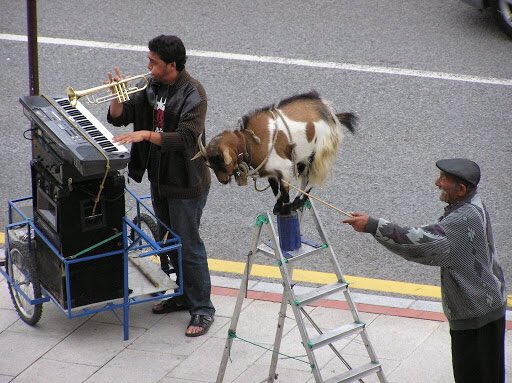 Did you ever see the routine with a goat, a step-ladder, a trumpet player and a gypsy? Now that’s worth a few coins I reckon.
My favourite beggar of all is El Llorón, a man who lurks
near the Granada cathedral and can turn on the water-works at will. This
weeping fellow fires off a series of mournful shrieks as he thrusts his
cap at you, evidently far too upset to give you the reason why, and
then he joins his mates for a smoke and a laugh around the corner.
Most tiresome are the gypsy ladies – we are still in Granada – who
pin a cutting of rosemary onto your shirt ‘for luck’ and then attempt to
charge you for the trick.
In the resorts, most of the beggars appear to be Eastern-European. At
least, in my local supermarket, each and every exit has its very own pordiosero (and for all I know, there’s one stationed outside the lavatory window).
‘How is Piotr doing over there in Spain?’
‘Yes, he has found a secure position in one of their food-stores’.
I’m sure most of them are nice, except for that bad-tempered fat lady who always shrieks invective at me when I pass her.
But I think I have more time for the tramps; although, come to think of
it, I rarely see more of them than just the occasional glimpse of their legs sticking out of a full and
indubitably ripe container.
I saw one of our beggars at the check-out the other day, buying three
beers with a handful of one and two cent coins which were solemnly
counted out by both him and the sales-girl. That fellow’s been sitting
outside the door in the same patch for years; I mean, for all I know by now he’s on the town hall’s padrón. Perhaps he’s generally too drunk to stand.
I was next in the queue behind him looking impatient and going ‘tut tut’, while er, holding a six-pack and a bottle of vodka.
The writer Laurie Lee later went back to Spain, crossing over the
Pyrenees in 1937 to join the International Brigades and fight on the
Republican side. And yes, he took his violin with him.
Sad to say, most of those who live through begging these days don’t appear to have the same urge to give anything back.


.jpg)