Monday, June 22, 2015

Mojácar Earthquake

Mojácar and Vera were largely destroyed in an earthquake which occurred on the night of November 9th 1518. Articles in Spanish here and here tell the story.
There had been a series of worrisome trembles that year ever since mid-June, but nothing to match the final convulsion.
Briefly, with the eternal threat of the Barbary Pirates (I wrote about them here), and all the local defenses demolished by the ferocity of the earthquake - we are on a major fault line, the same one that finished off the Minoan Civilization in Crete in 1450BC - the area was suddenly and abruptly in a bad way. It was, after all, just thirty years after the towns had been liberated by the Reyes Católicos.
It was a Tuesday, and the earthquake arrived around about midnight. Vera was totally destroyed (the hill behind the current location of the city 'Cerro del Espíritu Santo' was the old town) and Mojácar was badly hit. There's an eye-witness account from the then mayor of Mojácar - Iñigo Guevara - who described the collapsed castle in these terms: 'I saw it all fallen in, until the very foundations were visible. There is almost nothing left of the fortress which is so flattened that it appears to have been destroyed by all the artillery of the world'. A report from the time says that almost a third of the eighty homes which made up Mojácar had collapsed. Another report says that the clergy were frightened to give Mass in the church due to its state. It says in the original:  "En la dicha villa de Moxacar no se dize misa a causa que los clerigos no osan entrar a dezir misa a la yglesia porque esta para caerse a causa del terremoto que agora hizo”. A little over a dozen people died in Mojácar as a result of the earthquake. In Vera, the death-toll reached 150. The survivors of the catastrophe  fired an arrow into the sky to chose the site of the new town (Wiki).
Vera in the Middle Ages
The Pirates? 1,500 Moors showed up outside the defenceless village of Mojácar on October 7th 1522. Some of them might even have been born there. No doubt it was time to head for the hills...

Thursday, June 18, 2015

Back at El Boticario

Trawling back to last September here on Spanish Shilling, I wrote about the Parque El Boticario outside Almería City in the Los Llanos de La Cañada (near the Riding Club). This is a 14Ha park designed by the Conserjería del Medio Ambiente, stocked with all the different flora of the province ('1.300 árboles, 2.000 arbustos y 75.000 plantas'), with a duck-pond, 'Moorish gardens', children's park and other wonders. The whole thing, built with European funds, was hastily offered on completion to either the Diputación or the City of Almería. Both declined the kind offer.
So Medio Ambiente (a bloated and largely useless organisation - how could it be otherwise?) was left with the job of maintenance, gardening and watering. They naturally dropped the ball. The park last September was dry and in a sorry state - some of those senior's exercise machines which every village and town feels obliged to buy and leave dotted around, were rusted out. Some overflowing dustbins from a Sunday party. Some dead trees and bushes, some infected plants (chumbo, palm trees and olive, indifferently attended.
A second visit a couple of weeks ago, after a few spring rains (a few), and the Boticario looked a little better. There's a large bar/restaurant, evidently rented out privately, on the edge of the park. Perhaps it pays for a gardener or two.
The park is open - except on Mondays - and it's a nice and of course quiet place to visit, but don't expect to see the maintenance and respect it deserves... 
Later:  I returned a third time later in June, and walked around the higher part of the park, where the shrubs are ever drier. Then, on leaving the park out of the gate - just in front I found the Bar Álamo (it means a poplar tree). Great air-conditioning, and the owner is an accomplished artist with some of her pictures up on the walls.


Monday, June 15, 2015

The Bug in the Computer

This fine looking but rather creepy picture was made by an AI, an Artificial Intelligence. A computer. I understand that it was told to go and make something artsy and this is what it came up with. The story is here.
We have been warned about these things - computers which are so clever that they can upgrade themselves without our interference, making them cleverer still. Those who enjoy Terminator will be familiar with these things, and the premise - or perhaps promise - that they will one day decide that the World doesn't need Humans any longer.
Cue the sinister music.
While I am not the one to write the story, in my version there would be a saviour. Small and fairy-like, in their tens of billions, those minuscule flies from the chumbo, the prickly pear, that have assailed Almería this year. They swarm and fill our eyes, noses and mouths. They go straight through the mosquito netting. They swat into a tiny red blob of cochineal. They are in our drinks, our food,they are clouding milk-white around the lights and, most destructively of all, they fly into the fans and the insides of our computers.
Short-circuiting them.
Would the AI stand a chance against the tiny creatures that have defeated our scurvy ecologistas? Not likely! 

Monday, June 01, 2015

Barbara Napier. It's Been a Year.

Barbara died a year ago, and I miss her.
She was a brave woman and a kind one. She suffered from a disfiguring disease called Wegener's Granulomatosis, and from 2002 until her death on June 4th 2014, she was not only in terrible pain, but was forced to undergo the most humiliating and terrible punishment, together with at least thirty major operations. These were either paid by the insurance we had, or later, when money was tight, by the Spanish National Health (which is very good, and our thanks to them).
Barbara was born in San José, California on July 7 1953 (she wrote about her early life - and her poisonous siblings - on her blog here) and she arrived in Spain in around 1980, staying originally with her parents who were living in Mojácar, but soon, in her own house on land next to the family estate.
She must have been amazing when she was young. Here's what a friend of Barbara called Sharon wrote:
'I just wanted to share a special memory I have of Barbara with you. My parents lived on Trinity Ct. near Foothill Elementary School and Barbara lived miles away from me in another part of Saratoga. One Saturday she called and said she was going to come see me. About an hour later the doorbell rings and Barbara is at the front door and her horse was out on the street. It must have been Jiggs. She got back on him and we stood out there and chit-chatted for a while until she decided it was time to ride him home. Of course for her to ride to my house and back home she had to ride on Highway 9 for several miles. I always wished I could have seen the expressions on the faces of drivers as she rode her horse home on a major highway. She was one of a kind and fearless. I feel honored to have known her'.
Barbara soon learned Spanish, by mixing with the local farmers and showing her interest in animals. She would go out riding with Don Diego, the doctor, as he did his 'rounds' of the far-off isolated cortijos up in the hills. One old lady complemented her on her idioma - 'you ain't from around here', she said, 'not sounding like that... you're probably from Los Gallardos!'. Barbara was immensely pleased.
Barbara ran a donkey-taxi on Mojácar beach her first year here to make ends meet (it was really a mule) and had a job working as secretary for the mayor - Paco Marullo. Later, after we met and married, she started a charity here called 'Animo' to help disabled kids using equine assisted therapy. Put 'em on a horse and let 'em go, in my (very ignorant) words. Many children came through our stables, and many more volunteers helped, until the money ran dry thanks to a newspaper I ran (rather badly). Barbara traveled to various meetings, in Germany, Austria, France and England, and held a congress here with guest-speakers from the various world bodies, including the FRDA and other major players in the field. The head of the ONCE told us once that he heard about Barbara's work while in Australia. Spain being Spain, Barbara's efforts were totally ignored in this country, but 'hey'.
You can read about her charity and her love of animals on her blog Animo.
Later, she tried to set this dream up a second time, if on a smaller scale, but with not much enthusiasm from the Spanish once again, apart from the brilliant support of Loli Berenguer from the Centro Ecuestre Albero in Almería, and a luke-warm support from the University. The Mojácar Town Hall, of course, never took the slightest interest in any of this, not even when Barbara organised competitions of donkey baseball during several years.

Portrait of me, Barbara and Daniel at my art gallery in Bédar. Photo by Michael Sucker.

Barbara with Padre Ángel from Mensajeros de la Paz. On the right is Dra. María Rose.
Barbara loved kids, and the house was always full of them. Many - and I exaggerate only slightly - stayed for several years. A hard day at the newspaper and a warm welcome from the children, or an important lesson of relativity from the disabled kids over at the stables.
We have three children of our own, Jessica, Amber and Daniel and four grand-children. They all live in the USA (jobs for foreigners - even bilingual ones -  are scarce in Spain).
Barbara was my soul mate, and now she's gone.

Saturday, May 30, 2015

The Threat of Brexit

A bit like the 'Big One' which threatens California, Britons living in Europe are worried about the distant rumblings of a possible retreat by London from the EU known as 'the Brexit'. What would the departure of the United Kingdom from the European Union mean for the two million or so Britons living in Europe, and, does anyone in the UK care?
The answer to the second question is easy enough. They don't. This is because we Britons living in Europe have no voice, no champion, no representation.
If London left Europe, then the Britons living in France, in Spain, in Germany or in Poland would find their lives changed considerably, but worst of all, no one knows by how much. It would not even be a decision made by the British as to what would happen to us, after all, they would no longer be a part of the European Parliament. In Spain, we would expect to be treated as non-European citizens with the return of work permits. We would have convertible accounts at the bank and a visa in our passport. We would lose medical coverage and social security. We would of course lose the vote locally (many of us have already lost it in the UK) leaving us even more 'voiceless and forgotten'. Even the Gibraltarians have more rights that we do.
Would we be thrown out of Spain? The eccentric Mr Farage, leader of the 'euro-sceptics' thinks not – we are such a benefit to our Spanish hosts, pumping in money to the country by the hour. I don't agree.
Britain is a country, that like any other, is ruled by opinion and experience. We, the 'ex-pats', are neither popular nor appreciated. But the looming referendum is not about us, it is about the future of Britain itself. What to do with all these pesky Europeans who are filling up the country, taking our jobs and our women? Particularly the Eastern Europeans, who will work for half of what any self-respecting Briton would expect.
Back in the sixties, a leading member of the fascist National Front and cousin of my mother, told us that they only wanted the support of the little people, the workers, the unskilled and unschooled. These are the people who follow our philosophy, he cried, thumping the table, these are the folk who hate the foreigners... (We left the UK shortly afterwards).
So, if Britain decides against staying in Europe, despite the inevitable loss of earnings by the chocolate factory who sells sweeties to Poland, or the paper handkerchief manufacturer with twenty four languages squeezed onto the box, the battle is not about British industry, it is to do with the immigrants.
If the bigots win, then the Poles and the Lithuanians and the Romanians will need to leave. But so, of course, will the 200,000 Spaniards living in the UK, and the 350,000 Frenchmen. Despite this, does anyone seriously think that Madrid or Paris would nevertheless accept Farage's nonsense and allow us all to stay?
Which begs the next question. Where would Whitehall put us all? Tents on Salisbury Plain?
Perhaps Brussels should take care of us (as currently, we are still Europeans) and draw up a plan to create a kind of Nissan Passport to give those of us about to be defenestrated by the British voter special rights as Europe's first full citizens.
But, putting fantasy to the side for a moment, the bottom line for a possible departure of Britain from the European Union leaves this all-important uncertainty – no one speaks for us, therefore, we receive no answer.
What is going to happen to us?

Saturday, May 16, 2015

The Worm Has Turned: British Ex-pats May Have a New Champion

Spain is stuck in a year of elections. We had the Andalucian ones back in late March – still unresolved and now with the threat of fresh Andalucía elections for September. We face local elections across the country on May 24th. These are joined on the same day by regional elections in most parts of the country (excepting Andalucía, Catalonia, Galicia and the Basque Country). In September, the Catalonians will be holding their own regional elections, with a view towards independence in the near future. Finally, probably in November, we shall be called to the urns once again for the General Elections.

The two major parties, the Partido Popular and the PSOE (the traditional right and left) are joined by not only the usual regional independent parties, some of which are as old-fashioned as the PP and the PSOE themselves, but also by upstarts Ciudadanos (right wing) and Podemos (left wing anti-austerity).

One of the more interesting struggles, however, will be resolved next Sunday, when the small town of Mojácar in Almería goes to the polls, because one of the leading parties there is headed by an Englishwoman called Jessica Simpson. 38 year old Jessica is the candidate for 'Somos Mojácar' (We are Mojácar) which is a group made up of various different local parties and associations. Jessica, like only a few of the majority British resident in the resort, is bilingual, having lived locally for almost all of her life. She is married to a Spaniard and has two children going through the local school system.

Jessica is interesting to the local panorama – a foreigner at last within the Town Hall to represent integration and foreign participation in that most hallowed of Spanish institutions, the plenary session of the Town Hall (she already has four years experience as a local councillor), but she could be more interesting still as a champion for the voiceless Britons living in Spain.

There are something between 290,000 and 750,000 Britons living in Spain (depending on who one believes) and they have little or no voice in what is going on. Spain to tax them unfairly or to demolish their homes? No one to stick up for them. The UK to leave the EU, causing untold and ill-considered hardship? No one to defend their interests. Europe has a parliament made up of MEPs, but none of them represent either their citizens abroad or the larger group of émigré Europeans – thirty million who live in other European countries, of which two million are Britons. There is, in short, a large group of displaced and voiceless Europeans living within the very cradle of democracy itself.

In Europe, we need more Jessica Simpsons, but first, she must win Mojácar.

Monday, May 11, 2015

Pointing Percy at the Porcelain.

While Spain has made leaps and bounds in almost every sphere, public lavatories still need some way to go. We may no longer be in the field of the old travel guide who recommended under 'Conveniences' to 'where possible, best start your own', but there are still a few problems that need ironing out.
Being a fastidious and modern country, ruled by all sorts of obscure interests - often of a commercial leaning - we must now expect wheelchair-accessible toilets, even if the building in question has a stairway to get to it. Perhaps, you see, you broke your leg after you gained the bar.
Probably tripped over the step.
Some lavvies don't have a seat, for a reason which I shall shortly be examining, and customers, certain customers, may no doubt be obliged to fastidiously hover over the pan. At least they flush. My mother once pulled the chain on a local dunny and the whole tank fell on her head.
On the bright side, the days of being invited to put the used paper in a handy nearby basket have more or less passed.
New bogs have lower and close-to-the-porcelain tanks, so a collapsing reservoir rarely happens anymore, even if the flow in the modern variant is somewhat reduced. Which may explain why customers sometimes feel that their brief visit to the WC is rather second-hand. Indeed, I once stayed in a very smart hotel in Melilla and, on removing the wrapper on the crapper and lifting the lid, found a large turd in the bowl. They had a chocolate on the pillow, too.
Talking of low tanks, many modern privies have a pan so close to the flusher than the seat won't stay vertical for The Gentlemen. It's hard and unnatural to try and hold the seat up while taking a whizz, so the usual thing is to not bother, and merely piss all over the commode, seat included. Using your foot doesn't work either unless you are seriously well-endowed.
'Yes, I've finished, go ahead' you mutter to the next person as you make your escape.
Maybe as many as a quarter of all public johns have this unfortunate design-flaw, at least around where I live. 
One small step better, other thrones have a seat which appears to be steady, but will suddenly fall from the vertical with a mighty crash. If that doesn't make you jerk mid-stream, nothing will.
It's all because the tank is to close to the khazi, for goodness sake. I can't imagine who designs these things, the potty company or the installers.
It's as if the Nation's plumbers all sit down to pee - or maybe, knowing more than we do, and like the travelers of old: they prefer to start their own. 

Saturday, May 02, 2015

Franco is Still Dead (Although, He Does Seem to be Moving Slightly)

 I was a handsome young fellow in those days, un señorito if I say so myself. I was living in Mojácar in a society of older and generally rather drunken Europeans and a sprinkling of Spaniards who treated us, in those days, with a mixture of no-doubt gratitude and respect, as we learned a few words of Spanish, built unimaginably large houses and drove astonishing cars (usually with the steering wheel in an unlikely configuration) and sometimes bought them a drink in the bar in the village square - the Indalo run by Antonio (he's still there). Toma una copa conmigo, my dad would say.
Some of those cars would fall off the cliff as we drove home, sometimes with tragic results, but we were left alone by the police - we were bringing wealth to the village and it was sorely needed. Jacinto, the old mayor, his job awarded to him by the provincial governor, was careful to see that we were happy and that no one watered down the gin.
They were idylic times.
Franco, we said, if the subject came up, he's a good old thing - keeps the place safe. And it was true enough. The Guardia Civil were feared and when it came to it they were, let's say, suitably 'trigger happy'. Things were quiet enough in our small, forgotten, ignored and peaceful corner of a province that, during the Civil War, had been fiercely supportive of the Republicans.
The Swedes up in Jávea went rather further than we did, organising one day a big (and approved) rally in the bull-ring, with home-made banners reading 'Arriba España' and 'Up Franco' (they meant well). But we were quiet enough - never talk about politics or religion was our motto. Antonio, un brandy por favor.
Then came word that the Old Boy was failing. He was put on life support in the Ruber in Madrid and lay in a coma for several weeks. Saturday Night Live in New York famously began its news-segment each week with the story that 'the Caudillo of Spain, Francisco Franco, is still dead'.
And then, he was. On November 20th 1975, the Generalísimo breathed his last and Spain went into heavy mourning. Everything was closed down and quiet.
The small group of emigrés that lived in and around Mojácar naturally felt sorry for their kind hosts and thought that the best thing to do would be to show up at the iglesia for the mass to celebrate the soul of the murderous old sod. We trooped in to the church, dressed in shirts and ties (those of us who owned such things) and were faintly surprised to see that, apart from a couple of old girls dressed in the kind of black you don't normally see these days, and a startled-looking priest, there was nobody at all. The cura gamely got on with his pater nosters and we stood or sat, as required, while trying to look as sorrowful as we could. What will they do without the old swine? we wondered.
At last the service creaked to an end. We passed through the door of the church into the somber evening outside, where a large and evidently indignant group of Mojaquero males were waiting for us. A pause. Then Jacinto suddenly broke the pregnant silence: 'Antonio, go and open up the bar, the extranjeros are thirsty'.

I found the newspaper featured at the top of this story while cleaning out a box of junk this morning.


Monday, April 20, 2015

High in the Sierras: A Visit to Trevélez, Granada

We had taken the car out for the day, somewhere. Maybe to Tabernas, I said, or along the coast to find some more fiddler crabs. The car sped along heading, apparently, inland from Almería. 'Or we could go to Trevélez', I said, 'they do trout there'.
There's no map in the car, and the GPS doodab on the mobile phone is fiddly. But we headed, in a roundabout route, towards the Granada Alpujarras. Up past astonishing views, fields in flower, tiny white villages and distant blue hills: snow in the high peaks. The last twenty kilometres from Cádiar on a narrow road with a dramatic death-fall inches away from the wheels made it a vertiginous drive (above all, when taking photographs and steering at the same time).
Trevélez eventually arrived and we got out.
The village of just 800 inhabitants has a touristy look to it, and is known for its ham, its trout and its elevation (1,500m). Away from the main square, with its numerous restaurants, tourist shops, buses and a modest number of milling-around visitors, the upper village is white, steep and quiet. A small restaurant guarded by an elderly mare, called the Mesón Haraiçel caught my eye (partly, wondering how one pronounces a - presumably mozarabe - name like that). We sat outside on a tiny terrace and ordered quite the best meal I've had in ages, with a pot of heavy local wine and a bottle of gaseosa (the drive down, you know).
I had revueltos, trucha and home-made helado de higo, everything except that fig ice cream served with extra jamón serrano. Cor.
I told the waitress that, if we had of come from Michelin, we would we handing out estrellas like confetti. She seemed suitably pleased and went off to tell the cook. 'He says thank you', she reported back to us, 'but could you put something nice in TripAdvisor?'.


 The journey home was even more delightful, especially since the GPS navigator or whatever it is let us down slightly, and we eventually rejoined the coast down in Motril.

Saturday, April 18, 2015

Learning English

I had made a comment elsewhere about the number of English-language schools in Almería, including one with the odd name of 'The Mancunian Academy', which presumably teaches its students to speak the Queen's English with a flat Manchester twang. A friend from that city laughed when I told him and said ... the poor things will all be speaking Espancunian. Indeed!
A student I know in the Almería educational system is sixteen and he and his 120 classmates are using a book called 'The Skin I'm In' by a black American author called Sharon Flake. It's written in the vernacular: '...Then I had to fess up and tell her I forgot to do it. She asked Mr Pajolli if it's OK for me to use my office time to do my math homework. He said, yeah, but that I'd have to make up the time later. Teachers don't do nothing but cause you grief, I swear that's all they do.'
There used to be a Scotsman living in Roquetas and who taught English. Can you imagine the sounds his more attentive students made?
McDonalds, the burger people, have a catchphrase: 'I'm lovin' it'. Bad English my friends!
So here's the deal: Learn English from someone who speaks or writes it clearly, because the point is to be able to communicate to those English-speakers you will be meeting later on. Not all of them will speak it very well, so why not make it easy for them. Yeah?

Monday, April 06, 2015

Lorca Procession, Easter Friday

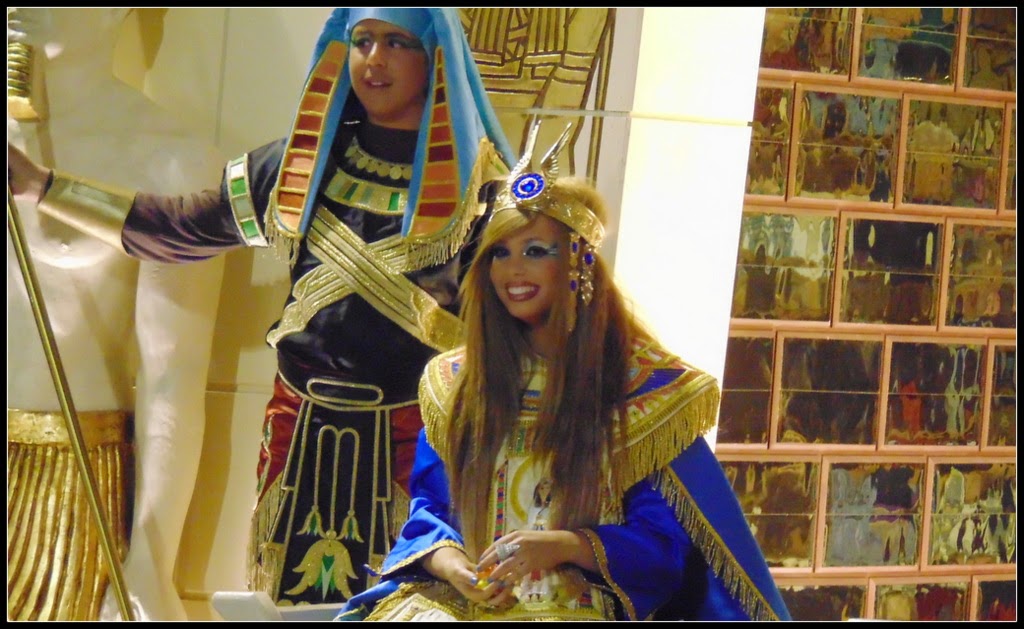
Some pictures from the Lorca festival on Friday's Viernes Santo. The show - a mixture of the religious and the pagan - has penitentes, musical bands, Roman legions, chariot races, religious floats, Egyptians, trick-riding from horsemen and women, devils, emperors and a star turn by the Four Horsemen of the Apocalypse. The procession took about three hours and they are, apparently, already preparing for next year, where the main point is to outdo the other guilds (there are four: the Reds, the Purples, the Blues and the Whites. The last two, the biggest, must field around four hundred people each...).


Tuesday, March 31, 2015

The Entertainer: 30 Years Old

While its successor will have decided to ignore the occasion, The Entertainer, Spain's first independent free English-language weekly newspaper, turns thirty this Saturday. The first edition of the paper was published in Mojácar back on April 4th 1985, following some sterling work on a kitchen table. The small newspaper, started by Mike Connolly, soon grew in size and popularity and, with investment and participation from Lenox Napier, who still edits The Entertainer Online as a blog, the paper grew to three weekly editions, covering the coast from Gibraltar to Valencia. An ongoing court-case prohibits this historian from saying what happened next, except that The Entertainer abruptly changed its name and ownership around the Turn of the Century, to become the Euro Weekly News.

Tuesday, March 24, 2015

The Quietest Place in Almería in by the Cabo de Gata


I was visiting the area between the Barriada called Cabo de Gata and the fishing village of Las Salinas this Sunday, following a rainy day. There is a lookout post for birds, although not many flamingos about this weekend. I saw my first house martin for the season. Now is the time in Almería for wildflowers.