There’s something queer about the food these days. You go to a restaurant to eat and half of the menu is designed for some kind of wedding feast. It’s all got fancy-dancy for some reason. Perhaps the Michelin Man is seated at table number seven. What’s wrong with ‘sat’?
In the good ol’ days, food was food. No cream doodah then, no fennel sauces or roasted swedes. Simple stuff. A salad was lettuce, sliced onions and tomatoes with a heavy and oily aliño; now it’s got enough different kind of vegetables rattling around the plate to make a rabbit blanch. The main course used to be a plate of what one hoped were mutton chops (or were they perhaps goat?) or slices of pork (known collectively in our area by the foreign contingent as ‘crotchmeat’) or perhaps a plate of chicken knuckles with chips.
How to prepare chicken knuckles. Take one chicken, have at it with an axe, then drop result into a sartén with plenty of oil and garlic. Fry to taste. Riquísimo.
All the best crotcheramas (as we called them) could manage this simple fare, and with a bottle of really quite nasty wine, the whole thing, plus pan, came to around sixty Pesetas a head. Now, what’s wrong with that?
There was no menu and no price list. If you didn’t know what you wanted, or couldn’t understand the waiter, you wandered into the kitchen and pointed.
In those days, if we wanted a decent roast, we’d have to drive to the nearest butcher. He was a blood-spattered German trading six hours down the coast in the Calle San Miguel, Torremolinos’ high street. We’d fill up the plastic freezer box, spend the night on the piss, and head home with a headache the following day.
The twenty or so who made up the foreign community in the village in those days would be waiting for us on our doorstep when we returned. One of them was a retired air vice-marshal with a plummy accent called ‘Tabs’. My parents had left the door ajar one particular evening and had gone round the corner to the first and only foreign bar for a nip while the roast roasted. Tabs, on his way up the hill for a pink gin, smelt the rich smell of the roast waftin’ on the evening air and stopped by the house to invite himself to dinner. He went in and found no one around, so he checked inside the oven – as one does - to have a look at his potential dinner. Satisfied, he carried on to the pub for a large one and to obtain an invitation from my mother, in which he was successful.
Now our oven was one of those old Butano three burner ones with a lid and a slight wobble. When the hungry party returned an hour later to check on the roast’s progress my mother found that Tab’s tour of inspection had, by briefly opening the oven door, put out the gas. Tabs later recalled that ‘no one from the lower ranks had ever talked to him like that before’.
The milk in those days was undrinkable. It came in two litre glass bottles with a thin neck. There was a slightly blue cast to it due to the fact that the manufacturer had substituted the cream for pork grease and added formaldehyde to keep it stable. This baby could sit in the sun all day. Tea, if we could get it, came in teabags brought out from England loose in people’s luggage, wrapped around the socks. Eggs and chips were the standby at home, and cocido in the restaurant in the square. Tabs would insist on the plates being warmed, without much success from the kitchen-wallah, so he would usually place his plate under his shirt for a few minutes to do the job. ‘Under trying circumstances’, he would say, ‘one must keep up appearances’.
Another dish of the time remains to this day a favourite of mine, although it is now extremely hard to find. You see, it’s too cheap. This is ‘Huevos a la Flamenca’, a small earthen dish with ham or some kind of donkey-sausage served with peas, peppers and a fried egg. The whole, cooked in tomato paste. I happened across one the other day outside Granada: delicious!
Food, back in those days, was scarce and no one was going to mess around with sauces. Actually, come to think of it, it may have been because you couldn’t get cream. Eggs, tomatoes, potatoes, peppers, salchichón, chicken and pork was about your lot. The local grocers, known in a gesture of Spanglish relations as ‘The Foodings’ had a few tins on the shelves plus ‘Spanish’ bread, truly awful chocolate, some rather nasty looking sardines and a rack of wine in returnable bottles (two Pesetas back). They’ve still got the chocolate. Credit was extended to favoured customers; a dried lima bean went into your jar for each five peseta 'duro' owed. This system was eventually overturned – literally – by an escaped chicken that broke into the store one night. Reportedly, it ate most of the evidence.
Tapas, even more than today, were the solution. You used to get a bloody good tapa in Andalucía with your quinto or your tinto. A piece of magra, lean pork, with some chips and bread. Two fried cordoñíz eggs on toast. A ham, cheese and alioli cherigan. A small plate of whitebait... a fat chunk of tortilla de guisantes... home made potato crisps (when was the last time?)... a few of those would set you up nicely.
So these days it’s all la-di-dah. The menu’s in English (and Spanish, and French, and Italian, and German...), the food is all poncy, the wine list is exhaustive (and exorbitant), the postres all come from those fine people at Frigo and, worst of all, You Can’t Get Huevos A La Flamenca.
Thursday, May 27, 2010


Thursday, May 20, 2010
A Rare Marble Bath
 This hand-carved marble bath comes from the old balneario behind Cuevas. It'll be around a hundred years old. We've had it in our garden in Mojácar as a planter for the past forty years and we wondered if you would like it in yours.
 It's 6'3" long, by 2'5" wide by about 1'10" high. So, about 1.90ms long.
Priced to go: 2000€ (Going once... going twice...).
Sunday, May 16, 2010
Naked and Proud
Recently, a gentleman decided to walk from Land’s End to John O’ Groats, a journey of around a thousand miles. It’s a pleasant enough route, I once did it on a bicycle. The news, of course, isn’t the peregrination of this fellow per se, so much as in the way he was dressed. Or rather, wasn’t. The first time I read about him, in a copy of an unsuccessful magazine called ‘News from Home’, I thought it said that he was a ‘naturalist’ and that he was one of those bearded people who wanders about clutching binoculars and wittering on about the sexual habits of rabbits (which I suspect are pretty straightforward) and followed by a patient, philosophical and faceless cameraman whose main job is to not get noticed, leap-frog in front of our hero, and watch for his shadow in the action shots. However on examining the photograph, and re-reading the piece, I found that the ambler was a rucksack-toting ‘naturist’, or one of those people who enjoys wandering about nude in public.
I once got to know another example of this tendency in Mexico. This chap, mad as a rat, enjoyed diving in the warm Pacific waters in search of lunch. He also favoured relative nudity. He would wear an oxygen tank, a mask, a wheezer, a vest full of handy pockets, a waterproof watch (good to five hundred metres), a weight belt, fins and a large knife strapped to his right leg. Practically the only part of his body visible to the onlooker was his knob.
And here we find the difference between nudists and what are apparently known in Spain as ‘textiles’. A nudist is not interested in ‘going as he was born’, but to leave uncovered the parts which are normally covered.
You can say that someone wearing underpants is dressed, whereas someone who is covered everywhere except for his genitalia is either a pervert or a ‘naturist’. I wouldn’t want to mix the two concepts; perhaps the difference is in the presence or otherwise of a mackintosh.
The consideration of the nude body, away from the sexual angle, offends nobody. In fact, the reverse. Michelangelo’s David is one of the most sublime examples of art in the world. There is no championship of the sexual organs: he’s just young, brave and inspirational. The same effect would not have been reached by the sculptor if he’d chosen a fat old gentleman with a pot.
If you want sex, there’s the incoherent Britney Spears for example. I’m sure that she would be delightful in the nude, but wearing just a pair of white cotton panties would even be preferable, as any girl knows.
Goodness knows, there is nothing wrong with wandering around naked in your own house or in other private places knowing that you are not going to be seen by unknown people. Nudity bothers no one in a controlled environment. But here’s the rub about naturism: the entire group (they insist on wandering about in gangs) knows that they are a herd of people highly conscious of the fact that they disturb the majority of society – not in small part due to the evidence of their small parts. Sadly, few of them look like David or Britney, and rather incline us to think of a brisk session on an ironing board. It’s in your face, but it’s not esthetic.
‘Ah, but we don’t look’, they say.
Yeah, yeah.
Naturists say that ‘clothes don’t make the person’ and that they can liberate themselves from the mundane competition of appearance. Unless they’ve forgotten to take off their Cartier or Rolex, it’s true that they can successfully manage to hide their position in society. Like anyone cares.
But, everything in its place, as the saying goes. During the eleven and a half months of the warm season, the shops and banks are filled with half-dressed Englishmen, in socks and y-fronts, standing patiently in queues or pushing trolleys full of beers, whisky and digestive biscuits. I’m usually obliged to pretend that I’m Swedish or from Iceland. That overweight fellow over there sweating into the lettuces isn’t one of ours, and, no Señora, I don’t even speak his language. Actually, he probably feels overdressed, why, just last week he streaked – or at least waddled – across a football game.
But that’s my own particular Calvary. I don’t happen to live in a nudist colony and I certainly can’t imagine, as the joke goes, where they keep their money.
For practical reasons, when the weather is hot, I’ll grant that you have to remove some clothing (with the local social limits in mind), but, when it gets cold, I reach for a sweater. No worries. But them?
They eat.
A few years ago, my accountant invited me for lunch at a naturist restaurant on the beach. Despite recommendations to the contrary from the specialized magazines on the subject, I didn’t feel entirely comfortable in the beach-bar, clothed and surrounded by naked Germans tucking into their paella and chips. I hadn’t the least desire to take off my apparel. Apart, that is, for my shirt which I had inadvertently stained with tomato sauce. Everybody was staring at me as if I was the nutter. We were sat – or in some cases fastened – to metal chairs. Yes, there were a couple of girls at other tables who weren’t bad, but we were eating, for chrissake (the moment when I first managed to raise my eyes and see them was, coincidentally, the moment I had the accident with the tomato sauce). Two hundred people staring at me like I’m peculiar and I don’t think it was down to the cigarette handily wedged behind my right ear. Then, during the pudding, a man from the next table suddenly rose to his feet in an evident state of excitability. Jaysus, gimme a light...
I changed my accountant the following day for an Argentinean one. A dressed one. I believe he even wore a tie. Perfecto.
Unfortunately, he soon stole everything I owned, including my clothes.
Which explains why I go around this way. It’s not because I like it, see, it’s because I have to.
I once got to know another example of this tendency in Mexico. This chap, mad as a rat, enjoyed diving in the warm Pacific waters in search of lunch. He also favoured relative nudity. He would wear an oxygen tank, a mask, a wheezer, a vest full of handy pockets, a waterproof watch (good to five hundred metres), a weight belt, fins and a large knife strapped to his right leg. Practically the only part of his body visible to the onlooker was his knob.
And here we find the difference between nudists and what are apparently known in Spain as ‘textiles’. A nudist is not interested in ‘going as he was born’, but to leave uncovered the parts which are normally covered.
You can say that someone wearing underpants is dressed, whereas someone who is covered everywhere except for his genitalia is either a pervert or a ‘naturist’. I wouldn’t want to mix the two concepts; perhaps the difference is in the presence or otherwise of a mackintosh.
The consideration of the nude body, away from the sexual angle, offends nobody. In fact, the reverse. Michelangelo’s David is one of the most sublime examples of art in the world. There is no championship of the sexual organs: he’s just young, brave and inspirational. The same effect would not have been reached by the sculptor if he’d chosen a fat old gentleman with a pot.
If you want sex, there’s the incoherent Britney Spears for example. I’m sure that she would be delightful in the nude, but wearing just a pair of white cotton panties would even be preferable, as any girl knows.
Goodness knows, there is nothing wrong with wandering around naked in your own house or in other private places knowing that you are not going to be seen by unknown people. Nudity bothers no one in a controlled environment. But here’s the rub about naturism: the entire group (they insist on wandering about in gangs) knows that they are a herd of people highly conscious of the fact that they disturb the majority of society – not in small part due to the evidence of their small parts. Sadly, few of them look like David or Britney, and rather incline us to think of a brisk session on an ironing board. It’s in your face, but it’s not esthetic.
‘Ah, but we don’t look’, they say.
Yeah, yeah.
Naturists say that ‘clothes don’t make the person’ and that they can liberate themselves from the mundane competition of appearance. Unless they’ve forgotten to take off their Cartier or Rolex, it’s true that they can successfully manage to hide their position in society. Like anyone cares.
But, everything in its place, as the saying goes. During the eleven and a half months of the warm season, the shops and banks are filled with half-dressed Englishmen, in socks and y-fronts, standing patiently in queues or pushing trolleys full of beers, whisky and digestive biscuits. I’m usually obliged to pretend that I’m Swedish or from Iceland. That overweight fellow over there sweating into the lettuces isn’t one of ours, and, no Señora, I don’t even speak his language. Actually, he probably feels overdressed, why, just last week he streaked – or at least waddled – across a football game.
But that’s my own particular Calvary. I don’t happen to live in a nudist colony and I certainly can’t imagine, as the joke goes, where they keep their money.
For practical reasons, when the weather is hot, I’ll grant that you have to remove some clothing (with the local social limits in mind), but, when it gets cold, I reach for a sweater. No worries. But them?
They eat.
A few years ago, my accountant invited me for lunch at a naturist restaurant on the beach. Despite recommendations to the contrary from the specialized magazines on the subject, I didn’t feel entirely comfortable in the beach-bar, clothed and surrounded by naked Germans tucking into their paella and chips. I hadn’t the least desire to take off my apparel. Apart, that is, for my shirt which I had inadvertently stained with tomato sauce. Everybody was staring at me as if I was the nutter. We were sat – or in some cases fastened – to metal chairs. Yes, there were a couple of girls at other tables who weren’t bad, but we were eating, for chrissake (the moment when I first managed to raise my eyes and see them was, coincidentally, the moment I had the accident with the tomato sauce). Two hundred people staring at me like I’m peculiar and I don’t think it was down to the cigarette handily wedged behind my right ear. Then, during the pudding, a man from the next table suddenly rose to his feet in an evident state of excitability. Jaysus, gimme a light...
I changed my accountant the following day for an Argentinean one. A dressed one. I believe he even wore a tie. Perfecto.
Unfortunately, he soon stole everything I owned, including my clothes.
Which explains why I go around this way. It’s not because I like it, see, it’s because I have to.
Friday, May 14, 2010
The Mojácar Protest
The protest against the mayoress' plan for a small underground carpark next to the church duly occured this morning in Mojácar. A carpark for forty cars, by the way and to state the obvious, doesn't cost half as much as one for eighty, since half of an underground carpark is ramps and passageways and turn-arounds and support posts. They aren't cheap. The answer to the Mojácar village parking is (and has always been) a huge great extension of the village on the side by the Pavana. The bigger the better. Make it look like the village (i.e. employ a proper architect) and put in shops and a hotel and whatever seems appropriate... but put in a lot of parking spaces.  Anyhow, todays protest was a slight rag-bag of groups, the ACEM, the PSOE, a couple of opposition politicians (Gabriel Flores, Diego García (the Gasolinero), Pedro Morales and Albert Schröter - in fact - almost all the opposition councillors), the Mojácar se Mueve group, the Plataforma Mojácar Peatonal (I seem to be wearing one of their stickers), the Mojácar Positiva (the 'let's swamp us in tourists' group) and some non-aligned protestors.
Anyhow, todays protest was a slight rag-bag of groups, the ACEM, the PSOE, a couple of opposition politicians (Gabriel Flores, Diego García (the Gasolinero), Pedro Morales and Albert Schröter - in fact - almost all the opposition councillors), the Mojácar se Mueve group, the Plataforma Mojácar Peatonal (I seem to be wearing one of their stickers), the Mojácar Positiva (the 'let's swamp us in tourists' group) and some non-aligned protestors.Unlike the last time we had a public protest about town hall plans when only foreigners demonstrated and got beaten up by the local mojaqueros for their presumption (Bartolo's rape of the Fuente back in 1986), there was on this occasion a mixture of around 200 local foreigners, Spaniards and mojaqueros. I think there might have been more if the protest was advertised a bit better (not a word in the Weenie and friends) and if it had of been on a Saturday and perhaps a bit later in the day...
The municipal police apparently took photos... so there goes my building licence!!
The crowd marched through the Plaza Nueva, up the M30 (as the street past the church will one day be renamed) and away up to the Town Hall's department of Urbanismo (which started out as a school, later, under Rosmari's direction, became a market, and is now our Palace of Urban Planning). From there, with various people whistling and Liberio honking a conch-shell, the crowd continued towards the ayuntamiento where various slogans were chanted, including 'Rosmari, aprende: el pueblo no se vende'. A vocal group under the PSOE banner tried to promote their agenda with 'Rosmarí, dimite' etc...
Finally, someone read out a speech which made a pretty good point: Mojácar is a pueblo de bohemios, he said, and he who forgets his past loses his identity. Our heritage is a cultural concept and not a political one.
Well, let's see what happens next.
Friday, May 07, 2010
Demonstration in Mojácar
Mojácar se Mueve, a citizens group in Mojácar, has called for a demonstration next Friday 14th May from 9.30am against the town hall’s plans for the Plaza de Arbellán, next to the church in the pueblo.
The first stage is to knock down the Loro Azul and the 'schoolmaster's building', currently used as a public lavatory. The Loro Azul fellow has already taken residence in the nearby Budú Bar (which, four mayors back, used to have a little tunnel next to it, the historic Arco de Luciana).
The second stage is to dig in the rock an underground parking space for forty cars - at an estimated 50,000 euros per car. These spaces will be (or are envisaged to be) for residents only – although paid, at least in part, with public money.
In stage three, a new town hall will be built facing you as you come up the street past the church, with another building, for an oficina de turismo, slightly to the left and a small square taking up the remaining bit (on the left). In short, the pueblo should be pedestrian (as far as possible) and the narrow street past the church should not become a two-way traffic artery. Furthermore, digging this underground carpark (the smaller they are, the more expensive 'per car') in solid rock will keep the barrio in acute discomfort for a year and may weaken the church itself. Madness!
Finally, the thought of a town hall being built anywhere near where 90% of the mojaqueros live - i.e. on the playa - is not considered as making any sense.
This plan is - apparently - still in an early stage and with enough protest can be stopped.
The money for this project – around six million euros - is to come from public land sold in Macenas a few years back. Don’t we have any better ideas than this?
Mojácar se Mueve: MANIFESTACION, el próximo 14 de mayo, viernes, a las 9 y media de la mañana, se convoca a todo aquel que este en contra del PARKING SUBTERRANEO de la iglesia para que nos manifestemos de manera pacifica, y así hacer notar a nuestros gobernantes que no estamos de acuerdo, y que no se puede hacer lo que se les venga en gana, sin contar con el pueblo.
The first stage is to knock down the Loro Azul and the 'schoolmaster's building', currently used as a public lavatory. The Loro Azul fellow has already taken residence in the nearby Budú Bar (which, four mayors back, used to have a little tunnel next to it, the historic Arco de Luciana).
The second stage is to dig in the rock an underground parking space for forty cars - at an estimated 50,000 euros per car. These spaces will be (or are envisaged to be) for residents only – although paid, at least in part, with public money.
In stage three, a new town hall will be built facing you as you come up the street past the church, with another building, for an oficina de turismo, slightly to the left and a small square taking up the remaining bit (on the left). In short, the pueblo should be pedestrian (as far as possible) and the narrow street past the church should not become a two-way traffic artery. Furthermore, digging this underground carpark (the smaller they are, the more expensive 'per car') in solid rock will keep the barrio in acute discomfort for a year and may weaken the church itself. Madness!
Finally, the thought
 of a town hall being built anywhere near where 90% of the mojaqueros live - i.e. on the playa - is not considered as making any sense.
This plan is - apparently - still in an early stage and with enough protest can be stopped.
The money for this project – around six million euros - is to come from public land sold in Macenas a few years back. Don’t we have any better ideas than this?
Mojácar se Mueve: MANIFESTACION, el próximo 14 de mayo, viernes, a las 9 y media de la mañana, se convoca a todo aquel que este en contra del PARKING SUBTERRANEO de la iglesia para que nos manifestemos de manera pacifica, y así hacer notar a nuestros gobernantes que no estamos de acuerdo, y que no se puede hacer lo que se les venga en gana, sin contar con el pueblo.
Saturday, May 01, 2010
Delfos
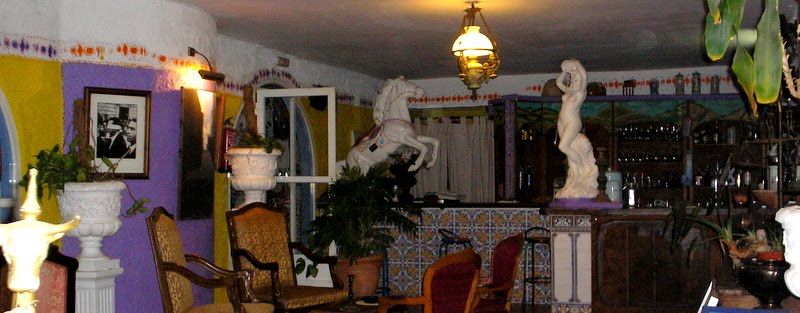 Delfos, an art gallery and bar, is on the road between Mojacar and Turre. It's open every evening from 9.00pm. Mariano, who has a great knowledge about Spanish modern art, will show you around or just pour you a drink as you take it easy. No tapas, no one selling roses and no accordion players.
 Mojácar, it is said, is blessed with an enormous number of bars. Most of them being the usual stainless steel dives where a lack of imagination, a reptilian smell of stale sweat and the pounding thump from the music system make the gentle art of conversation as lost as a five cent brandy. The Delfos is an exception to this, with a phenomenal decoration from the last twenty or thirty years of Spanish art peppered with a few foreign masters (that's a Fritz horse in the middle of my picture). It's a different way of looking at life - over a whisky.
The locale is huge, with odd rooms and outside terraces filled with objets, sculptures and paintings. It was designed - and more or less built - by Manuel Coronado (one of Spain's best known modern artists) about twenty years ago. The Mojácar town hall as usual, confronted by the chance to improve its image with an injection of culture and some famous artists, fell over itself to do nothing.
It's not perhaps the kind of place to go drinking, but it's the place you take people to when you want to show off your town. Look, you say, have you ever seen a place like this?
Tuesday, April 27, 2010
Putting Old Cars Through their Paces
I bought my first car from a dealer in Almería. I was eighteen and had recently (that morning, probably) passed the driving test in Huercal Overa. The car was a kind of old Renault van called a 4F with the push-pull gears, but fitted with an Ondine engine rather than the usual 4L couchez-avec egg-beater. This meant that the old girl could thunder along at a rather better speed than suggested by the body and was just the ticket for me. The passenger seat was removable; it merely hooked in at the front, so it offered a rather nasty surprise to anyone sat next to me when I stepped on the brake, but with the seat parked on the tarmac, I had room to stretch out full length on a thin mattress for a snooze. That’s right: my first vehicle was a camper.
I remember belting one day down the wiggly line on the map laughably called a road which connected Mojácar with Murcia and all points north. In those far-off times, roads went through towns, rather than round them, which meant you could stop for a libation every hour or two. Trucks would work their winkers to let you pass. There were no discernable speed limit and no one took any notice of the signs anyway. There were drain-channels across the road which, if hit with sufficient speed, would cause you to leave a dent in your roof as the car dipped and you didn’t. On this occasion I was approaching Murcia at somewhere over a hundred kph when I saw two cops on the side of the road, just at the point where the road itself dropped about six inches and turned into a rutted track. No warning signs, of course. Spoil the fun. There wasn’t time to slow down nor was I inclined to, as the two grinning policemen waved me past, like fans at the track. I think I broke a kind of automotive long-jump record that day.
The car took me to England in about 1972 on an early adventure in my life, the only time I have ever driven from here-to-there, all the way through to Calais and across the channel. Crossing into France caused me some embarrassment as I stopped at the frontier and whipped out my passport at the desk with a merry ‘Bong-jour’ only to see a small package arc across my line of vision. It was a single and rather elderly prophylactic that I had kept in an inner pocket ‘for emergencies’. To my horror, monsieur le flic saw it as well. ‘Is ze engleesh gentleman goin to defloweur one of our fine French beautees?’ he asked kindly, picking it up and returning it to me. Sadly not.
The front axle of my passion-wagon fell off in Norfolk and a mechanic friend of the family told me that it would cost 50 pounds to repair and that the car wasn’t worth it. Yea, right. So, once fixed, and driving back home, again through France and into Spain, the old Renault van proved him wrong. It lasted another couple of years before I sold it to the Bédar town hall.
A few years later, a Spanish friend with an odd sense of humour told our family of how he had just bought a strange foreign car: a brand he couldn’t remember (you could only buy Simcas, Renaults, Citroens and Seats in Spain in those days, peppered vaguely with a few enormous American Dodges and a strange kind of Austin making sure that the British car industry would remain a world power forever). He had left this car, he continued, in Almería, parked on some side-street and the problem was, as he explained to the police, he couldn’t remember where he had left it and, as they attempted to take down some details, he admitted that he had no idea what sort of car it was. Despite this unforgivable lack of crossing one’s tees and dotting one’s ayes, the car was eventually located and returned to its concerned owner… who promptly sold it to my father. It soon became mine. It was a two-tone Karmann Ghia 1500 Special and easily the worst car ever made. It had a rear engine hidden under a false boot and a large and empty space in the front, empty, that is, except for some rust and a sack of cement. Without this aid, the front wheels would lose all contact with the road once you got up to about sixty, which may have helped improve my reaction time and general driving skills but must nevertheless be seen as a major design flaw. Sometime along the way, a school-friend came to stay and asked to borrow the car. He seemed a decent sort, and played a lot of cricket. He wanted to go down to Marbella for some amorous reason. I gave him the keys. I have never heard from him or the car since. I hope he’s all right.
I met my fastest and most terrifying car for the first time when wandering around in Madrid and suddenly saw her sat in the window of a second-hand car studio. This was a red Italian super-car, a 1967 Iso Rivolta with a gigantic American Corvette V8 engine in it, making the car capable of breaking the sound barrier. I was about 30 and in the mood for some muscle and so I bought it from the suspiciously grateful dealer for a million pesetas. The car brought me down to Mojácar in a personal record time, helped by not having any brakes at all. It was quite splendid. It turned out that the car had belonged to a political nutter who had shot some left-wing lawyers dead in a famous attack in Madrid in 1977. He obviously wouldn’t be using it for a while. To give you some idea of how fast this luxury four-seater was, the speedo – while unfortunately broken – went up to 300kph.
But that was then, before they invented air-bags, satellite navigation and eight-track. Today I drive an old Mercedes lovingly made in 1984 which, at a top speed of around 100, is a bit slower than I’ve been used to, but it does mean that the traffic cops and those ugly speed trap gizmos on the motorway will leave me alone as I chug effortlessly past. These days, that’s enough for anyone.
I remember belting one day down the wiggly line on the map laughably called a road which connected Mojácar with Murcia and all points north. In those far-off times, roads went through towns, rather than round them, which meant you could stop for a libation every hour or two. Trucks would work their winkers to let you pass. There were no discernable speed limit and no one took any notice of the signs anyway. There were drain-channels across the road which, if hit with sufficient speed, would cause you to leave a dent in your roof as the car dipped and you didn’t. On this occasion I was approaching Murcia at somewhere over a hundred kph when I saw two cops on the side of the road, just at the point where the road itself dropped about six inches and turned into a rutted track. No warning signs, of course. Spoil the fun. There wasn’t time to slow down nor was I inclined to, as the two grinning policemen waved me past, like fans at the track. I think I broke a kind of automotive long-jump record that day.
The car took me to England in about 1972 on an early adventure in my life, the only time I have ever driven from here-to-there, all the way through to Calais and across the channel. Crossing into France caused me some embarrassment as I stopped at the frontier and whipped out my passport at the desk with a merry ‘Bong-jour’ only to see a small package arc across my line of vision. It was a single and rather elderly prophylactic that I had kept in an inner pocket ‘for emergencies’. To my horror, monsieur le flic saw it as well. ‘Is ze engleesh gentleman goin to defloweur one of our fine French beautees?’ he asked kindly, picking it up and returning it to me. Sadly not.
The front axle of my passion-wagon fell off in Norfolk and a mechanic friend of the family told me that it would cost 50 pounds to repair and that the car wasn’t worth it. Yea, right. So, once fixed, and driving back home, again through France and into Spain, the old Renault van proved him wrong. It lasted another couple of years before I sold it to the Bédar town hall.
A few years later, a Spanish friend with an odd sense of humour told our family of how he had just bought a strange foreign car: a brand he couldn’t remember (you could only buy Simcas, Renaults, Citroens and Seats in Spain in those days, peppered vaguely with a few enormous American Dodges and a strange kind of Austin making sure that the British car industry would remain a world power forever). He had left this car, he continued, in Almería, parked on some side-street and the problem was, as he explained to the police, he couldn’t remember where he had left it and, as they attempted to take down some details, he admitted that he had no idea what sort of car it was. Despite this unforgivable lack of crossing one’s tees and dotting one’s ayes, the car was eventually located and returned to its concerned owner… who promptly sold it to my father. It soon became mine. It was a two-tone Karmann Ghia 1500 Special and easily the worst car ever made. It had a rear engine hidden under a false boot and a large and empty space in the front, empty, that is, except for some rust and a sack of cement. Without this aid, the front wheels would lose all contact with the road once you got up to about sixty, which may have helped improve my reaction time and general driving skills but must nevertheless be seen as a major design flaw. Sometime along the way, a school-friend came to stay and asked to borrow the car. He seemed a decent sort, and played a lot of cricket. He wanted to go down to Marbella for some amorous reason. I gave him the keys. I have never heard from him or the car since. I hope he’s all right.
I met my fastest and most terrifying car for the first time when wandering around in Madrid and suddenly saw her sat in the window of a second-hand car studio. This was a red Italian super-car, a 1967 Iso Rivolta with a gigantic American Corvette V8 engine in it, making the car capable of breaking the sound barrier. I was about 30 and in the mood for some muscle and so I bought it from the suspiciously grateful dealer for a million pesetas. The car brought me down to Mojácar in a personal record time, helped by not having any brakes at all. It was quite splendid. It turned out that the car had belonged to a political nutter who had shot some left-wing lawyers dead in a famous attack in Madrid in 1977. He obviously wouldn’t be using it for a while. To give you some idea of how fast this luxury four-seater was, the speedo – while unfortunately broken – went up to 300kph.
But that was then, before they invented air-bags, satellite navigation and eight-track. Today I drive an old Mercedes lovingly made in 1984 which, at a top speed of around 100, is a bit slower than I’ve been used to, but it does mean that the traffic cops and those ugly speed trap gizmos on the motorway will leave me alone as I chug effortlessly past. These days, that’s enough for anyone.
Monday, April 19, 2010
A Licence to Hunt Frogs
In the old days, it was easy enough to find frogs. They would be croaking in some corner of the garden or leaping into a nearby pond. Sometimes there would be hundreds of miniature amphibians, perfect but tiny, wandering around the edge of a pool as if on their first morning stroll. Nice little chaps, frogs.
‘I say waiter, do you have frogs legs’. ‘Oui, monsieur’. ‘Splendid. Hope over the counter, would you, and get me a sandwich’.
I had read in the paper that a large pond in some pueblo in the province was full to bursting of ‘renacuajos’, tadpoles. It would have been what editors call ‘a slow news day’. The reason this interested me was because we have had a lot of mosquitoes lately and if there’s one thing that enjoys a good meal of these horrible insects, it would be frogs. The bugs are out now, and biting. Besides which, the pump in our swimming pool is bust so I can’t empty (and paint) the piscina and I don’t want to get into trouble and be blamed for the clouds of mozzies by the neighbours. I also want to do my bit for the environment, so won’t be buying any nasty sprays. Best thing for everybody would be a shovelful of frogs tossed into the deep-end.
All I needed to make this plan a success was a bucket-load of the little critters collected from the local pond or some handy reserve of stagnant water.
In the old days when I was a boy and first exhibiting an interest in the small animals and insects that surrounded me, I would catch a few sticklebacks with a jam-jar and a bit of string while wearing flannel shorts and Start-rite shoes stuck gamely in some mud. This would be a rather hit or miss affair at best; but now I am glad to say that I am rather more hi-tech in my hunting.
I get my boy to do it.
We are spoilt for choice at the moment, with lakes, ponds, pools, gullies, reservoirs and endless puddles all full from the heavy rains over the past months. This blessing from the skies, apart from causing a welcome surge in the roof-repair business locally, has brought a wondrous crop of wild flowers to stipple the hills and fields with every colour that Nature can imagine, and is now causing the first stirrings of insect-life, bees, butterflies, glow-worms, dragon-flies and, of course, mosquitoes.
It was a warm day and there wasn’t much doing so we went down to the ‘creek’ up past Turre, where the steep and narrow bridge dog-legs over the gulch, at the narrow bit of the Rio Aguas as it splutters its way down from the snowy mountains far inland. There’ll be frogs there. You can park the car off the road at the top in some handy ditch, deep in a patch of wild flowers. The descent to the river-bed is tricky, as it’s all overgrown, but we made it safely to the bottom, jam-jars and bits of string quivering with excitement. Years ago, there used to be small black terrapins living down there and it was worth the odd inconvenience of a shoe full of water to catch them. Now, in a small and localised example of extinction, there’s none left. Just water-boatmen, caddis flies and mosquitoes perched in the branches of the trees. It is a peaceful place down there under the bridge, although something felt wrong, as if we were being watched. A bit creepy. We saw the dried husks of some dead swallows tossed violently around in the undergrowth. There didn’t seem to be any frogs about so, unsettled, we soon left.
We drove back and went down to the riverbed near our house, where the winter rains have collected into what turns out to be quite a large lake. The gravel-grovelers in the rambla appear to have built this for some reason or other with their bulldozers and tractors. There were some large aquatic birds scudding across the surface and I heard the call of a lone bullfrog but we couldn’t find much sign of life once we had climbed down to the edge, apart from the floating body of a dead goldfish. How on earth did that get there?
The town hall will need to spray this expanse of water soon, as the season’s mosquitoes are larger than normal and they are getting hungry. Perhaps the dreaded global warming or something strange in the water is doing it. The story is, and you may have heard this already, the mosquitoes are so big this year that their wings have atrophied and they have lost the power of flight. They are said to run along the ground after their pray, like asthmatic rabbits. Two or three bites from these things can empty a leg.
We return home and I feed the chicken some dog-food (which it seems to prefer over rooting around in the garden). The eggs are a trifle gamey but they are regularly laid and the shell is certainly strong. You have to break them with a hammer.
There’s a pond way up above the pueblo towards the top of the mountain, guarded these days by a chain. No biggy. I go up there with a bit of muslin to scoop out some tadpoles for my jam-jar. This time, I have some success and bring home a smear of wriggling pond-life which I toss into the bottom of the mostly empty swimming pool. There is an odd moment of suspense before the water begins to bubble and churn. To my surprise and horror, I can see the insect larvae eating the unfortunate tadpoles in a feeding frenzy like something out of an old Jaws movie. I go quickly inside and close the windows.
They are climbing out of the pool now. Using the ladder. The sky is empty of birds. I’ve got a tin of spray, a fly-swat, a plug-in with a little blue pellet and a loaded shotgun. We’ve nailed pieces of wood over the shutters and put a chest of drawers in front of the fireplace. A blond American woman is making us a cup of tea in the kitchen as the first exploratory ‘thunks’ and bangs start at the base of the door in the front room. There’s a crash from upstairs. The radio is babbling some nonsense about horse racing at Ascot.
Where is that helicopter from the town hall? We need some insecticide down here!
‘I say waiter, do you have frogs legs’. ‘Oui, monsieur’. ‘Splendid. Hope over the counter, would you, and get me a sandwich’.
I had read in the paper that a large pond in some pueblo in the province was full to bursting of ‘renacuajos’, tadpoles. It would have been what editors call ‘a slow news day’. The reason this interested me was because we have had a lot of mosquitoes lately and if there’s one thing that enjoys a good meal of these horrible insects, it would be frogs. The bugs are out now, and biting. Besides which, the pump in our swimming pool is bust so I can’t empty (and paint) the piscina and I don’t want to get into trouble and be blamed for the clouds of mozzies by the neighbours. I also want to do my bit for the environment, so won’t be buying any nasty sprays. Best thing for everybody would be a shovelful of frogs tossed into the deep-end.
All I needed to make this plan a success was a bucket-load of the little critters collected from the local pond or some handy reserve of stagnant water.
In the old days when I was a boy and first exhibiting an interest in the small animals and insects that surrounded me, I would catch a few sticklebacks with a jam-jar and a bit of string while wearing flannel shorts and Start-rite shoes stuck gamely in some mud. This would be a rather hit or miss affair at best; but now I am glad to say that I am rather more hi-tech in my hunting.
I get my boy to do it.
We are spoilt for choice at the moment, with lakes, ponds, pools, gullies, reservoirs and endless puddles all full from the heavy rains over the past months. This blessing from the skies, apart from causing a welcome surge in the roof-repair business locally, has brought a wondrous crop of wild flowers to stipple the hills and fields with every colour that Nature can imagine, and is now causing the first stirrings of insect-life, bees, butterflies, glow-worms, dragon-flies and, of course, mosquitoes.
It was a warm day and there wasn’t much doing so we went down to the ‘creek’ up past Turre, where the steep and narrow bridge dog-legs over the gulch, at the narrow bit of the Rio Aguas as it splutters its way down from the snowy mountains far inland. There’ll be frogs there. You can park the car off the road at the top in some handy ditch, deep in a patch of wild flowers. The descent to the river-bed is tricky, as it’s all overgrown, but we made it safely to the bottom, jam-jars and bits of string quivering with excitement. Years ago, there used to be small black terrapins living down there and it was worth the odd inconvenience of a shoe full of water to catch them. Now, in a small and localised example of extinction, there’s none left. Just water-boatmen, caddis flies and mosquitoes perched in the branches of the trees. It is a peaceful place down there under the bridge, although something felt wrong, as if we were being watched. A bit creepy. We saw the dried husks of some dead swallows tossed violently around in the undergrowth. There didn’t seem to be any frogs about so, unsettled, we soon left.
We drove back and went down to the riverbed near our house, where the winter rains have collected into what turns out to be quite a large lake. The gravel-grovelers in the rambla appear to have built this for some reason or other with their bulldozers and tractors. There were some large aquatic birds scudding across the surface and I heard the call of a lone bullfrog but we couldn’t find much sign of life once we had climbed down to the edge, apart from the floating body of a dead goldfish. How on earth did that get there?
The town hall will need to spray this expanse of water soon, as the season’s mosquitoes are larger than normal and they are getting hungry. Perhaps the dreaded global warming or something strange in the water is doing it. The story is, and you may have heard this already, the mosquitoes are so big this year that their wings have atrophied and they have lost the power of flight. They are said to run along the ground after their pray, like asthmatic rabbits. Two or three bites from these things can empty a leg.
We return home and I feed the chicken some dog-food (which it seems to prefer over rooting around in the garden). The eggs are a trifle gamey but they are regularly laid and the shell is certainly strong. You have to
 break them with a hammer.
There’s a pond way up above the pueblo towards the top of the mountain, guarded these days by a chain. No biggy. I go up there with a bit of muslin to scoop out some tadpoles for my jam-jar. This time, I have some success and bring home a smear of wriggling pond-life which I toss into the bottom of the mostly empty swimming pool. There is an odd moment of suspense before the water begins to bubble and churn. To my surprise and horror, I can see the insect larvae eating the unfortunate tadpoles in a feeding frenzy like something out of an old Jaws movie. I go quickly inside and close the windows.
They are climbing out of the pool now. Using the ladder. The sky is empty of birds. I’ve got a tin of spray, a fly-swat, a plug-in with a little blue pellet and a loaded shotgun. We’ve nailed pieces of wood over the shutters and put a chest of drawers in front of the fireplace. A blond American woman is making us a cup of tea in the kitchen as the first exploratory ‘thunks’ and bangs start at the base of the door in the front room. There’s a crash from upstairs. The radio is babbling some nonsense about horse racing at Ascot.
Where is that helicopter from the town hall? We need some insecticide down here!
Friday, April 16, 2010
Up on the Roof
The infinity of space is a subject that makes us dream. The Hubble observatory, drifting purposefully around our planet like an extra from a Kubrick movie, brings us its extraordinary photographs of the births and deaths of far flung galaxies. A star some ten thousand light years away explodes in a cataclysmic act and consumes, in a moment, a dozen planets that had anxiously spun around it. Everything recorded with infinite detail by the space observatory as if it were happening in real time, and not, as the astronomical measure suggests, some ten thousand years ago. The stuff of wonders!
Here on earth, a massive particle-accelerator machine buried under the earth in Switzerland crashes atoms together with the force of star-bursts and traces the millionth of a second after ‘the Big Bang’ when, mysteriously, something rather large went ‘pop’ and it all began.
Led by these thoughts, when I read in the press that there was to be a spectacular meteor shower called ‘the Lyrids’, to be offered ‘with various shooting stars every minute’, I went up the ladder on to my empty roof-top, with a sleeping bag and a pair of binoculars which used to belong to a German officer and were found in the sands of the Libyan desert a few years after the Second War together with a treasure map and an empty litre of schnapps. They had probably belonged to Rommel. I had recently picked the glasses, bottle and map up in the Sunday Market off a bloodless-looking blonde gypsy called Karl.
These meteor showers are a nighttime sprinkle of ‘shooting stars’, a poor description really, as they are small lumps of galactic rock that incandesce when they meet the Earth’s atmosphere, burning up long before they hit the ground. Unless, of course, they are a bit bigger, in which case they make a sizable thump.
That particular night was cloudless, the skies clean and the stars as cold and hard as a banker’s heart.
Lying in my thin sleeping bag and gazing at the firmament, after a few hours had crept uneventfully past, I suddenly saw a red light coming in from the west. I doubted that it might be a UFO, common enough round here during the sixties, when Mojácar seemed to abound with them, and when people would impatiently wait for a breathless and exaggerated flying saucer story to end to cap it with another even more interesting and improbable one. Meetings these days with small green creatures being a rarity (unless of course they want to breathalise you), and with the absence of a non governmental organization for their care, it seemed more likely to be a light from the Madrid plane – or possibly the plane alight – or perhaps the nub end of my wife’s cigarette.
And I thought she had given up.
‘Any meteorites?’ she asked.
‘Nary a one, the astronomers must have got it wrong’.
Apparently, they were twenty four hours out, which isn’t bad for several million light years; so, the next night found me on the roof again. Nothing. Zip. Nada. I may have dozed off, of course, and missed the action. Anyhow, about five in the morning, I could see some red sparks over to the west, but they were probably just an illegal exhalation from the Carboneras power station which may well be one of the biggest (and dirtiest) in Europe, but doesn’t seem to stop us having regular power-cuts here at home. In fact, each time I decide to write an article entitled ‘Sevillana are Complete Bast-’, the power in our barrio promptly goes out. It’s nothing short of uncanny.
The Spanish press, of course, stung by attacks about our coughing and wheezy power station, eventually convinced our mayor a few years back that the smog which he’d complained about was nothing more than a collective delusion similar to something a group of shepherds might have seen a couple of thousand years ago in Palestine, and nothing more about this phenomenon has ever been said. Odd really, either I’m the only one who still has these visions of a cloud of orange/gray dirt banded across the sky, or maybe there’s still a lot of sand in my binoculars. By the way, the power has just gone out again. It had better not do so during tonight’s Real Madrid/Barça game or there will be hell to pay.
We might never know who won.
Whoever did, from the roof that evening, meteorites or indeed footballs kicked by Messi were not in evidence.
It rained the following night, but there I was, back on top with my sleeping bag, not this time to observe the stars, but to cover a leak over the bedroom.
In the old times, our craftsmen would build flat roofs because it was cheaper, less likely to fall down, and because furniture in those days didn’t complain over the odd dousing from a leak. Economics continue to play a role today and I should state that I’m lucky to be able to enjoy the use of my own roof as the catchy ‘pyramid’ style of construction favoured by some developers (one man’s roof is the next man’s terrace, and so on for fifteen steps into the mountain) can lead to additional problems from your ‘next floor neighbour’, and obtaining permission to fix a leak – often with the help of a lawyer – from someone who hasn’t been back since he bought his ‘holiday-home’ apartment five years ago can easily become complicated. The ‘pyramid style’ (‘retranqueo’), by the way, is how we go over the local two-storey limit.
A flat roof has another overweening advantage which will become clear when our little town fulfills its evident intention to expand to seventy thousand souls, with the consequent and inevitable collapse of its risible road system. I’ll be able to park my helicopter there.
Apparently a meteor the size of an aircraft carrier went past one night last week. I didn’t see it but it would have left a large dent in whatever it hit if it hadn’t have been just a bit off target, missing the Earth by a quarter of a million kilometers. No doubt it will be back in 2012.
These days, I sleep fulltime on my roof, wrapped in my muslin quilt against the insects; admiring the horizontal views (while they last) and the refulgent vertical ones. I breathe the reasonably uncontaminated air with relish as I continue to watch the night sky for meteorites, flying saucers and incandescent projectiles arching over me (to land explosively in the trees) fired enthusiastically at the heavens from the local fiestas.
There are worse ways to live.
Here on earth, a massive particle-accelerator machine buried under the earth in Switzerland crashes atoms together with the force of star-bursts and traces the millionth of a second after ‘the Big Bang’ when, mysteriously, something rather large went ‘pop’ and it all began.
Led by these thoughts, when I read in the press that there was to be a spectacular meteor shower called ‘the Lyrids’, to be offered ‘with various shooting stars every minute’, I went up the ladder on to my empty roof-top, with a sleeping bag and a pair of binoculars which used to belong to a German officer and were found in the sands of the Libyan desert a few years after the Second War together with a treasure map and an empty litre of schnapps. They had probably belonged to Rommel. I had recently picked the glasses, bottle and map up in the Sunday Market off a bloodless-looking blonde gypsy called Karl.
These meteor showers are a nighttime sprinkle of ‘shooting stars’, a poor description really, as they are small lumps of galactic rock that incandesce when they meet the Earth’s atmosphere, burning up long before they hit the ground. Unless, of course, they are a bit bigger, in which case they make a sizable thump.
That particular night was cloudless, the skies clean and the stars as cold and hard as a banker’s heart.
Lying in my thin sleeping bag and gazing at the firmament, after a few hours had crept uneventfully past, I suddenly saw a red light coming in from the west. I doubted that it might be a UFO, common enough round here during the sixties, when Mojácar seemed to abound with them, and when people would impatiently wait for a breathless and exaggerated flying saucer story to end to cap it with another even more interesting and improbable one. Meetings these days with small green creatures being a rarity (unless of course they want to breathalise you), and with the absence of a non governmental organization for their care, it seemed more likely to be a light from the Madrid plane – or possibly the plane alight – or perhaps the nub end of my wife’s cigarette.
And I thought she had given up.
‘Any meteorites?’ she asked.
‘Nary a one, the astronomers must have got it wrong’.
Apparently, they were twenty four hours out, which isn’t bad for several million light years; so, the next night found me on the roof again. Nothing. Zip. Nada. I may have dozed off, of course, and missed the action. Anyhow, about five in the morning, I could see some red sparks over to the west, but they were probably just an illegal exhalation from the Carboneras power station which may well be one of the biggest (and dirtiest) in Europe, but doesn’t seem to stop us having regular power-cuts here at home. In fact, each time I decide to write an article entitled ‘Sevillana are Complete Bast-’, the power in our barrio promptly goes out. It’s nothing short of uncanny.
The Spanish press, of course, stung by attacks about our coughing and wheezy power station, eventually convinced our mayor a few years back that the smog which he’d complained about was nothing more than a collective delusion similar to something a group of shepherds might have seen a couple of thousand years ago in Palestine, and nothing more about this phenomenon has ever been said. Odd really, either I’m the only one who still has these visions of a cloud of orange/gray dirt banded across the sky, or maybe there’s still a lot of sand in my binoculars. By the way, the power has just gone out again. It had better not do so during tonight’s Real Madrid/Barça game or there will be hell to pay.
We might never know who won.
Whoever did, from the roof that evening, meteorites or indeed footballs kicked by Messi were not in evidence.
It rained the following night, but there I was, back on top with my sleeping bag, not this time to observe the stars, but to cover a leak over the bedroom.
In the old times, our craftsmen would build flat roofs because it was cheaper, less likely to fall down, and because furniture in those days didn’t complain over the odd dousing from a leak. Economics continue to play a role today and I should state that I’m lucky to be able to enjoy the use of my own roof as the catchy ‘pyramid’ style of construction favoured by some developers (one man’s roof is the next man’s terrace, and so on for fifteen steps into the mountain) can lead to additional problems from your ‘next floor neighbour’, and obtaining permission to fix a leak – often with the help of a lawyer – from someone who hasn’t been back since he bought his ‘holiday-home’ apartment five years ago can easily become complicated. The ‘pyramid style’ (‘retranqueo’), by the way, is how we go over the local two-storey limit.
A flat roof has another overweening advantage which will become clear when our little town fulfills its evident intention to expand to seventy thousand souls, with the consequent and inevitable collapse of its risible road system. I’ll be able to park my helicopter there.
Apparently a meteor the size of an aircraft carrier went past one night last week. I didn’t see it but it would have left a large dent in whatever it hit if it hadn’t have been just a bit off target, missing the Earth by a quarter of a million kilometers. No doubt it will be back in 2012.
These days, I sleep fulltime on my roof, wrapped in my muslin quilt against the insects; admiring the horizontal views (while they last) and the refulgent vertical ones. I breathe the reasonably uncontaminated air with relish as I continue to watch the night sky for meteorites, flying saucers and incandescent projectiles arching over me (to land explosively in the trees) fired enthusiastically at the heavens from the local fiestas.
There are worse ways to live.
Tuesday, April 13, 2010
Mojácar Changes Shape
It is said that the old village of Mojácar, that white cubist wonder squatting on the final hill of the Sierra Cabrera as it tumbles towards the sea, is the magnet, the ‘imán’ that brings us all to this area. Oh, I know that, once here, we never visit the pueblo of Mojácar, but it is nevertheless something that we are all attached to. Its dramatic and unequalled appearance – something beyond Spanish in its austerity and sharp majesty – is the inspiration for all of us ‘homesteaders’ and visitors. How could it have ever been built? Paul Becket, one of the earliest foreigners to set up home here, said that the village was a place of wondrous beauty (he was a Dane and liked Shakespeare), despite the best efforts of the mojaqueros to the contrary.
We were Becket’s neighbours, and shared the same view of the village – I mean the scenic one rather than the misanthropist one, of course. Indeed, from where we live, just below the village and practically in its shadow, the feeling is that a decent earthquake would dash the whole place down from its eyrie and that we would have lots of interesting new neighbours.
But, to return to the top: Mojácar’s narrow streets remind us of her Moorish past, when short figures in lumpy robes and veils scuttled past one another as they went about their business. The houses had small barred windows and were whitewashed each spring. Flowerpots bursting with blooms brought colour to the alleyways and, beyond the noise from the open-air cinema on Tuesday, Thursday and Saturday nights (I learnt my Spanish there), the village was pretty quiet after twelve. There may have been a couple of foreign bars and one French-run discothèque, but the Guardia kept strict rules about opening times (though not about driving drunk which seemed in those innocent days to be a lawful and perhaps inevitable consequence of drinking). More recently, disco pubs open until three or four (or five) have ruined the peaceful evenings, together with the bright wattage of streetlights, truculent public illumination and crass neon signs in lurid colours. As far as driving drunk goes… well, watch out for the hoards of humourless cops with their clipped salutes and breathalysers. The narrow casements meanwhile have become giant strengthened-glass display windows protecting shelves upon shelves of Chinese-made tat.
The town hall has just decided, in plenary session, that things will be a little bit quieter once again, and has ordered one of the fifty-odd bars in the village to be demolished. This particular bar was, it is true, a bit loud and did stay open until rather late, but the good news is that the owner has now taken on another place nearby. So now we have just 49 places to get a drink. The reason for knocking down the bar and the apartment upstairs (our first home in Mojácar back in 1967), together with the old ‘school-masters houses’ – cheap housing built in the Franco era for what used to be the school next door, now the town’s department of urban planning – is to build a large plaza there. These new demolitions join another city-block which came down a few years back, together with another old building and the ‘Arco de Luciana’ - the tunnel under somebody’s bedroom that led down towards the Muralla which, so far, four mayors have failed to replace. The Muralla, now a pizza restaurant, for several years ran as a disco-pub with a ‘motorway licence’ – meaning it could stay open 24 hours a day if it felt like it. From below, down in my barrio, we could listen all night while comfortably tucked up in our beds to the local equivalent of the Top Twenty. And then try and get up in the morning. Now it’s much more peaceful, except during fiestas when the bands, fireworks, sirens and other festive sounds keep us all awake. Or perhaps we join in. I like to bring my trumpet. Anyhow, it seems to me that knocking down these buildings by the church will create a kind of massive ‘bald spot’ for the village. Under part of this – and ‘bang’ goes the idea of pedestrianising the Pueblo Viejo y Noble de Mojácar – they plan to cut into the rock there and build an underground parking-lot for forty cars (at an apparent cost of around 50,000 euros per coche). This of course helping to make the narrow road past the church into a kind of M30. Look forward to traffic lights.
Meanwhile, to continue with the metaphor, Mojácar is developing a middle-age paunch around the bottom of the town, at the ‘Fuente’ where new bars and sundry erections – including a future art-museum – are transforming the residential focus of the town, although parking remains a premium.
We also hear – at second hand, of course – of a project to build a roundabout outside the Hotel Moresco (I know, it’s like something out of a Buñuel film). This artifice will empower traffic to run ‘contracorriente’ against the one way system back down the hill as far as the narrow (but widened) Calle de San Sebastián below Tito’s house, allowing home-owners in the new block being built there – at the foot of the three year-old orange crane – to park. This insane idea to support a promoter at the expense of the rest of us apparently enjoying the unqualified support of the Town Hall architect.
Elsewhere, the new double-decker parking lot just opened over Easter at the now rather unfortunately named ‘Campo de Fútbol’ has provided either 104 or 206 parking spaces (depending on whether the Town Hall allows use of the downstairs bit or not. They are apparently not entirely sure what to do with it having spent the Government’s ‘PlanE’ grant of 1.4 million euros on building the thing). There is even talk of a third car-park for the village, so that tee-shirt and humorous-ashtray collectors will have ease of parking. This third car-park, which has been touted around now for many years, is to hang off the side of the hill by a bar called the Pavana and, in the event of that earthquake referred to earlier, will be leading the village as it plunges towards me and mine below.
The town hall apparently plans to build some other dependencies inside the village, as that august institution expands in size. Any suggestion of moving the ayuntamiento to the playa, where around 90% of the population of Mojácar lives, is treated with the derision it deserves.
So, as the once-magnificent village of Mojácar bakes slowly in the sun, waiting for the coaches and the night to roll round, the Indalo quietly steals away, climbs onto the back of a lorry from Antas and is whisked away bearing a load of fresh vegetables to Germany and new adventure.
We were Becket’s neighbours, and shared the same view of the village – I mean the scenic one rather than the misanthropist one, of course. Indeed, from where we live, just below the village and practically in its shadow, the feeling is that a decent earthquake would dash the whole place down from its eyrie and that we would have lots of interesting new neighbours.
But, to return to the top: Mojácar’s narrow streets remind us of her Moorish past, when short figures in lumpy robes and veils scuttled past one another as they went about their business. The houses had small barred windows and were whitewashed each spring. Flowerpots bursting with blooms brought colour to the alleyways and, beyond the noise from the open-air cinema on Tuesday, Thursday and Saturday nights (I learnt my Spanish there), the village was pretty quiet after twelve. There may have been a couple of foreign bars and one French-run discothèque, but the Guardia kept strict rules about opening times (though not about driving drunk which seemed in those innocent days to be a lawful and perhaps inevitable consequence of drinking). More recently, disco pubs open until three or four (or five) have ruined the peaceful evenings, together with the bright wattage of streetlights, truculent public illumination and crass neon signs in lurid colours. As far as driving drunk goes… well, watch out for the hoards of humourless cops with their clipped salutes and breathalysers. The narrow casements meanwhile have become giant strengthened-glass display windows protecting shelves upon shelves of Chinese-made tat.
The town hall has just decided, in plenary session, that things will be a little bit quieter once again, and has ordered one of the fifty-odd bars in the village to be demolished. This particular bar was, it is true, a bit loud and did stay open until rather late, but the good news is that the owner has now taken on another place nearby. So now we have just 49 places to get a drink. The reason for knocking down the bar and the apartment upstairs (our first home in Mojácar back in 1967), together with the old ‘school-masters houses’ – cheap housing built in the Franco era for what used to be the school next door, now the town’s department of urban planning – is to build a large plaza there. These new demolitions join another city-block which came down a few years back, together with another old building and the ‘Arco de Luciana’ - the tunnel under somebody’s bedroom that led down towards the Muralla which, so far, four mayors have failed to replace. The Muralla, now a pizza restaurant, for several years ran as a disco-pub with a ‘motorway licence’ – meaning it could stay open 24 hours a day if it felt like it. From below, down in my barrio, we could listen all night while comfortably tucked up in our beds to the local equivalent of the Top Twenty. And then try and get up in the morning. Now it’s much more peaceful, except during fiestas when the bands, fireworks, sirens and other festive sounds keep us all awake. Or perhaps we join in. I like to bring my trumpet. Anyhow, it seems to me that knocking down these buildings by the church will create a kind of massive ‘bald spot’ for the village. Under part of this – and ‘bang’ goes the idea of pedestrianising the Pueblo Viejo y Noble de Mojácar – they plan to cut into the rock there and build an underground parking-lot for forty cars (at an apparent cost of around 50,000 euros per coche). This of course helping to make the narrow road past the church into a kind of M30. Look forward to traffic lights.
Meanwhile, to continue with the metaphor, Mojácar is developing a middle-age paunch around the bottom of the town, at the ‘Fuente’ where new bars and sundry erections – including a future art-museum – are transforming the residential focus of the town, although parking remains a premium.
We also hear – at second hand, of course – of a project to build a roundabout outside the Hotel Moresco (I know, it’s like something out of a Buñuel film). This artifice will empower traffic to run ‘contracorriente’ against the one way system back down the hill as far as the narrow (but widened) Calle de San Sebastián below Tito’s house, allowing home-owners in the new block being built there – at the foot of the three year-old orange crane – to park. This insane idea to support a promoter at the expense of the rest of us apparently enjoying the unqualified support of the Town Hall architect.
Elsewhere, the new double-decker parking lot just opened over Easter at the now rather unfortunately named ‘Campo de Fútbol’ has provided either 104 or 206 parking spaces (depending on whether the Town Hall allows use of the downstairs bit or not. They are apparently not entirely sure what to do with it having spent the Government’s ‘PlanE’ grant of 1.4 million euros on building the thing). There is even talk of a third car-park for the village, so that tee-shirt and humorous-ashtray collectors will have ease of parking. This third car-park, which has been touted around now for many years, is to hang off the side of the hill by a bar called the Pavana and, in the event of that earthquake referred to earlier, will be leading the village as it plunges towards me and mine below.
The town hall apparently plans to build some other dependencies inside the village, as that august institution expands in size. Any suggestion of moving the ayuntamiento to the playa, where around 90% of the population of Mojácar lives, is treated with the derision it deserves.
So, as the once-magnificent village of Mojácar bakes slowly in the sun, waiting for the coaches and the night to roll round, the Indalo quietly steals away, climbs onto the back of a lorry from Antas and is whisked away bearing a load of fresh vegetables to Germany and new adventure.
Sunday, April 11, 2010
Breeding Bulls in Cadiz

There are said to be three Anglo bullfight-appreciation associations around, one in New York, the second in London (and a very venerable club it is too) and the third being local: The Club Taurino de Mojácar.
This past weekend, the CTM filled a bus and took off for a weekend visit to the picturesque ‘white village’ or ‘pueblo blanco’ of Vejer de la Frontera in Cadiz and the chance to see around Spain’s best bull-breeding farm, the magnificent ganadería de Nuñez de Cuvillo.
I managed to wangle a seat on this trip which was organised by the Mojácar Councillor for Tourism Angel Medina together with Mike and Audrey Hathaway who tirelessly run this non-profit club as, they explain, a chance to get to know something about the real and traditional aspects of Spain.
The coach left early on Saturday morning and took the coastal route towards our destination, passing Málaga and, after a lunch-break in Torremolinos, continuing along the road past Gibraltar and the astonishing view of the Mediterranean narrows, North Africa, Ceuta and Tangiers, just apparently a stone’s-throw away. We eventually churned up the hill to Vejer de la Frontera in the mid-afternoon, where some of our 48-strong party flopped down in a handy bar as the rest were taken by a tour-guide around the dramatically beautiful hilltop town.
Vejer stands really on two hills, with the ‘old town’ – old in the days it fell to the Moorish captain Tarik (after which Gib-al-Tarik – Gibraltar was named) who thrashed the Visigoth king Don Rodrigo just below the town in 711 – and the facing ‘new town’ which is itself pretty old by anyone’s standards. The old town has a small castle, a walled inner-compound and an eccentric church which starts out at the back as a Christian building and ends up at the front as a far older mesquita, a mosque. But besides the hullabaloo of these larger attractions, the narrow white streets and steep inclines together with a modest statue of a local girl dressed with a veil, reminded me of a larger and better-kept Mojácar.
There’s a story that the Moorish prince took a Christian girl as his wife (it’s something that used to happens quite often, I’m surprised they don’t put a stop to it). The couple had to leave for North Africa when the Christians led by Sancho IV re-took Vejer in 1264. This girl, Zhora, missed her town and so the prince ordered a copy of it to be built in Morocco to cheer her up. The copy being the well-known and attractive town of Chaouen (now happily twinned with Vejer de la Frontera).
A hotel and a fine dinner awaited us that evening.
On the next day, the Sunday, the coach took us along through the rolling green hills of Cadiz to the estate of Nuñez de Cuvillo, generally accounted to be the best breeder of the Toro Bravo, the fighting bull. Here, on 2,500 hectares, the family breeds their bulls as they have done since old Joaquín bought the estate off the Osborne Domecq brothers in 1982. While not very used to tourists – I think we were the first foreign group they had received – they graciously showed us around. We saw how the four-year-olds are run, four times a day – to strengthen their legs for the corrida and we saw one of the vaqueros, the ‘cowboys’, snare a young week-old bullock and place him across his saddle to give him his ear-tag. The ganadería has an old Mexican-style farmhouse with stables and a museum, all accessed from an interior patio. José Tomás and other famous bullfighters will regularly visit to discuss and view the season’s bulls.
We were offered a splendid lunch next to their small bullring, decorated on the outside with plaques commemorating those (few) bulls known as ‘los indultados’ which are granted their freedom in the ring for uncommon bravery. Angel Medina, who had accompanied us on our trip, thanking the family on our behalf.
Our return on the bus took us along the inland route past Granada. We had travelled a long way – I wouldn’t want to drive it. Taking a comfortable bus is, oddly, a far easier way to go.
This past weekend, the CTM filled a bus and took off for a weekend visit to the picturesque ‘white village’ or ‘pueblo blanco’ of Vejer de la Frontera in Cadiz and the chance to see around Spain’s best bull-breeding farm, the magnificent ganadería de Nuñez de Cuvillo.
I managed to wangle a seat on this trip which was organised by the Mojácar Councillor for Tourism Angel Medina together with Mike and Audrey Hathaway who tirelessly run this non-profit club as, they explain, a chance to get to know something about the real and traditional aspects of Spain.
The coach left early on Saturday morning and took the coastal route towards our destination, passing Málaga and, after a lunch-break in Torremolinos, continuing along the road past Gibraltar and the astonishing view of the Mediterranean narrows, North Africa, Ceuta and Tangiers, just apparently a stone’s-throw away. We eventually churned up the hill to Vejer de la Frontera in the mid-afternoon, where some of our 48-strong party flopped down in a handy bar as the rest were taken by a tour-guide around the dramatically beautiful hilltop town.
Vejer stands really on two hills, with the ‘old town’ – old in the days it fell to the Moorish captain Tarik (after which Gib-al-Tarik – Gibraltar was named) who thrashed the Visigoth king Don Rodrigo just below the town in 711 – and the facing ‘new town’ which is itself pretty old by anyone’s standards. The old town has a small castle, a walled inner-compound and an eccentric church which starts out at the back as a Christian building and ends up at the front as a far older mesquita, a mosque. But besides the hullabaloo of these larger attractions, the narrow white streets and steep inclines together with a modest statue of a local girl dressed with a veil, reminded me of a larger and better-kept Mojácar.
There’s a story that the Moorish prince took a Christian girl as his wife (it’s something that used to happens quite often, I’m surprised they don’t put a stop to it). The couple had to leave for North Africa when the Christians led by Sancho IV re-took Vejer in 1264. This girl, Zhora, missed her town and so the prince ordered a copy of it to be built in Morocco to cheer her up. The copy being the well-known and attractive town of Chaouen (now happily twinned with Vejer de la Frontera).
A hotel and a fine dinner awaited us that evening.
On the next day, the Sunday, the coach took us along through the rolling green hills of Cadiz to the estate of Nuñez de Cuvillo, generally accounted to be the best breeder of the Toro Bravo, the fighting bull. Here, on 2,500 hectares, the family breeds their bulls as they have done since old Joaquín bought the estate off the Osborne Domecq brothers in 1982. While not very used to tourists – I think we were the first foreign group they had received – they graciously showed us around. We saw how the four-year-olds are run, four times a day – to strengthen their legs for the corrida and we saw one of the vaqueros, the ‘cowboys’, snare a young week-old bullock and place him across his saddle to give him his ear-tag.
 The ganadería has an old Mexican-style farmhouse with stables and a museum, all accessed from an interior patio. José Tomás and other famous bullfighters will regularly visit to discuss and view the season’s bulls.
We were offered a splendid lunch next to their small bullring, decorated on the outside with plaques commemorating those (few) bulls known as ‘los indultados’ which are granted their freedom in the ring for uncommon bravery. Angel Medina, who had accompanied us on our trip, thanking the family on our behalf.
Our return on the bus took us along the inland route past Granada. We had travelled a long way – I wouldn’t want to drive it. Taking a comfortable bus is, oddly, a far easier way to go.
I would like to thank Mike and Audrey Hathaway for their boundless enthusiasm – they are already planning several fresh trips for the club, including one to Caravaca de la Cruz in Murcia on May 13th and a full week’s trip to Granada with hotel from May 31st coinciding with the Corpus Cristi and the corridas. http://www.club-taurino-mojacar.com/
Wednesday, April 07, 2010
The Entertainer Online
You probably know my main webpage - The Entertainer Online - which covers local news and comment (I live in Mojácar, Spain), national news, plus a good list of local (non-commercial) links and some other material. The name 'The Entertainer' may be a bit odd, but I'm stuck with it slightly as the original 'Entertainer' was a local English-language newspaper produced by me which started back in 1985, exactly 25 years ago. It ran until I was obliged to sell it on a surprise three-year option in 1999 which the 'buyers' (until then, trusted staffers of mine) never respected - changing the name instead to 'The Euro Weekly' when the time to pay fell due and now - worse still - attempting to sue me for saying what sort of people they are. Spain being what it is, the judicial system can be a little eccentric, so the outcome could go either way (they've got expensive lawyers on their side, I've got the truth on mine).
So, money has understandably been short. I know, just another sob-story. There are lots of them in Spain.
Anyhow, that's all by the bye. The reason I'm writing is, the webpage has been down for a couple of days, after heavy electrical storms in the country where the server is. It should be back up today. Hope you like it!
So, money has understandably been short. I know, just another sob-story. There are lots of them in Spain.
Anyhow, that's all by the bye. The reason I'm writing is, the webpage has been down for a couple of days, after heavy electrical storms in the country where the server is. It should be back up today. Hope you like it!
Sunday, April 04, 2010
English as She is Wrote
I’ve written in the past about the knotty subject of integration for the Europeans: the foreigners, the ingleses or the what-have-yous. Every one of them with a copy of ‘Teach Yourself Spanish’ stashed under the bed. Unopened. Perhaps it’s a bit of a pipe dream to suggest that we all learn the language of Cervantes and start waffling about the finer points of Cante Jondo over a glass of fino with the good ol’ boys at the far end of the bar. After all, at 57 years old (the average age for a resident with time on his hands), it’s hard to expect someone to learn ten words of Spanish a day when he can barely remember the name of his wife.
The nation’s barmen and waiters have risen to the challenge and now enquire after the gentleman’s health in English. It’s actually a bit annoying for those Spaniards who had the misfortune to be born blonde, or indeed those foreigners who have learnt Spanish. They will still be treated to a ‘You wan’ beer?’ There’s not even much point in answering in Castellano in these circumstances as the waiter considers himself to be on a roll and won’t want to change gear. ‘Yea, I’ll take a big beer’ says the customer (he gestures so big).
Even in those establishments far from the tourist route (always excepting the town halls), most Spaniards can crank out enough English to save the day. Gone are the times when an outsider was treated like a Martian. Those far-off days when the mayor once asked me to tell a bawling foreign kid to shaddap. ‘But I don’t speak his language’, I said (the child was German). ‘You speak ‘foreign’, so speak foreign to the kid already’, answered the dignitary. He had a point.
But most foreigners aren’t those intrepid types who bought an old ruin in Fiñana and are fixing it up ‘poco a poco’, most foreigners, in fact, climbed off the plane yesterday and, after changing out of their worsteds into something more comfortable in their hotel room, have just sauntered into their first proper bar. Of course they won’t speak any Spanish – about half of them won’t even know they’re in Spain.
‘Hello mister, I espik ingli very well fandangui’. Laugh if you like, I was told that phrase by a Spanish co-worker.
Now that tourism has apparently taken such a knock, with improbable destinations like Serbia and Bulgaria starting to eat into our bucket and spade crowds, the Spanish are waking up – finally – to Residential Tourism. Which is, unfortunately, not necessarily a Good Thing. However, while there’s subject-matter for a few essays down the line, we’ll remain here with the topic of communication between neighbours, because long term neighbours need to be known and understood. In Sweden, the state actually pays that country’s immigrants to learn the language. Here, as we know, there has never been the least interest from the authorities regarding the improvement of our communicative skills. The only comments on this hoary subject coming from the Spaniards themselves: ‘they want to live here and they won’t learn our language!’ This is a bit unfair since, as I’ve suggested above, it’s not easy learning a new language when you’re a bit long in the tooth. I suspect that living in the midst of an English-speaking community in a town which is more or less prepared for your presence makes it all a bit easier, especially if you like chip butties – on the other hand, try parachuting into the middle of Albacete or somewhere ‘far from the madding crowds’ and you’d soon pick up some Spanish.
So locally, it’s the Spaniards who have made the effort and attempt to communicate in English: this often means that they employ Rumanians, who can evidently pick up a language in a week. In fact, the problem is more about those visitors here who don’t speak English. Imagine coming to Spain all the way from Jutland and having just ordered two beers in the hotel bar and been served a coffee, a gin and tonic and a bowl of crisps; and saying resignedly to your wife, ‘Gerda, ve should not have taken dose Spanish lessons. Ve should haff learnt English’.
Oddly, though, while our affable hosts and neighbours may have learnt some ‘inglés’ – perhaps for commercial reasons as they rarely pop into Fred’s Fish n’ Chippee for a merry bowl of mushy peas and a glass of Abbots – they are not too concerned about writing it properly. We have all seen the ‘This establishement has a complaining sheet’ thing, which has been hanging on the wall, by the way, since 1967, or one I saw tonight on the television - off topic but worth a mention - in homage to Dean Martin singing ‘My Riffle, my Horse, and Me’. One might suggest, since they are trying to catch the English-speaking customer, that they would, um, you know, ask a Brit over a beer to check the spelling, rather than run the risk of losing business and having the customer laugh at you… I mean, you can always pick out a friendly resident (unless you are threatening to knock down his house). He’s the one having a brandy at 9.00am. These residents, of course, make up a sizable part of the local economy, and this is why so many billboards, menus, and peculiar looking property-catalogues are enthusiastically splitting their infinitives at the prospect of doing business with them.
One cool day in November a couple of years back I was walking along Bond Street deep in conversation with a Spanish friend who is a councillor in our local town. As we sliced our way through groups of Arab and Russian shoppers we were wondering why there were no British people about. They had, of course, all moved to Spain but I didn’t tell him that. Suddenly, a tall Englishman with a clip-board apparently conducting a survey attempted to stop us. ‘Lo siento’, I said in Spanish, ‘No hablo inglés’. I don’t speak English. And we pushed past him. I actually felt his bemused glare scorching my back and after a few yards, I turned around to have a second look at him. He stared back and suddenly called in pretty good schoolboy Spanish, ‘¿Dónde está el ayuntamiento?’ Where is the town hall?
I think he had me sussed.
The nation’s barmen and waiters have risen to the challenge and now enquire after the gentleman’s health in English. It’s actually a bit annoying for those Spaniards who had the misfortune to be born blonde, or indeed those foreigners who have learnt Spanish. They will still be treated to a ‘You wan’ beer?’ There’s not even much point in answering in Castellano in these circumstances as the waiter considers himself to be on a roll and won’t want to change gear. ‘Yea, I’ll take a big beer’ says the customer (he gestures so big).
Even in those establishments far from the tourist route (always excepting the town halls), most Spaniards can crank out enough English to save the day. Gone are the times when an outsider was treated like a Martian. Those far-off days when the mayor once asked me to tell a bawling foreign kid to shaddap. ‘But I don’t speak his language’, I said (the child was German). ‘You speak ‘foreign’, so speak foreign to the kid already’, answered the dignitary. He had a point.
But most foreigners aren’t those intrepid types who bought an old ruin in Fiñana and are fixing it up ‘poco a poco’, most foreigners, in fact, climbed off the plane yesterday and, after changing out of their worsteds into something more comfortable in their hotel room, have just sauntered into their first proper bar. Of course they won’t speak any Spanish – about half of them won’t even know they’re in Spain.
‘Hello mister, I espik ingli very well fandangui’. Laugh if you like, I was told that phrase by a Spanish co-worker.
Now that tourism has apparently taken such a knock, with improbable destinations like Serbia and Bulgaria starting to eat into our bucket and spade crowds, the Spanish are waking up – finally – to Residential Tourism. Which is, unfortunately, not necessarily a Good Thing. However, while there’s subject-matter for a few essays down the line, we’ll remain here with the topic of communication between neighbours, because long term neighbours need to be known and understood. In Sweden, the state actually pays that country’s immigrants to learn the language. Here, as we know, there has never been the least interest from the authorities regarding the improvement of our communicative skills. The only comments on this hoary subject coming from the Spaniards themselves: ‘they want to live here and they won’t learn our language!’ This is a bit unfair since, as I’ve suggested above, it’s not easy learning a new language when you’re a bit long in the tooth. I suspect that living in the midst of an English-speaking community in a town which is more or less prepared for your presence makes it all a bit easier, especially if you like chip butties – on the other hand, try parachuting into the middle of Albacete or somewhere ‘far from the madding crowds’ and you’d soon pick up some Spanish.
So locally, it’s the Spaniards who have made the effort and attempt to communicate in English: this often means that they employ Rumanians, who can evidently pick up a language in a week. In fact, the problem is more about those visitors here who don’t speak English. Imagine coming to Spain all the way from Jutland and having just ordered two beers in the hotel bar and been served a coffee, a gin and tonic and a bowl of crisps; and saying resignedly to your wife, ‘Gerda, ve should not have taken dose Spanish lessons. Ve should haff learnt English’.
Oddly, though, while our affable hosts and neighbours may have learnt some ‘inglés’ – perhaps for commercial reasons as they rarely pop into Fred’s Fish n’ Chippee for a merry bowl of mushy peas and a glass of Abbots – they are not too concerned about writing it properly. We have all seen the ‘This establishement has a complaining sheet’ thing, which has been hanging on the wall, by the way, since 1967, or one I saw tonight on the television - off topic but worth a mention - in homage to Dean Martin singing ‘My Riffle, my Horse, and Me’. One might suggest, since they are trying to catch the English-speaking customer, that they would, um, you know, ask a Brit over a beer to check the spelling, rather than run the risk of losing business and having the customer laugh at you… I mean, you can always pick out a friendly resident (unless you are threatening to knock down his house). He’s the one having a brandy at 9.00am. These residents, of course, make up a sizable part of the local economy, and this is why so many billboards, menus, and peculiar looking property-catalogues are enthusiastically splitting their infinitives at the prospect of doing business with them.
One cool day in November a couple of years back I was walking along Bond Street deep in conversation with a Spanish friend who is a councillor in our local town. As we sliced our way through groups of Arab and Russian shoppers we were wondering why there were no British people about. They had, of course, all moved to Spain but I didn’t tell him that. Suddenly, a tall Englishman with a clip-board apparently conducting a survey attempted to stop us. ‘Lo siento’, I said in Spanish, ‘No hablo inglés’. I don’t speak English. And we pushed past him. I actually felt his bemused glare scorching my back and after a few yards, I turned around to have a second look at him. He stared back and suddenly called in pretty good schoolboy Spanish, ‘¿Dónde está el ayuntamiento?’ Where is the town hall?
I think he had me sussed.
Thursday, April 01, 2010
Illegal Properties - The Latest Word
Well, let's see: Spain has consistently ignored the subject of the tens of thousands of illegal homes sold, mostly, to northern Europeans and denied any responsibility for the fall-out. In fact, the subject is barely touched on by the media here who are all beholden to larger interests. The result has been, in a time of deep recession and job-loss, another door to prosperity firmly shut.
The Northern European homeowners fight quietly back. We have associations starting with the AUN, the ‘Abusos Urbanisticos ¡No!’, which is based in the Valencian Community and which began as a result of ‘Land Grab’, the process whereby a powerful developer can oblige a smaller land-owner to cede part of his property for urbanisation and, worse still, to pay a share of the improvements, which means sewerage, pavements, public lighting, parks and so on, making a fortune for some at the expense of others. This is a kind of forced expropriation for entirely commercial ends. The man who began the AUN, an organisation now with thousands of concerned members, was (as usual) a quietly retired individual who found himself a victim of ‘Land Grab’ on his home in Benissa, in Alicante.
In Almería, the AUAN was created to help face another property problem, where homes were built, marketed and sold: all with their paperwork apparently in order (at least, according to the promoters, the lawyers, the notaries and the town halls; which sounds good enough for anyone). But not good enough, apparently, for the Junta de Andalucía’s housing goons, who began a few years back by declaring an increasing number of homes – all owned by Europeans who had moved here to retire peacefully – to be ‘illegal’. They then chose just one of these ‘ten thousand illegal dwellings’ located in and around Eastern Almería, and knocked it down in January 2008 in an act which crashed around the world, appearing on British, German and Norwegian TV, in the British press, on the BBC World Radio (I was heard talking on this subject by people who know me in both Boston and Miami). The Junta’s aggression was covered in places as far apart as Australia and Bulgaria and this injustice even interrupted Robert Mugabe’s violent elections in Zimbabwe. This single case of the demolition of a home owned and lived in by simple retired folk has without doubt been felt around the world. The Junta de Andalucia’s experts in negative promotion nevertheless managed to trump this by declaring a further eight (later nine) homes in Albox (apparently cherry-picked at random) to be flattened in the early future, a notice which they issued to the owners (all British once again) on Christmas Eve last. The news once again thundered around the world and even more people, watching or reading this fresh horror, decided not to invest in Almería, a once-wealthy province which now enjoys the highest unemployment rate in Spain.
These homes, whether ‘illegal’ or not, are not cluttering up the coast, but are located inland, in small and often moribund municipalities where the young people are moving away and the small industries or agriculture of the past are often closed down. There is no tourism, for obvious reasons. No hotels, no beaches, no soaring monuments to the ingenuity of Man. They are just small pueblos where hard-working and tired northern Europeans can go to retire. This is Europe’s answer to Southern Florida. Each of those homes bought supposes a good chunk of money for the local community: and it also means that funds will be being transferred into the local banks from abroad every month, and from there into the local businesses. What’s not to like?
The AUAN, based in Albox, has been joined by the AULAN, based in Mojácar. This newer and smaller group helps out with similar cases to the AUAN, together with the problems that have arisen thanks to the new coastal laws. In essence, the beach used to have to be kept clear, not for the benefit of the ecologists or the tourists, but for the military. Clean beaches give a good field of fire, and one never knows when one might be invaded. Then the rules grew as this was taken over by the Central Government (coastal municipalities do not have control over the coast itself which ‘belongs’ to the State). In short, homes which are deemed to be too close to the ever-expanding coastal-zone, will fall under the increasingly complex ‘ley de costa’.
In other parts of the south and east of Spain, owners have had to face these and other problems, and more associations have sprung up to help defend them. There is the SOHA (Save Our Homes Axarquía) – which held a demonstration in Málaga this past month; there’s the very active AULN in Lliber (Alicante) and the CFRA in Chiclana (where the state has agreed that homes will be legalised by having them ‘urbanised’ with truly massive costs going to the unfortunate home-owners). There are other groups in Murcia, Coín, Marbella and so on. Most of these various associations have now unified under a national federation, called the FAUN.
Indeed, beside the presence of the property-owners’ associations, there have been several demonstrations across southern Spain and visits and support from various MPs, ministers and Euro-deputies. Furthermore, we see some sympathetic coverage in certain local English-language newspapers and we have, of course, massive exposure on British TV (the latest program being a documentary broadcast on March 30th by the BBC). All of this being for the Junta de Andalucía (operated by the PSOE) – and presumably the Generalitat Valenciana (PP) – like water of a duck’s back.
In January, Marta Andreasen MEP publicly humiliated Zapatero at the opening of Spain’s six-month presidency in Brussels and she was back on subject on March 17th, speaking at the Málaga demonstration where she said that she would do everything in her power to cut EU funding to Spain while this iniquitous situation continued (based on a vote to this end organised by Margrite Auken twelve months earlier, but since quietly forgotten).
We should recall the comment of the angry PP spokesman Manuel García-Margallo in Brussels last year regarding the ‘Auken Report’ who said that 'the image offered by Ms Auken suggests that Spain is a banana republic'.
So, to soften the blow of what is now described as ‘100,000 illegal homes in Andalucía’ (Diario Sur: 18 March 2010), almost all owned by retired Europeans, the Junta de Andalucía has initiated a couple of slightly cynical initiatives – the first is the creation of an official cast-iron government-controlled real-estate agency called ‘Spanish Homes Network’ (the banks, don’t forget, have well over a million homes to dispose of) which sells only guaranteed legal homes (the State has in effect become a Real-Estate) and the second initiative is the recent announcement of a Spanish government agent to be incorporated into both the Alicante and the Málaga British consulates, which is, at the very least, a turn-up for the books.
Clearly, neither of these splendid ideas will do anything for the tens of thousands of aggrieved and frightened property owners who have already bought homes in Southern or Eastern Spain and who will, unfortunately (the Spanish legal system being what it is) have to wait in limbo, anxiously, for the rest of their lives.
But now, perhaps there is a way of shortening the wait ‘as each property, one after the other, is scrutinised’ by the Junta’s department of housing. And so it proves. The Junta de Andalucía has now approved a new 'regulation of urban discipline' the ‘Reglamento de Disciplina Urbanística de Andalucía’, which 'agglutinates all the rules of prevention, inspection and sanction' of constructions into one handy package.
It gives town halls the right (and the obligation) to demolish 'manifestly illegal' buildings within a month of the owner being advised, according to the buck-passing Juan Espadas, the housing tsar for the Junta de Andalucía, as the capacity of town halls will 'be re-enforced in urban discipline, since it was previously alleged that the ayuntamientos couldn't halt construction in non-urbanisable areas because the courts wouldn't allow it'. You see – it wasn’t us…
Finally, far from backing down as the economies of many interior towns in Almería, Málaga and Cadiz are dismantled by the Junta’s erratic policies, Juan Espadas said that the British property-owners ‘should not attempt to pressure the Junta de Andalucía’ – presumably with more demonstrations, car-stickers and interviews with foreign-dog TV channels and journalists. He asked instead for 'tranquillity and patience'. Lots and lots of patience.
Something that President of the Andalucían Community Griñán doesn’t have. He fired Espadas on March 20th as part of an abrupt re-shuffle, and has passed the responsibility over to the ex-IU mayoress of Cordoba, now PSOE Independent Rosa Aguilar Rivero. No doubt we’ll soon be seeing what she’s got to say.
The Northern European homeowners fight quietly back. We have associations starting with the AUN, the ‘Abusos Urbanisticos ¡No!’, which is based in the Valencian Community and which began as a result of ‘Land Grab’, the process whereby a powerful developer can oblige a smaller land-owner to cede part of his property for urbanisation and, worse still, to pay a share of the improvements, which means sewerage, pavements, public lighting, parks and so on, making a fortune for some at the expense of others. This is a kind of forced expropriation for entirely commercial ends. The man who began the AUN, an organisation now with thousands of concerned members, was (as usual) a quietly retired individual who found himself a victim of ‘Land Grab’ on his home in Benissa, in Alicante.
In Almería, the AUAN was created to help face another property problem, where homes were built, marketed and sold: all with their paperwork apparently in order
 (at least, according to the promoters, the lawyers, the notaries and the town halls; which sounds good enough for anyone). But not good enough, apparently, for the Junta de Andalucía’s housing goons, who began a few years back by declaring an increasing number of homes – all owned by Europeans who had moved here to retire peacefully – to be ‘illegal’. They then chose just one of these ‘ten thousand illegal dwellings’ located in and around Eastern Almería, and knocked it down in January 2008 in an act which crashed around the world, appearing on British, German and Norwegian TV, in the British press, on the BBC World Radio (I was heard talking on this subject by people who know me in both Boston and Miami). The Junta’s aggression was covered in places as far apart as Australia and Bulgaria and this injustice even interrupted Robert Mugabe’s violent elections in Zimbabwe. This single case of the demolition of a home owned and lived in by simple retired folk has without doubt been felt around the world. The Junta de Andalucia’s experts in negative promotion nevertheless managed to trump this by declaring a further eight (later nine) homes in Albox (apparently cherry-picked at random) to be flattened in the early future, a notice which they issued to the owners (all British once again) on Christmas Eve last. The news once again thundered around the world and even more people, watching or reading this fresh horror, decided not to invest in Almería, a once-wealthy province which now enjoys the highest unemployment rate in Spain.
These homes, whether ‘illegal’ or not, are not cluttering up the coast, but are located inland, in small and often moribund municipalities where the young people are moving away and the small industries or agriculture of the past are often closed down. There is no tourism, for obvious reasons. No hotels, no beaches, no soaring monuments to the ingenuity of Man. They are just small pueblos where hard-working and tired northern Europeans can go to retire. This is Europe’s answer to Southern Florida. Each of those homes bought supposes a good chunk of money for the local community: and it also means that funds will be being transferred into the local banks from abroad every month, and from there into the local businesses. What’s not to like?
The AUAN, based in Albox, has been joined by the AULAN, based in Mojácar. This newer and smaller group helps out with similar cases to the AUAN, together with the problems that have arisen thanks to the new coastal laws. In essence, the beach used to have to be kept clear, not for the benefit of the ecologists or the tourists, but for the military. Clean beaches give a good field of fire, and one never knows when one might be invaded. Then the rules grew as this was taken over by the Central Government (coastal municipalities do not have control over the coast itself which ‘belongs’ to the State). In short, homes which are deemed to be too close to the ever-expanding coastal-zone, will fall under the increasingly complex ‘ley de costa’.
In other parts of the south and east of Spain, owners have had to face these and other problems, and more associations have sprung up to help defend them. There is the SOHA (Save Our Homes Axarquía) – which held a demonstration in Málaga this past month; there’s the very active AULN in Lliber (Alicante) and the CFRA in Chiclana (where the state has agreed that homes will be legalised by having them ‘urbanised’ with truly massive costs going to the unfortunate home-owners). There are other groups in Murcia, Coín, Marbella and so on. Most of these various associations have now unified under a national federation, called the FAUN.
Indeed, beside the presence of the property-owners’ associations, there have been several demonstrations across southern Spain and visits and support from various MPs, ministers and Euro-deputies. Furthermore, we see some sympathetic coverage in certain local English-language newspapers and we have, of course, massive exposure on British TV (the latest program being a documentary broadcast on March 30th by the BBC). All of this being for the Junta de Andalucía (operated by the PSOE) – and presumably the Generalitat Valenciana (PP) – like water of a duck’s back.
In January, Marta Andreasen MEP publicly humiliated Zapatero at the opening of Spain’s six-month presidency in Brussels and she was back on subject on March 17th, speaking at the Málaga demonstration where she said that she would do everything in her power to cut EU funding to Spain while this iniquitous situation continued (based on a vote to this end organised by Margrite Auken twelve months earlier, but since quietly forgotten).
We should recall the comment of the angry PP spokesman Manuel García-Margallo in Brussels last year regarding the ‘Auken Report’ who said that 'the image offered by Ms Auken suggests that Spain is a banana republic'.
So, to soften the blow of what is now described as ‘100,000 illegal homes in Andalucía’ (Diario Sur: 18 March 2010), almost all owned by retired Europeans, the Junta de Andalucía has initiated a couple of slightly cynical initiatives – the first is the creation of an official cast-iron government-controlled real-estate agency called ‘Spanish Homes Network’ (the banks, don’t forget, have well over a million homes to dispose of) which sells only guaranteed legal homes (the State has in effect become a Real-Estate) and the second initiative is the recent announcement of a Spanish government agent to be incorporated into both the Alicante and the Málaga British consulates, which is, at the very least, a turn-up for the books.
Clearly, neither of these splendid ideas will do anything for the tens of thousands of aggrieved and frightened property owners who have already bought homes in Southern or Eastern Spain and who will, unfortunately (the Spanish legal system being what it is) have to wait in limbo, anxiously, for the rest of their lives.
But now, perhaps there is a way of shortening the wait ‘as each property, one after the other, is scrutinised’ by the Junta’s department of housing. And so it proves. The Junta de Andalucía has now approved a new 'regulation of urban discipline' the ‘Reglamento de Disciplina Urbanística de Andalucía’, which 'agglutinates all the rules of prevention, inspection and sanction' of constructions into one handy package.
It gives town halls the right (and the obligation) to demolish 'manifestly illegal' buildings within a month of the owner being advised, according to the buck-passing Juan Espadas, the housing tsar for the Junta de Andalucía, as the capacity of town halls will 'be re-enforced in urban discipline, since it was previously alleged that the ayuntamientos couldn't halt construction in non-urbanisable areas because the courts wouldn't allow it'. You see – it wasn’t us…
Finally, far from backing down as the economies of many interior towns in Almería, Málaga and Cadiz are dismantled by the Junta’s erratic policies, Juan Espadas said that the British property-owners ‘should not attempt to pressure the Junta de Andalucía’ – presumably with more demonstrations, car-stickers and interviews with foreign-dog TV channels and journalists. He asked instead for 'tranquillity and patience'. Lots and lots of patience.
Something that President of the Andalucían Community Griñán doesn’t have. He fired Espadas on March 20th as part of an abrupt re-shuffle, and has passed the responsibility over to the ex-IU mayoress of Cordoba, now PSOE Independent Rosa Aguilar Rivero. No doubt we’ll soon be seeing what she’s got to say.
Monday, March 29, 2010
It's all a Blur
So what are the rules about blurring out faces in press photographs and TV news and documentaries? Are we protecting the innocent, or maybe the guilty? I’m confused. Is it the perpetuators, the criminals and the revolutionaries we shouldn’t see, or the police who catch them, or the innocent parties that happen to be in the picture? When ex-President Aznar flipped the bird the other day at some students who said he was a monster, we were treated in the Spanish press to Aznar, his raised second finger and the students, but not the surprised fellow with the computer-generated re-touch standing next to the truculent politician.
In England, they would have edited the offending digit.
When they remove the prisoners’ faces in those tedious documentaries about life behind bars in Alabama, I can’t help wondering (as I search for the TV control) why they don’t want us to see them. We might recognise them if we saw them again?
This would be a bad thing?
Sometimes – for our benefit and viewing pleasure – children’s faces will be blurred, if we are talking about children, or perhaps we see them modestly just from the waist down, or then again, the children just appear in the photograph, or video, because we were talking about something else. They are children, nothing more, except on news shows when they become victims or, just sometimes, future prisoners in Wandsworth. Conversely, why could we see Jon Venables as a child, but not as an adult?
Are we protecting them from these sex-lunatics we hear about, who will commit foul crimes upon themselves if left to contemplate this photo (but not that one)? So why are we occasionally covering or distorting their faces and why is it the other way round on the American shows? Or is it?
Lawyers, in a word. Don’t get me started.
It gets worse, the producers now blur out bits of the decoration they don’t like. The fellow’s tee-shirt on the Discovery Channel might have a brand-name written on it, or his cap, for Goodness sake (better not swear!). And what did that footballer just do? Heavens-to-Betsy! Blur it out!
This explains the fuss with Justin Timberlake revealing one of the boobies from that Jackson girl during the Super Bowl. We had already contemplated the horror before the producers could hit the Red Button. In fact, now they have the ‘one minute delay’.
And, as I think further, why do we suppress the sound of swearing in Anglo shows, with a LOUD BLEEP to make sure that the viewers will know that the censors and defenders of public morals are ever vigilant. Now they even put a blurry bit over the mouth so we can appreciate the censor’s zeal – unless you, the viewer, happens to be one of those rare people who can read lips closely enough to have the sound turned off (with the added advantage of not being pestered by those irritating BLEEPs), yet is somehow stirred to violence, wrath and the Old Testament by the prospect of a naughty word. If not, let me tell you all about subtitles.
Of course, beyond a previous agreement with the editor, I must abide by the Anglo rules of printing swear-words in my article with an absurd substitution of asterisks with just the first letter appearing before to give clever adults a guide as to what I might mean, yet confuse those children who look forward to my weekly output and would read them all in one go if only the adults ‘ud let them.
Those same kids are now expected to be in bed by 10.00pm as something called a ‘watershed’ is passed at this time. I am sure that they have watched enough ‘grown-ups’ telly’ long before they blossom into discovering the superior diversions of booze, sex and the other manifold attractions of young adulthood. In Spain, at least, the government control on our viewing is considerably more relaxed – and they don’t usually wait until 10.00pm before switching on ‘the better stuff’. In fact here, even some of the adverts are downright risqué. Unfortunately, the European parliament, again concerned about public decency, has recently managed to hold in check quite a bit of Spain and Italy’s more lusty output on the ‘little screen’, no doubt to keep those sweet little kids pure – those that bother to stay in and watch the box. Telly, come to think of it, is now no longer used at all by the eight to eighteen demographic, which prefers the endless attractions of the Internet where, despite the best efforts of Mrs Whitehouse’s continental successor, we can still pretty much find anything we want and, after a brave ruling from a Spanish judge recently, download anything we want as well (El Mundo 13 March) – at least here in España. Avatar, anyone?
Spain has nevertheless picked up a few ideas from the Anglos and will now blur things it doesn’t approve of. Policeman’s faces are often pixelated here and on occasion can sometimes be covered by a sinister looking black balaclava – particularly in the Basque Country – as if the local population would tear them apart if they only knew who it was that was marching their handcuffed second-cousins from their homes during a dawn raid.
So, as the blurry figures from the Sky TV – and, who knows, maybe YouTube – together with the silly expurgated BLEEPs, flicker and echo through the household, what about Hollywood? Have you ever seen a movie with a swear-word and a blurred mouth? No, you haven’t.
You won’t on Spanish TV either – here, they are not afraid of their language. All those expressive four (five and eight) letter words which pepper the idiom are given their full value, not hidden behind those silly asterisks. Honestly, the children don’t mind.
And, whether we can join the dots or not I don’t really know, but there is a lot less crime and disrespect here in Spain than you will find in Britain. Perhaps because the populace isn’t treated entirely like an idiot.
In England, they would have edited the offending digit.
When they remove the prisoners’ faces in those tedious documentaries about life behind bars in Alabama, I can’t help wondering (as I search for the TV control) why they don’t want us to see them. We might recognise them if we saw them again?
This would be a bad thing?
Sometimes – for our benefit and viewing pleasure – children’s faces will be blurred, if we are talking about children, or perhaps we see them modestly just from the waist down, or then again, the children just appear in the photograph, or video, because we were talking about something else. They are children, nothing more, except on news shows when they become victims or, just sometimes, future prisoners in Wandsworth. Conversely, why could we see Jon Venables as a child, but not as an adult?
Are we protecting them from these sex-lunatics we hear about, who will commit foul crimes upon themselves if left to contemplate this photo (but not that one)? So why are we occasionally covering or distorting their faces and why is it the other way round on the American shows? Or is it?
Lawyers, in a word. Don’t get me started.
It gets worse, the producers now blur out bits of the decoration they don’t like. The fellow’s tee-shirt on the Discovery Channel might have a brand-name written on it, or his cap, for Goodness sake (better not swear!). And what did that footballer just do? Heavens-to-Betsy! Blur it out!
This explains the fuss with Justin Timberlake revealing one of the boobies from that Jackson girl during the Super Bowl. We had already contemplated the horror before the producers could hit the Red Button. In fact, now they have the ‘one minute delay’.
And, as I think further, why do we suppress the sound of swearing in Anglo shows, with a LOUD BLEEP to make sure that the viewers will know that the censors and defenders of public morals are ever vigilant. Now they even put a blurry bit over the mouth so we can appreciate the censor’s zeal – unless you, the viewer, happens to be one of those rare people who can read lips closely enough to have the sound turned off (with the added advantage of not being pestered by those irritating BLEEPs), yet is somehow stirred to violence, wrath and the Old Testament by the prospect of a naughty word. If not, let me tell you all about subtitles.
Of course, beyond a previous agreement with the editor, I must abide by the Anglo rules of printing swear-words in my article with an absurd substitution of asterisks with just the first letter appearing before to give clever adults a guide as to what I might mean, yet confuse those children who look forward to my weekly output and would read them all in one go if only the adults ‘ud let them.
Those same kids are now expected to be in bed by 10.00pm as something called a ‘watershed’ is passed at this time. I am sure that they have watched enough ‘grown-ups’ telly’ long before they blossom into discovering the superior diversions of booze, sex and the other manifold attractions of young adulthood. In Spain, at least, the government control on our viewing is considerably more relaxed – and they don’t usually wait until 10.00pm before switching on ‘the better stuff’. In fact here, even some of the adverts are downright risqué. Unfortunately, the European parliament, again concerned about public decency, has recently managed to hold in check quite a bit of Spain and Italy’s more lusty output on the ‘little screen’, no doubt to keep those sweet little kids pure – those that bother to stay in and watch the box. Telly, come to think of it, is now no longer used at all by the eight to eighteen demographic, which prefers the endless attractions of the Internet where, despite the best efforts of Mrs Whitehouse’s continental successor, we can still pretty much find anything we want and, after a brave ruling from a Spanish judge recently, download anything we want as well (El Mundo 13 March) – at least here in España. Avatar, anyone?
Spain has nevertheless picked up a few ideas from the Anglos and will now blur things it doesn’t approve of. Policeman’s faces are often pixelated here and on occasion can sometimes be covered by a sinister looking black balaclava – particularly in the Basque Country – as if the local population would tear them apart if they only knew who it was that was marching their handcuffed second-cousins from their homes during a dawn raid.
So, as the blurry figures from the Sky TV – and, who knows, maybe YouTube – together with the silly expurgated BLEEPs, flicker and echo through the household, what about Hollywood? Have you ever seen a movie with a swear-word and a blurred mouth? No, you haven’t.
You won’t on Spanish TV either – here, they are not afraid of their language. All those expressive four (five and eight) letter words which pepper the idiom are given their full value, not hidden behind those silly asterisks. Honestly, the children don’t mind.
And, whether we can join the dots or not I don’t really know, but there is a lot less crime and disrespect here in Spain than you will find in Britain. Perhaps because the populace isn’t treated entirely like an idiot.
Wednesday, March 24, 2010
Two Winters
We enjoy two winters here in Almería, the proper one, which lasts for a few months and is usually passably survivable, and the tourist one, which lasts rather longer. The first is a spell of cold, some rain, even some snow. We will have a couple of biblical events to keep us cheerful – a major flooding perhaps or a cliff collapse. A road is blocked and a pipe freezes. The price of long-sleeved tee-shirts goes up slightly and word reaches us of the British cabin crew on strike.
I have spent most of our winter out in the garden cutting down trees and sawing up firewood for the evening’s entertainment, in front of the telly. The rest of Europe pretends that they are managing just fine, thank you, while well aware that we are doing a lot better down here. Perhaps, as some recent survey suggests, 44% of the people remaining in Britain will decide to take up their inclination to move ‘overseas’, and it could be that a few of those, attracted by our weather, will head in this direction, their cheque book and the phone number of a really good lawyer in their inside pocket.
But our physical winter, three months of so-so weather, followed by nine months of sun, is inverted when it comes to ‘the season’. Tourists flock to Almería – Christmas and Easter excepted – during the summer break which just runs from mid-June until mid-September, coinciding neatly with the opening periods of the wealthier discothèques, beach-bars and hotels. So the nine months in the figurative winter of empty beaches and delightful walks in the hills and the three months of the tourist-summer (horrible, far too hot – a perfect time to go and visit someone elsewhere), leave us in reality with six months of perfect warm weather and splendidly quiet and peaceful life without queues, noise and people in the supermarkets wearing nothing more than sunburns and swimming trunks and shouting at the check-out staff.
This perfect period, divided as it is by the summer high-season into two, has just started. Three months, less a few days over Easter, when the tourists are still wherever tourists come from, working in some niner to fiver and thundering twice daily through the hyperborean night in uncomfortable passenger trains dreaming of some far-off break abroad where they can raise some hell. Don’t you miss it?
As we consider our good fortune to live here, at least during the major part of the year outside that brief and savage summer onslaught, we go about our unspoken business of turning our adopted pueblos into true communities.
Meanwhile, the Spanish authorities, the politicians and the bankers, have all decided that tourism is the panacea to the country’s problems. Pack ‘em in tight and lock the doors. Sex, sea, sun and sangria. And then, keeping with that particular letter from the alphabet, they can sod off back home. The recipe has worked well enough in the past twenty years and so it has to keep on going. Benidorm is a veritable wonder. A few towns across the country have actually increased their volume in the last season – well, a couple of them anyway: Isla Cristina and a place in Catalonia have been mentioned. Mojácar has nevertheless been singled out for criticism recently as having ‘obsolescent and mature’ hotels – which means that it’s time to knock down and rebuild several of our steamier tripperdomes. Who knows? Perhaps just knock them down and be done with it. Mojácar in fact has some modern establishments and it also has the Parador, a hotel which actually attracts wealthy people who spend money.
Spending money, you see, is the whole point of tourism, but don’t tell the government accountants who are much more interested in numbers rather than results.
Not that the numbers are very promising either. Hotel occupancy was down 13% in 2009 over the previous year across Spain, according to Exeltur, a travel organisation.
In fact, tourism is a shaky premise anyway, as a cheaper or brighter or jollier new place elsewhere, in Cyprus or the Dominican Republic or Croatia or Murcia, can leave your resort dead in the water from one season to the next. Tourists, particularly the ones who ‘work hard for fifty weeks a year’ are not necessarily loyal to a particular destination. They want to let their hair down. Cheaply.
A report of typhus or man-eating jellyfish can empty out a resort in a jiffy. The brush-fire that desolated Mojácar last year and crippled part of the population was considered of little importance by the town hall. However, they were frightened of losing their tourists and actually obtained funds from the Andalucian government, not to rebuild, replant or repair, but to help promote their hotels. So tourism is accepted even at the local level to be a vital yet tricky beast.
The ministry of tourism, sports, business and dental floss is aware of this and is tossing obscene amounts of money at the job of promoting Andalucía, which involves the usual tactics and targets which have been used since Hannibal showed up with his elephants. There was a huge Andalucía pavilion at the Berlin Travel Show last week, and no doubt much business was made as exhibitors from one stand went and visited those from the one next door. Videos, key-rings, postcards, calendars, a couple of clog dancers, a small bowl of traditional food (who really eats garullos in real life?) and a hundred other timewasters were all rolled out. The real business, of course, offering hotels with hundreds of beds, or chains of hotels with thousands of beds, for a slightly cheaper price than the competition, is all done elsewhere and at a different time.
The ‘experts’ try and promote new ideas, forget the tired old sol y playa, they say (which accounts for 99% of all tourism – how many package-hotels are there in Albox?); how about gastronomic tourism? (Pass the garullos, they smell delicious.)
But it’s not really working, despite the businesses that cater to the tourist trade; the hotels, discos, nick-nack shops and all doing their level best to try and increase not only the number of visitors – which is bad enough for the all-year long residents – but the length of the season as well.
It is said that every foreign home-owner (who puts a fortune into the community while yearning for peace, beauty, safety and other noble improvements) started out as a tourist. But, despite the efforts of the tourist board to the contrary, the best tourists are those who come under their own steam and search out the places, restaurants and shops which appeal to them. It’s not much use to local business when five hundred people are having a micro-waved lunch in the hotel down the road.
But let’s not worry about this small cloud on our horizon, as we now have three months when the weather is perfect, the roads are empty and the barman still remembers our name.
I have spent most of our winter out in the garden cutting down trees and sawing up firewood for the evening’s entertainment, in front of the telly. The rest of Europe pretends that they are managing just fine, thank you, while well aware that we are doing a lot better down here. Perhaps, as some recent survey suggests, 44% of the people remaining in Britain will decide to take up their inclination to move ‘overseas’, and it could be that a few of those, attracted by our weather, will head in this direction, their cheque book and the phone number of a really good lawyer in their inside pocket.
But our physical winter, three months of so-so weather, followed by nine months of sun, is inverted when it comes to ‘the season’. Tourists flock to Almería – Christmas and Easter excepted – during the summer break which just runs from mid-June until mid-September, coinciding neatly with the opening periods of the wealthier discothèques, beach-bars and hotels. So the nine months in the figurative winter of empty beaches and delightful walks in the hills and the three months of the tourist-summer (horrible, far too hot – a perfect time to go and visit someone elsewhere), leave us in reality with six months of perfect warm weather and splendidly quiet and peaceful life without queues, noise and people in the supermarkets wearing nothing more than sunburns and swimming trunks and shouting at the check-out staff.
This perfect period, divided as it is by the summer high-season into two, has just started. Three months, less a few days over Easter, when the tourists are still wherever tourists come from, working in some niner to fiver and thundering twice daily through the hyperborean night in uncomfortable passenger trains dreaming of some far-off break abroad where they can raise some hell. Don’t you miss it?
As we consider our good fortune to live here, at least during the major part of the year outside that brief and savage summer onslaught, we go about our unspoken business of turning our adopted pueblos into true communities.
Meanwhile, the Spanish authorities, the politicians and the bankers, have all decided that tourism is the panacea to the country’s problems. Pack ‘em in tight and lock the doors. Sex, sea, sun and sangria. And then, keeping with that particular letter from the alphabet, they can sod off back home. The recipe has worked well enough in the past twenty years and so it has to keep on going. Benidorm is a veritable wonder. A few towns across the country have actually increased their volume in the last season – well, a couple of them anyway: Isla Cristina and a place in Catalonia have been mentioned. Mojácar has nevertheless been singled out for criticism recently as having ‘obsolescent and mature’ hotels – which means that it’s time to knock down and rebuild several of our steamier tripperdomes. Who knows? Perhaps just knock them down and be done with it. Mojácar in fact has some modern establishments and it also has the Parador, a hotel which actually attracts wealthy people who spend money.
Spending money, you see, is the whole point of tourism, but don’t tell the government accountants who are much more interested in numbers rather than results.
Not that the numbers are very promising either. Hotel occupancy was down 13% in 2009 over the previous year across Spain, according to Exeltur, a travel organisation.
In fact, tourism is a shaky premise anyway, as a cheaper or brighter or jollier new place elsewhere, in Cyprus or the Dominican Republic or Croatia or Murcia, can leave your resort dead in the water from one season to the next. Tourists, particularly the ones who ‘work hard for fifty weeks a year’ are not necessarily loyal to a particular destination. They want to let their hair down. Cheaply.
A report of typhus or man-eating jellyfish can empty out a resort in a jiffy. The brush-fire that desolated Mojácar last year and crippled part of the population was considered of little importance by the town hall. However, they were frightened of losing their tourists and actually obtained funds from the Andalucian government, not to rebuild, replant or repair, but to help promote their hotels. So tourism is accepted even at the local level to be a vital yet tricky beast.
The ministry of tourism, sports, business and dental floss is aware of this and is tossing obscene amounts of money at the job of promoting Andalucía, which involves the usual tactics and targets which have been used since Hannibal showed up with his elephants. There was a huge Andalucía pavilion at the Berlin Travel Show last week, and no doubt much business was made as exhibitors from one stand went and visited those from the one next door. Videos, key-rings, postcards, calendars, a couple of clog dancers, a small bowl of traditional food (who really eats garullos in real life?) and a hundred other timewasters were all rolled out. The real business, of course, offering hotels with hundreds of beds, or chains of hotels with thousands of beds, for a slightly cheaper price than the competition, is all done elsewhere and at a different time.
The ‘experts’ try and promote new ideas, forget the tired old sol y playa, they say (which accounts for 99% of all tourism – how many package-hotels are there in Albox?); how about gastronomic tourism? (Pass the garullos, they smell delicious.)
But it’s not really working, despite the businesses that cater to the tourist trade; the hotels, discos, nick-nack shops and all doing their level best to try and increase not only the number of visitors – which is bad enough for the all-year long residents – but the length of the season as well.
It is said that every foreign home-owner (who puts a fortune into the community while yearning for peace, beauty, safety and other noble improvements) started out as a tourist. But, despite the efforts of the tourist board to the contrary, the best tourists are those who come under their own steam and search out the places, restaurants and shops which appeal to them. It’s not much use to local business when five hundred people are having a micro-waved lunch in the hotel down the road.
But let’s not worry about this small cloud on our horizon, as we now have three months when the weather is perfect, the roads are empty and the barman still remembers our name.
Thursday, March 18, 2010
The Lowly Tee Shirt
I’m not by nature a flashy dresser – I’d have moved to Milano rather than Mojácar if I was – but early this morning I noticed that I needed to give the old shoes a bit of a shine. Well, right after I’d finished scraping the dog mess off them.
The shoes, a clean shirt and all the bits in-between, would be accompanying me a little later to see the bank manager about my overdraft. It seemed like a good investment to make and I certainly didn’t want to leave the wrong kind of deposit on the floor.
So, under the sink in the kitchen for the bottle of Old Mrs Smoker’s Patent shoe-liquid, a small brush and a rag. The brush, the small bottle of Mrs S and… a tee shirt. In fact, under that sink in the kitchen, in that hard to get to cupboard reserved for polish, squeezo and bug-spray, I found a whole nest of tee shirts.
Now, Mrs Rambeau likes to keep her memories in photo albums, and we have a camera for this. We also have a shelf packed full of volumes of nostalgia, baby pictures and people grinning whitely at the flash. Whereas I prefer to have my closest moments emblazoned across my chest and following this stored lovingly in my drawer. So I was surprised to see a pile of treasures, old memories, drunken sprees, exotic dancing women and other things that go up to make a gentleman’s life complete, images in cotton rather than film, all stacked under the sink.
‘Ah’, I mourned, as I pulled out the first one, covered in old silver polish and grime, with a few really quite small holes in it, ‘but this one comes from my trip to Mexico’. But worse was to come. My cycle-trip across Britain was next: Land’s End to John of Groats with the ‘Fentiman Flyers’. We had cycled all that way when I was about 34 and could still do that sort of thing, while eating, drinking and smoking along the entire route. It was my only trip I’d ever done in Britain (besides the regular train trip to school) and now, all that was left was the old tee-shirt, stained and unloved.
Others followed. A set that I’d printed up myself on the occasion of the first ever Moors and Christians in Mojácar, which like so many traditions around here, is not as old as one might think. I had printed 300, sold about four and the bulk of the remainder were there, under the blasted sink.
Tee shirts are a relatively new invention. They are simply under-vests with a message or picture on them. Plain white ones had become respectable with Marlon Brando and the decorated versions followed along in America in around 1965 and in Europe a few years later. Tee shirts are a way to make a statement which, unlike tattoos, is easily removable at the end of the evening. We have political tee shirts (vote for me), funny tee shirts (vote for them), protest tee shirts (don’t vote for them), nihilist tee shirts (don’t vote!), existential tee shirts (why vote?) and explanatory tee shirts (it’s their country, like. Know what I mean?).
Oh, and wet t-shirts (spelt the American way since they are inexplicably more popular in Miami than in Garrucha), which, on reflection, get my vote.
But before these all came along, and these garments were merely white and worn under a shirt, the hippies invented the tie-dye. You took a tee shirt and wrapped a few rubber bands or tied bits of string around chunks of it, maybe sealed a pinch in a plastic bag, all tightly knotted, and put the whole thing into a boiling pot of dye, available for three pesetas in all fine shops in Vera. Boil for a while, or until your mother came rushing into the kitchen, douse in cold salty water (was it? Or did the salt go into the first pot?), untie the bits of string and, hey presto. A mungy looking mess! Let your hair grow long, wear some Goulimine beads, sit cross-legged on the floor while picking out the best buds on the cardboard cover of a Santana album (try and do that on a CD), roll a doobie and hope that no one notices your tie-dyed tee shirt came out a bit wonky.
Well, that cultural phenomenon didn’t last long.
But the idea did. The lowly undergarment – less its cousin, the string-vest that only an Englishman could wear – was coming of age. It started to have colour and began to be worn alone. Well, when the weather permitted. It was only a matter of time before someone came up with catchy designs and words. Including endless copies of Che Guevara looking beatific; some very silly ones (‘I’m with stupid’ and ‘My parents went to Albox…’) and a lot, at least around here, in meaningless Spanglish (‘I lovve your drum’ and one I saw this morning: ‘Quiksilver’). I think my first proper as-we-understand-them-today tee shirt came from a beach-bar night-club called Trader John’s (better known afterwards as ‘the Congo’) a sort of down-market but lots of fun night spot you would never either find or would be allowed to operate these days (Spain having, in my opinion and as far as drinking is concerned, gone to the dogs). It helped make both the club and indeed Mojácar famous. So simple: a logo and the name of the joint. Now, alas, lost.
The next one, traces of which are still reposing, in shreds, under the sink, was another good old and well-loved number which said ‘Relieve Mafeking’. People would come up, you know, with a well-crafted tee shirt. Why I should treasure this one is probably best left to me and my confessor.
I’ve gone though loads of these simple yet decorative garments over the years; sometimes bought but usually acquired free, one way or the other. The latest, stolen I suspect, is a splendid effort. This one will never make its way into the rag-box. It’s an artist's inspiration of what must be Caribbean people dancing away with tom toms and so on, and the catchy phrase ‘Rasta Riddim’ gaily etched above the illustration. Below, it says ‘Peace, Love, Harmony’.
And below that, it adds somewhat obliquely, ‘Mojácar’.
Even the moths wouldn’t mess with this one.
The shoes, a clean shirt and all the bits in-between, would be accompanying me a little later to see the bank manager about my overdraft. It seemed like a good investment to make and I certainly didn’t want to leave the wrong kind of deposit on the floor.
So, under the sink in the kitchen for the bottle of Old Mrs Smoker’s Patent shoe-liquid, a small brush and a rag. The brush, the small bottle of Mrs S and… a tee shirt. In fact, under that sink in the kitchen, in that hard to get to cupboard reserved for polish, squeezo and bug-spray, I found a whole nest of tee shirts.
Now, Mrs Rambeau likes to keep her memories in photo albums, and we have a camera for this. We also have a shelf packed full of volumes of nostalgia, baby pictures and people grinning whitely at the flash. Whereas I prefer to have my closest moments emblazoned across my chest and following this stored lovingly in my drawer. So I was surprised to see a pile of treasures, old memories, drunken sprees, exotic dancing women and other things that go up to make a gentleman’s life complete, images in cotton rather than film, all stacked under the sink.
‘Ah’, I mourned, as I pulled out the first one, covered in old silver polish and grime, with a few really quite small holes in it, ‘but this one comes from my trip to Mexico’. But worse was to come. My cycle-trip across Britain was next: Land’s End to John of Groats with the ‘Fentiman Flyers’. We had cycled all that way when I was about 34 and could still do that sort of thing, while eating, drinking and smoking along the entire route. It was my only trip I’d ever done in Britain (besides the regular train trip to school) and now, all that was left was the old tee-shirt, stained and unloved.
Others followed. A set that I’d printed up myself on the occasion of the first ever Moors and Christians in Mojácar, which like so many traditions around here, is not as old as one might think. I had printed 300, sold about four and the bulk of the remainder were there, under the blasted sink.
Tee shirts are a relatively new invention. They are simply under-vests with a message or picture on them. Plain white ones had become respectable with Marlon Brando and the decorated versions followed along in America in around 1965 and in Europe a few years later. Tee shirts are a way to make a statement which, unlike tattoos, is easily removable at the end of the evening. We have political tee shirts (vote for me), funny tee shirts (vote for them), protest tee shirts (don’t vote for them), nihilist tee shirts (don’t vote!), existential tee shirts (why vote?) and explanatory tee shirts (it’s their country, like. Know what I mean?).
Oh, and wet t-shirts (spelt the American way since they are inexplicably more popular in Miami than in Garrucha), which, on reflection, get my vote.
But before these all came along, and these garments were merely white and worn under a shirt, the hippies invented the tie-dye. You took a tee shirt and wrapped a few rubber bands or tied bits of string around chunks of it, maybe sealed a pinch in a plastic bag, all tightly knotted, and put the whole thing into a boiling pot of dye, available for three pesetas in all fine shops in Vera. Boil for a while, or until your mother came rushing into the kitchen, douse in cold salty water (was it? Or did the salt go into the first pot?), untie the bits of string and, hey presto. A mungy looking mess! Let your hair grow long, wear some Goulimine beads, sit cross-legged on the floor while picking out the best buds on the cardboard cover of a Santana album (try and do that on a CD), roll a doobie and hope that no one notices your tie-dyed tee shirt came out a bit wonky.
Well, that cultural phenomenon didn’t last long.
But the idea did. The lowly undergarment – less its cousin, the string-vest that only an Englishman could wear – was coming of age. It started to have colour and began to be worn alone. Well, when the weather permitted. It was only a matter of time before someone came up with catchy designs and words. Including endless copies of Che Guevara looking beatific; some very silly ones (‘I’m with stupid’ and ‘My parents went to Albox…’) and a lot, at least around here, in meaningless Spanglish (‘I lovve your drum’ and one I saw this morning: ‘Quiksilver’). I think my first proper as-we-understand-them-today tee shirt came from a beach-bar night-club called Trader John’s (better known afterwards as ‘the Congo’) a sort of down-market but lots of fun night spot you would never either find or would be allowed to operate these days (Spain having, in my opinion and as far as drinking is concerned, gone to the dogs). It helped make both the club and indeed Mojácar famous. So simple: a logo and the name of the joint. Now, alas, lost.
The next one, traces of which are still reposing, in shreds, under the sink, was another good old and well-loved number which said ‘Relieve Mafeking’. People would come up, you know, with a well-crafted tee shirt. Why I should treasure this one is probably best left to me and my confessor.
I’ve gone though loads of these simple yet decorative garments over the years; sometimes bought but usually acquired free, one way or the other. The latest, stolen I suspect, is a splendid effort. This one will never make its way into the rag-box. It’s an artist's inspiration of what must be Caribbean people dancing away with tom toms and so on, and the catchy phrase ‘Rasta Riddim’ gaily etched above the illustration. Below, it says ‘Peace, Love, Harmony’.
And below that, it adds somewhat obliquely, ‘Mojácar’.
Even the moths wouldn’t mess with this one.
Friday, March 12, 2010
A Short Walk through Town
I was walking down the street of our local market town the other day, day-dreaming of the light chores that faced me as I fiddled absently with a shopping list in my jacket pocket, when a car suddenly hooted its horn behind me and practically gave me a heart attack. ‘¡Ehh Tío! What's the hurry?’ I shouted, annoyed.
It's not like there's any room on the pavement for me to walk which is why I understandably choose the street. The pavement is full of trees, cracks, holes, dust-bins, ONCE stands, chairs and tables, parked motorcycles, telegraph poles, partly dismantled telephone booths, low flying shop awnings (duck, or lose an eye), an old iron bench, a half-filled skip, prams and trolleys, visitors from the north (who evidently don't know the rules), shop signs, accordion players, traffic directions and postcard stands. Little old people will have taken a wooden chair out of their gloomy ground-floor home to turn it to face their front door, and will be sitting on it grimly ignoring the passers by. Many motorists have parked at least two wheels on the pavement, which can vary arbitrarily in width from several metres wide to the span of a hand. Some flagstones and cornerstones are missing. A dusty square hole suggests a departed tree.
A pavement in Andalucía is rather like the tile skirting in a room: it's there strictly for show.
So there I was, walking down the street, dodging the pedestrians, cars, motorbikes and ice-cream carts when this car honked behind me!
Not that I took any notice.
The cars are double-parked down the High Street, the Calle Mayor, some with their emergency lights on giving the impression that the drivers will soon return. A bus disgorges passengers from the middle of the street while the traffic waits with more or less patience behind. A motorbike evidently laden with the entire family takes to the pavement. Its exhaust pipe appears to be missing.
In front of the bank, work-men are inexplicably painting a new zebra crossing. They will just do half the street (protected by red cones) this morning and perhaps they will return tomorrow to do the rest. Perhaps not. There's a zebra crossing on the other street which was never finished, as if the diligent street-crossing pedestrian will be obliged to give up his object in mid-flow, or perhaps he'll pass obligingly across into another dimension. Like most of the people in the scene, I am only faintly interested in what the painted white stripes are for: a decoration...? a service...? Do children try just to walk on the stripes for good luck?
In Almería city, the town hall has painted them in attractive red and white bands. The opposition councillors are complaining: they should just be in white. Preferably a white that fades after a few weeks...
A family of gypsies is standing on the pavement now, just opposite a zebra crossing. Are they thinking of using it, or is it just a comfortable place to congregate? The traffic hesitates slightly in doubt. But no, it's just a variation of the companionable group standing on a street corner, chatting away agreeably while, inadvertently, breaking the flow. Who's in a hurry anyway?
Seduced by the white lines, a visitor lurches into the street. Streets are indeed for crossing, nobody disputes this, but the white lines are not there to make you forget to look at the oncoming traffic, or to forgo waving a rolled up newspaper at it. A car pulls to a halt as the visitor heads blindly across the street towards the souvenir shop: the car behind swerves and accelerates past the first one, narrowly missing the opportunity to make the ‘it happened here’ news-page of the provincial daily. The nearby municipal policeman, shocked into inaction, decides it is time to go and have a quiet nip in the English bar. Perhaps he won't have to pay.
I am sat by now at a nearby table under a spreading tree, trying to ignore a panhandling dog who somehow thinks I might share my tapa with him. ‘Bugger off’ I tell him, flapping my paper in his direction. ‘Shame’, tuts an oily Englishwoman sat at a sunny table nearby. The dog edges hopefully towards her. It growls at an approaching street vendor clutching several miracle spanner kits and a fishing rod. ‘Looky looky’, mumbles the itinerant merchant disconsolately at the Englishwoman as the dog edges him off. I leave a couple of euros next to my empty beer glass since I don’t want to go inside again. The owner won’t mind. He's a tiresome Atletí supporter who always has the sports TV on at full blast inside and knows that I don’t like football. Anyway, the Russian girl does the tables.
A wave of horns echoes down the street as the double-parked cars take their inevitable and regular toll. It’s strange how emergency lights are considered as a polite and respectful signal to stop the traffic-flow for a shorter or perhaps longer period. Sometimes, if the horns are insistent enough, the absent driver will erupt out of a shop at a sort of half-waddle-run, apologetic and shrugging helplessly. ‘I wouldn’t have stopped the entire street, you know’, his gesture indicates, ‘but I had to carry out this rather important little negotiation’. As the traffic lets out its collective clutch, it occurs to me that it's a perfect moment to amble across the plaza to the shady side and check out the blind man's lottery results. Money back or try again! A bicycle has been chained to the bench in front of the shoe-shop, slowing the pedestrian traffic down still further. I'm not too judgmental about this, seeing as the bike is mine. I release it from the bench and we slowly walk along the street together towards the port and the prospect of a fish lunch. I’ll do the shopping later. I'm not in any hurry.
It's not like there's any room on the pavement for me to walk which is why I understandably choose the street. The pavement is full of trees, cracks, holes, dust-bins, ONCE stands, chairs and tables, parked motorcycles, telegraph poles, partly dismantled telephone booths, low flying shop awnings (duck, or lose an eye), an old iron bench, a half-filled skip, prams and trolleys, visitors from the north (who evidently don't know the rules), shop signs, accordion players, traffic directions and postcard stands. Little old people will have taken a wooden chair out of their gloomy ground-floor home to turn it to face their front door, and will be sitting on it grimly ignoring the passers by. Many motorists have parked at least two wheels on the pavement, which can vary arbitrarily in width from several metres wide to the span of a hand. Some flagstones and cornerstones are missing. A dusty square hole suggests a departed tree.
A pavement in Andalucía is rather like the tile skirting in a room: it's there strictly for show.
So there I was, walking down the street, dodging the pedestrians, cars, motorbikes and ice-cream carts when this car honked behind me!
Not that I took any notice.
The cars are double-parked down the High Street, the Calle Mayor, some with their emergency lights on giving the impression that the drivers will soon return. A bus disgorges passengers from the middle of the street while the traffic waits with more or less patience behind. A motorbike evidently laden with the entire family takes to the pavement. Its exhaust pipe appears to be missing.
In front of the bank, work-men are inexplicably painting a new zebra crossing. They will just do half the street (protected by red cones) this morning and perhaps they will return tomorrow to do the rest. Perhaps not. There's a zebra crossing on the other street which was never finished, as if the diligent street-crossing pedestrian will be obliged to give up his object in mid-flow, or perhaps he'll pass obligingly across into another dimension. Like most of the people in the scene, I am only faintly interested in what the painted white stripes are for: a decoration...? a service...? Do children try just to walk on the stripes for good luck?
In Almería city, the town hall has painted them in attractive red and white bands. The opposition councillors are complaining: they should just be in white. Preferably a white that fades after a few weeks...
A family of gypsies is standing on the pavement now, just opposite a zebra crossing. Are they thinking of using it, or is it just a comfortable place to congregate? The traffic hesitates slightly in doubt. But no, it's just a variation of the companionable group standing on a street corner, chatting away agreeably while, inadvertently, breaking the flow. Who's in a hurry anyway?
Seduced by the white lines, a visitor lurches into the street. Streets are indeed for crossing, nobody disputes this, but the white lines are not there to make you forget to look at the oncoming traffic, or to forgo waving a rolled up newspaper at it. A car pulls to a halt as the visitor heads blindly across the street towards the souvenir shop: the car behind swerves and accelerates past the first one, narrowly missing the opportunity to make the ‘it happened here’ news-page of the provincial daily. The nearby municipal policeman, shocked into inaction, decides it is time to go and have a quiet nip in the English bar. Perhaps he won't have to pay.
I am sat by now at a nearby table under a spreading tree, trying to ignore a panhandling dog who somehow thinks I might share my tapa with him. ‘Bugger off’ I tell him, flapping my paper in his direction. ‘Shame’, tuts an oily Englishwoman sat at a sunny table nearby. The dog edges hopefully towards her. It growls at an approaching street vendor clutching several miracle spanner kits and a fishing rod. ‘Looky looky’, mumbles the itinerant merchant disconsolately at the Englishwoman as the dog edges him off. I leave a couple of euros next to my empty beer glass since I don’t want to go inside again. The owner won’t mind. He's a tiresome Atletí supporter who always has the sports TV on at full blast inside and knows that I don’t like football. Anyway, the Russian girl does the tables.
A wave of horns echoes down the street as the double-parked cars take their inevitable and regular toll. It’s strange how emergency lights are considered as a polite and respectful signal to stop the traffic-flow for a shorter or perhaps longer period. Sometimes, if the horns are insistent enough, the absent driver will erupt out of a shop at a sort of half-waddle-run, apologetic and shrugging helplessly. ‘I wouldn’t have stopped the entire street, you know’, his gesture indicates, ‘but I had to carry out this rather important little negotiation’. As the traffic lets out its collective clutch, it occurs to me that it's a perfect moment to amble across the plaza to the shady side and check out the blind man's lottery results. Money back or try again! A bicycle has been chained to the bench in front of the shoe-shop, slowing the pedestrian traffic down still further. I'm not too judgmental about this, seeing as the bike is mine. I release it from the bench and we slowly walk along the street together towards the port and the prospect of a fish lunch. I’ll do the shopping later. I'm not in any hurry.
Monday, March 08, 2010
Saints and Sinners
So, another public holiday has passed when everything, or at least, most things, were firmly shut. Shops and banks shut; boutiques and bars open. Of course, it wasn’t a public holiday, but since that particular celebration – in this case the ‘Día de Andalucía’ – fell on a Sunday, we got to take the next working day, the Monday, off. Spain has a considerable number of public holidays, saint’s days, patron saint days, town fiestas, long week-ends, six-week holidays (stipulated by law), extensive maternal and now paternal leave and other reasons to put the ‘shut’ sign up on the door, including a small bank I know in the sierras which shuts for fifteen minutes each morning around eleven when the entire staff (Diego) goes next door to the bar for a coffee and a fag.
I forgot once again, and missed seeing any announcement of the Día de Andalucía and its satellite, and got caught out as I do every year. It’s a bit like trying to meet someone important. Either they are not there, or you are not there, or the place where you were to meet was not there. We shall have to reschedule again.
Since we are known – us foreigners – as ‘los ingleses’, and as always my apologies to the lone Icelandic citizen who is reading this, I shall note here that England has a saint, a chap called George, who had some trouble with a dragon. George (or Jorge) is also the saint for Catalonia (where on his saint’s day, it is traditional to give a present to the loved one; red roses for women and books for men). Apart from putting on a blazer and buying the dragon a sherry, I don’t know what else they do in England.
This hard-working and patient blessèd one also finds time to stand in for Ethiopia (not a word to Leaky Lee), Greece, Germany, Portugal, Malta, and, as I learn from the trusty Internet, he is also the patron saint of skin-disease sufferers and syphilitics. Not bad for a chap generally considered to have never existed or if he did, to have kept his head down as far as possible.
The Arabs believe that St. George can restore mad people to their senses; and to say a person has been sent to St. George's, is equivalent to saying he has been sent to a lunatic asylum. I think there’s one in Huercal Overa.
The Saint George’s Cross, a red cross on a white flag, is much in evidence at England football matches and is also seen around here a fair bit, since it is also the flag for Almería, although with San Indalecio – the fellow who started up as Almería’s first bishop (and martyr in 721) and ended up as a cast iron wall-hanging - as the patron saint for the province (May 15th).
According to my calendar, a Catholic number with Jesus and the Bleeding Heart which the seed-shop kindly gave me a couple of months ago, George’s big day falls this year on a Friday; and April 23rd is a fiesta in León and Aragon, two communities both in the north of Spain, but, oddly, and despite the flag, it’s that rarest of days here in Almería – an absolutely normal working day.
Not celebrated by the ‘almerienses’, nor indeed by the ‘ingleses’.
Oh, I know that a couple of restaurants have a ‘do’, bangers and mash and a pint of ‘Old Villanous’, perhaps a quick chorus of ‘aaahm one of the ruins that Cromwell knocked abaht a bit’, but the heart isn’t really in it and it’s not a patch on the Robbie Burns deal back in January with haggis, whisky and the ever-mournful ‘Auld Lang Syne’.
In fact, we don’t really have our own day to celebrate. Other ‘tourist towns’ in Spain have a special ‘foreigners day’, like in Torremolinos, and Mijas and San Fulgencio and Calpe. Why are there none of these celebrated in Almería? I’m thinking a bit beyond just marmalade stalls and guess the weight of the vicar, we need a full breakfast here. A steam band, morris dancers and a proper sangría (as only we Brits know how to make it, nudge nudge). I think the Spanish and expat community would come together, especially after a couple of glasses of the killer cocktail (one of those few rare local things I like to think we have improved upon), as they do so harmoniously in those other towns mentioned above.
We need a little pride: some repletion. After all, it was a good idea coming here to live, wasn’t it? That’s right, let’s celebrate the fact!
As things stand, our towns in Eastern Almería go back to the beginning of time. We have had settlements of the Argar, the Icini, the Phoenicians, the Romans, Visigoths, Moors, Spaniards and now us. However, unless we want to end up like the Visigoths, forgotten two years after they left (or were killed - I’ve forgotten which), we expats need to leave our mark. In my town, Mojácar, despite being about 60% British, there is almost no evidence of our presence there. You won’t find a ‘Calle Inglés’ or ‘Avenida de Londres’ or perhaps even ‘La Casa de los Británicos’. Before you start on me, we do have a Calle Rumanía, Grecia, Italia, Dinamarca and Francia and, in the pueblo, an Avenida de Paris. I’m saying, what’s wrong with us lot? I’m not talking about ‘taking over’, but just ‘joining in’.
Well, that and ‘how many Greeks live here anyway?’
So perhaps it’s time to have a ‘Foreigners’ Day’. There are more foreigners than locals in a number of towns in Eastern Almería, and it would be nice to celebrate something together. I mean, it’s not like we muck in as a rule, or vote in the local elections or help to choose the ‘damas del honor’ in the town’s summer bash.
The Spanish are always in favour of a fiesta so the idea really isn’t all that foreign after all. In fact, I’ve been to a few foreign fêtes – in Cabrera and El Pinar – but what I’m talking about here is a full-blooded act of integration. A huge and merry street party going on until late. We’ll take the following day off as well. Bunting and fireworks! Our Spanish neighbours may not catch the point of singing all eighteen verses of ‘John Barleycorn Must Die’, or care for the taste of shepherds pie, but at least they should try it (trust me, they’ll love my killer sangría).
So let’s meet halfway across the street on this one, take the best part of our various cultures and turn it into something better.
By the way, the Patron Saint of Europe is Saint Benito (21st March); he founded the Benedictine Order, could mix a mean Brandy Alexander and is said to have invented the Scotch Egg.
Now you’re talking.
I forgot once again, and missed seeing any announcement of the Día de Andalucía and its satellite, and got caught out as I do every year. It’s a bit like trying to meet someone important. Either they are not there, or you are not there, or the place where you were to meet was not there. We shall have to reschedule again.
Since we are known – us foreigners – as ‘los ingleses’, and as always my apologies to the lone Icelandic citizen who is reading this, I shall note here that England has a saint, a chap called George, who had some trouble with a dragon. George (or Jorge) is also the saint for Catalonia (where on his saint’s day, it is traditional to give a present to the loved one; red roses for women and books for men). Apart from putting on a blazer and buying the dragon a sherry, I don’t know what else they do in England.
This hard-working and patient blessèd one also finds time to stand in for Ethiopia (not a word to Leaky Lee), Greece, Germany, Portugal, Malta, and, as I learn from the trusty Internet, he is also the patron saint of skin-disease sufferers and syphilitics. Not bad for a chap generally considered to have never existed or if he did, to have kept his head down as far as possible.
The Arabs believe that St. George can restore mad people to their senses; and to say a person has been sent to St. George's, is equivalent to saying he has been sent to a lunatic asylum. I think there’s one in Huercal Overa.
The Saint George’s Cross, a red cross on a white flag, is much in evidence at England football matches and is also seen around here a fair bit, since it is also the flag for Almería, although with San Indalecio – the fellow who started up as Almería’s first bishop (and martyr in 721) and ended up as a cast iron wall-hanging - as the patron saint for the province (May 15th).
According to my calendar, a Catholic number with Jesus and the Bleeding Heart which the seed-shop kindly gave me a couple of months ago, George’s big day falls this year on a Friday; and April 23rd is a fiesta in León and Aragon, two communities both in the north of Spain, but, oddly, and despite the flag, it’s that rarest of days here in Almería – an absolutely normal working day.
Not celebrated by the ‘almerienses’, nor indeed by the ‘ingleses’.
Oh, I know that a couple of restaurants have a ‘do’, bangers and mash and a pint of ‘Old Villanous’, perhaps a quick chorus of ‘aaahm one of the ruins that Cromwell knocked abaht a bit’, but the heart isn’t really in it and it’s not a patch on the Robbie Burns deal back in January with haggis, whisky and the ever-mournful ‘Auld Lang Syne’.
In fact, we don’t really have our own day to celebrate. Other ‘tourist towns’ in Spain have a special ‘foreigners day’, like in Torremolinos, and Mijas and San Fulgencio and Calpe. Why are there none of these celebrated in Almería? I’m thinking a bit beyond just marmalade stalls and guess the weight of the vicar, we need a full breakfast here. A steam band, morris dancers and a proper sangría (as only we Brits know how to make it, nudge nudge). I think the Spanish and expat community would come together, especially after a couple of glasses of the killer cocktail (one of those few rare local things I like to think we have improved upon), as they do so harmoniously in those other towns mentioned above.
We need a little pride: some repletion. After all, it was a good idea coming here to live, wasn’t it? That’s right, let’s celebrate the fact!
As things stand, our towns in Eastern Almería go back to the beginning of time. We have had settlements of the Argar, the Icini, the Phoenicians, the Romans, Visigoths, Moors, Spaniards and now us. However, unless we want to end up like the Visigoths, forgotten two years after they left (or were killed - I’ve forgotten which), we expats need to leave our mark. In my town, Mojácar, despite being about 60% British, there is almost no evidence of our presence there. You won’t find a ‘Calle Inglés’ or ‘Avenida de Londres’ or perhaps even ‘La Casa de los Británicos’. Before you start on me, we do have a Calle Rumanía, Grecia, Italia, Dinamarca and Francia and, in the pueblo, an Avenida de Paris. I’m saying, what’s wrong with us lot? I’m not talking about ‘taking over’, but just ‘joining in’.
Well, that and ‘how many Greeks live here anyway?’
So perhaps it’s time to have a ‘Foreigners’ Day’. There are more foreigners than locals in a number of towns in Eastern Almería, and it would be nice to celebrate something together. I mean, it’s not like we muck in as a rule, or vote in the local elections or help to choose the ‘damas del honor’ in the town’s summer bash.
The Spanish are always in favour of a fiesta so the idea really isn’t all that foreign after all. In fact, I’ve been to a few foreign fêtes – in Cabrera and El Pinar – but what I’m talking about here is a full-blooded act of integration. A huge and merry street party going on until late. We’ll take the following day off as well. Bunting and fireworks! Our Spanish neighbours may not catch the point of singing all eighteen verses of ‘John Barleycorn Must Die’, or care for the taste of shepherds pie, but at least they should try it (trust me, they’ll love my killer sangría).
So let’s meet halfway across the street on this one, take the best part of our various cultures and turn it into something better.
By the way, the Patron Saint of Europe is Saint Benito (21st March); he founded the Benedictine Order, could mix a mean Brandy Alexander and is said to have invented the Scotch Egg.
Now you’re talking.
Subscribe to:
Posts (Atom)