Thursday, August 31, 2006

A Very Special Concert


The fiestas are all but over (just... one... more... week-end...) but, since the standard of the entertainment here in Mojácar has been derisory over the past couple of months - not a single worthy act during the entire summer season - Lenorex Productions (Is It Live - or Is It Lenorex?) have decided to put on one Top Class Act.

And I've got a ticket!

Wednesday, August 23, 2006

The Municipal Vote 2007


The PSOE has long worried about the ‘foreign vote’ in local elections. In 1994, the government of Felipe Gonzalez had proposed that those Europeans living in Spain and listed on the padrón (the town hall registry) should be able to vote in local elections. The paperwork was prepared for the June 1995 elections but an ambitious junior minister, Alfredo Pérez Rubalcaba, put the blockers on it at the last moment with the very real worry that the foreigners would probably vote conservative…
In the end, the Europeans were allowed to vote for the European elections (where they of course made no impact), but not the local ones…

By 1999, with a PP government in power and new European rules on émigrés, we were able to – finally – vote in local elections. I was 45 and at last had the vote. I had never been able to vote – beyond the thrilling 1995 European election – in any meaningful way either in England – where I’m from, or Spain, where I’ve lived and actually held residence since 1969.

I could not only vote, I could appear on a list and ask to be voted for. The Spanish inter alia changed their constitution to allow for this for the first time since it was written in 1978. The Europeans, over eighteen, registered on some padrón and who had signed a note asking to vote were able to involve themselves in politics. Added to this, the Norwegians (not a EU state) were able to vote – although not run for office.

Although the ‘European’ vote was never going to make much difference – we live in small coastal pueblos rather than politically powerful cities – the outcome was rather disappointing. A relatively small number of Europeans turned up to the polling booths (some to be turned away for various obscure reasons) and some thirty coastal pueblos – occasionally fielding foreigners safely far down their lists – were in some small measure affected by the European vote. In Mojácar, an independent party, Mojácar 2000, was able with foreign support to wrest control of the ayuntamiento. Its councillors were Spanish.
In Jávea (Alicante), a foreigner became a councillor. There was little else to report.
In 2003’s local elections, the foreigners managed a little better, with some 550 voting from the possible 1,950 enfranchised Europeans in Mojácar. No councillors though. In Jávea, the councillors grew to three and they have now formed their own political party for next May’s local elections (Nueva Jávea at www.nuevajavea.com ).

The proposed European Constitution that was thumping about last year, supported by the Spanish but roundly thrashed by the French (and promptly dropped from the ‘to do’ pile of Tony Blair and others), is unkind to Europeans who live in other countries than their own. We can not vote in regional or national elections or – of course – in referenda. We are powerless in Pan-European elections because of our spread. These evident reasons would make us ‘second class European citizens’.

So in Spain, the European vote has slowly grown. Returning to Mojácar, citizens’ meetings, bad politics (still no foreigners or even English-speakers working in the town hall) and better awareness have all started to bring the European residents out of their self-imposed isolation. Mojácar now has as many European as local voters. The field begins to look interesting…

Enter, stage left, our old friend Rubalcaba, now the Minister for the Interior.
All foreigners should be able to vote in local elections, says the socialist, as it’s only fair.
Well, yerss, but the socialist interest is in votes rather than rights. The large number of immigrants that have flowed into Spain from the Third World and have received indulgences or amnesties from the government, together with work and residence permits, will hardly be voting for the conservative Partido Popular.

Let’s look at some numbers (El País 23 August 2006).

Europeans in 2003 (i.e. ‘registered’, being politically expedient but not true numbers): 360,000. In 2007, this should increase to 620,000. By 2007 there should be 165,000 Brits. From the non-EU bit of Europe, and joining the Union in December 2006, there should be 190,000 Rumanians and 60,000 Bulgarians (the Spanish authorities actually estimate the real figure for these two nationalities at 480,000). From certain South American states, add another 350,000 (Spain is fond of South America. Rubalcaba said in a recent speech that he wants to cement the Ibero-American brotherhood. I don’t think they’ll be voting conservative either). The addition of the rest of South America (Ecuatorians in particular), Moroccans, Chinese, Sub-Saharans, Russians and my wife, a (non-voting) American passport holder, were too much for the El País to consider, but there are, in fact, some four million foreigners living in Spain at the moment. Theoretically, perhaps three million would qualify: most being supportive of the PSOE from whence the manna floweth.

These wonderful ideas are not acceptable to Brussels as yet, but the PSOE has firm intentions for next year and the PP is currently on its back foot.

Tuesday, August 22, 2006

The Point is - you see: ¡es mío!


The traffic has been intense over the past couple of months. There are few places to park (you don't make money building parking spaces) and the visitors have taken all the spots. The streets are decidedly narrow and won't support more than one line of parked cars (even that will clog up some calles). The shop-keepers have to walk miles as the roads are blocked with delivery trucks, people getting lost, Mojácar choo choo trains, people going around showing off their huge four-wheel drive gas-guzzlers and then there's the few parking spots being reserved for minorities for artistic rather than practical reasons (the handicapped, scooters, those with no sense of justice etc). Zebra crossings, enormous trash cans for bottles, for cardboard (overflowing at the moment), skips, gazeeboes, signs, huts, tourist offices, kiddy-gardens and even a few trees, all contribute to make parking spots hard to find. Especially when you're working.
Which is why we double park. Actually!
A new block of shops and offices, just built in front of the Parque Comercial on Mojácar playa, has no on-ground parking at all. I suppose they're gonna use the existing parking. Well done the planners.
Anyway, here's a view of a site just behind the Parque Comercial. As you can see, in a sudden burst of solidarity with his cousins who run all the shops there, our boy has fenced off the block so as that no one can park there. You see, ¡es mío!

Later: Well, no. It's even worse. It's not the owner who is closing off this space for about a hundred cars. No. It's the neighbour. The vecino de enfrente. He doesn't like dust apparently. There you are.
I spent most of this afternoon driving around there in circles.

Tuesday, August 15, 2006


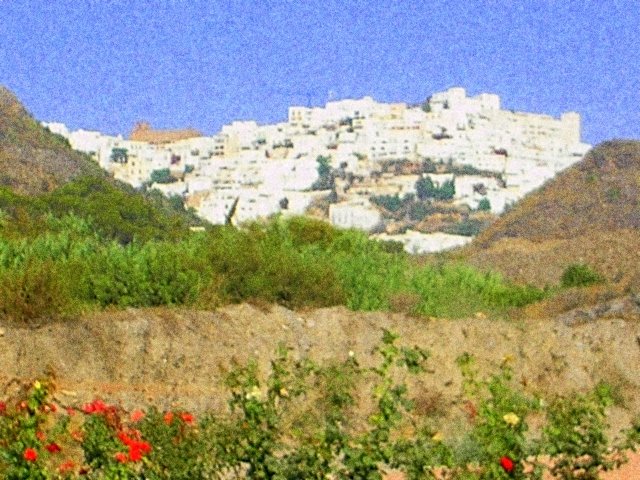
Here's a cute summer picture of Mojácar. It looks much more peaceful here than the reality of the holiday thrash. The August fiestas will begin on Friday 25th of the month, concluding on Monday 28th. There shouldn't be anyone left after that to party...

Wednesday, August 09, 2006

Dearest Beloved

Dear Ms Daboo, I was very sorry to hear about the tragic death of your father, the treasurer for the Bank of Umginginglovu. Truly sad.
Being a complete idiot, I believe every word of your tragic tale, and, since I am also a greedy idiot, I am intrigued by your kind offer to give me fifty per cent of the twenty five million dollars U.S. that your Dad left hidden under a rock just behind the B of U’s urinals. I understand that all I need to do is to give you my bank details, passwords and so on so that you can transfer this sum to my account, where I will hold it safe until you show up and I will give you half of it. I would be Honoured to be an instrument in your cunning yet noble plan to export your daddy's lolly to Civilization.
I have to tell you, I have received no less than seventy (yep, Seventy!) similar offers in the past month, all obvious frauds, and I must warn you to be on the look-out for clever yet dishonest people who rely on the duplicity of strangers.
Perhaps you should give me your bank details so that I can be sure that you won’t be defrauded.
Desmond.

Monday, August 07, 2006

Gimme a glass of milk – inna dirty glass…

Spain has always had an interest in milk, even if, until recently, you couldn’t find a cold glass of it anywhere.
The old milk was a definite bluish colour and came in a 1.5l glass bottle with a narrow top and a metal cramp, like a coke bottle. This stuff could sit in the sun for weeks without losing its taste and often did. Apparently, to help it last, they took the cream out of the milk and added a shot of pig fat. The blue colour came, apocryphally, from the formaldehyde that kept the mixture quiet. This explains why breakfast cereals came to Spain rather late. Pour that stuff over your Frosties, it would have eaten them before you could.
Later UHT milks from different companies, now mostly in the handy tetrabrik box, became acceptable for coffees and so on. A cup of (proper) tea would be shaken by this stuff, but you can get used to anything. Now, we even have sippin’ milk in the supermarkets. Tastes good.
While milk has never been considered a serious drink (despite the best efforts of some of the producers to tell us different in the usual kids adverts), it has certainly spawned a whole slew of versions. We have milk with vitamins, milk with calcium, skimmed milk, partially skimmed milk, milk with royal jelly, milk with acidophilus (a handy bacteria apparently found in drool), specially flavoured chocolate, vanilla and strawberry milks, rice milk and soya veggy milk. In point of fact, I doubt any of them ever loitered under a cow. Certainly Barbara’s pet calf, Petit Suisse, refused point blank to drink one particular brand, the Valencian-produced ‘Leche Ram’. I see the company has since gone pear-shaped. Perhaps the calf knew something.
At the same time, yoghurt has done just fine. I think I first tried yoghurts here in Spain as a child. The Danone people (a company from Barcelona), were putting out their early flavours by the time I first arrived here in 1966 (they actually started in 1919, selling the stuff in farmacias) and apart from the plain one (add jam and sugar), there was at least a strawberry one going strong. How long they might have lasted outside a fridge is probably best not to consider today. These days, there are an untold number of flavours clogging up the nation’s cold-shelves, with anything that grew on a tree or a stalk being processed into a yoghurt cup. You can now even get ‘Greek yoghurt’ (thicker than the usual stuff). Spain is not, with this notable exception, very kind to Greece (try and find a Greek restaurant, a pair of crapcatchers or a bottle of ouzo).
Together with yoghurt, another milk-based little number on the shelves is guajada, a set rennet made from sheep’s milk. It comes in a little stone pot. With a squirt of honey, it’s pretty good.
Spain triumphs with its ice creams. The main area for ‘artesanal’ ices is the interior of Alicante and Valencia provinces, notably Jijona (also famous for its nougat). Heladerías cover the main streets and offer dozens of alternatives. They (thank goodness) are all licenced, so you can put a shot of whisky on top of your tart. In fact, tarta al guisgüi (as the purists would spell it) is one of the best and most august of Spain’s postres, together with the ice-cream bar with two or three flavours (vanilla, strawberry and chocolate), natillas (a custardy thing) and the ubiquitous flan, the crème caramel. Then, there’s leche frita, or ‘fried milk’ – it comes in caramel covered chewy lumps – to try as well.
Before the fridge came along, and those fat blue bottles of Puleva ‘milk’ were still being used for arcane cooking reasons, Spaniards would often put condensed milk (which I think came from Holland) in their coffee. They still do, and as a ‘bonbón’, your coffee will give you a good kick-start.

Monday, July 31, 2006

The Water Carrier

Man, it’s hot! Apart from a strong wind in the afternoon, the air is flat, slightly steamy, and hot. No doubt the rest of Spain is hotter, since we are just a few hundred metres above sea level and only a few kilometres inland, but it’s bad enough. The weatherman yesterday told us that the hot weather we’ve been enjoying for the past two weeks is likely – to get hotter.
He didn’t look too worried; he probably has an air-conditioned home, an air-conditioned car and an air-conditioned studio. Come to think of it, he’s probably, partially, the reason why the weather is so bloody hot.
My house backs into the side of a ‘terraza’ – one of those thin flat fields that climb up the side of the hills and are built up with heavy stones that the peasants used to fashion before the water table fell and the foreigners arrived clutching wads of cash and golf clubs. Together with thick walls (it’s an old house) and high ceilings, it’s moderately cool inside.
We have mosquito netting on some of the windows – the cats are working on reducing the percentage – and a few ‘plug-ins’ here and there. The town hall claims that it has recently fumigated the area, and indeed, there are no other bugs around, except the aforementioned mosquitoes and their daytime friends the flies.
The shopkeepers are unclear as to whether they have sold more or less tee-shirts and humorous ashtrays this year (our sole commercial activity besides rum-and-cokes and apartments) although most agree that there are more visitors who, for some reason or other, spend less.
Since residents rarely venture into the humorous ashtray shops and favour their own tee-shirts (often displaying an amusing play on the word fcuk), the shop-keepers are keen to attract… yet… more turistas with plans to build a huge car-park in the village (containing a hotel, a disco, offices, apartments, tee-shirt emporia and other attractions which, together, - and let’s face it - pay more than parking spots do). Anyway, the walk will do ‘em good!
A new statue has been erected at the back of the village of Mojácar. It is the third in a line of mojaqueras draped in their finery. In fact, such mythical hooded creatures, dressed in shawls, skirts and aprons, with perfect chests covered in a brocaded blouse, with their faces covered with a shawl gripped between their teeth, would carry huge earthen pots of water on their heads up from the fuente. You can imagine how hot they used to get.
This particular one, in bronze, appears to be shaking the dust off her feet. She cost the Ayuntamiento 25,000 euros, and is the Parthian shot of our mayor Gabi, who will be handing over the keys to the petty cash to his successor RosMari Cano in two months. Whether a more appropriate statue for the pueblo would be a man dressed in sandals, hat and sunglasses, with a camera round his neck and carrying a small plastic bag with ‘souvenir’ written on it is hard to say. After all, we don’t like to recognise anyone’s efforts towards this community unless they are at least fifth generation or, at a pinch, in the air-conditioning business.

Monday, July 24, 2006

Sippin' with The Pope

One of my favourite drinks in Spain is an iced milky drink called horchata. It tastes sweetly of nut. The drink is originally from Valencia and it is made from sugar, water, cinnamon and tiger nuts. Since no one knows what a tiger nut is, we might as well stick with the Spanish name, chufa.
The plant (I discover) is a kind of tuber, very good for you and all that, and almost impossible to get rid of if it is growing in your garden. On the bright side, you can always make more horchata since the drink only lasts a few days before spoiling.
Not many people like it, which seems a shame, and the drink is low on the list of an Almerían bar’s priorities, however, after twelve hundred years or so in relative obscurity, its time has finally come. As so many things in Spain, horchata has become political.
It started the other day, with Pope Benedict XVI’s visit to Valencia.
Now, as the Partido Popular has slightly lost its teeth while the government espouses its new ideas, which could be summed up as ‘all change’, the champion of good old family values, whether as a Catholic or not, have been firmly passed to The Church, and its leader, the German Shepherd.
Dressed in white for purity, and quietly ‘not connecting’ with the president, the Pope’s two days in the Levante city were a success for the faithful – those who yearn for the good and simple times of the past, a more innocent age, in short, the small ‘c’ conservatives.
It has always been told that horchata was invented by the Valencians during the time of the Moorish occupation of Spain – which lasted for a pretty healthy seven hundred years or more and helps explain all those Moors and Christian festivals and why they keep putting up statues of hard-working mojaqueras with their faces covered all over Mojacar. At any rate, such a Moorish girl had once lifted her veil just enough to take a healthy chug of some milky looking drink when a Christian king, Jaime 1 de Aragon, happened along on his horse and asked if he could have a go. ‘Cor’, he said, ‘this is gold, girlie’, or, in valenciano, ‘Això és or, xata!’. Horchata.
During the Pope’s recent visit to Valencia, now one of the hold-outs of conservatism, Catholicism, anti-Zapatero-ism and so on, the horchata makers filled the city with wheeled carts and sold the drink to the pilgrims. The Pope, following in Jaime’s royal footsteps, was graciously inclined to take an iced glass of the beverage, pronounced it delicious, and thus nailed its fate as a truly catholic… well, you get the picture.
Let me help. The drink is made by small manufacturers (not evil multinationals) and is the only thing that’s wet that cannot be mixed with any form of alcohol. It separates instantly when a shot of grog hits it. That, and it’s white.
Please contrast this refreshment with the socialist’s preferred beverage – sparkling wine from Barcelona. The ubiquitous cava!
And horchata is good, too. Perhaps an acquired taste, but I often enjoy one during the summer months. Unfortunately, come October 1st, like homemade ice cream, the tourists and (hopefully) Mojacar’s mosquito population, horchata disappears for another season.

Friday, July 21, 2006

The Phone Cut

The phone had been out for a few days, but the internet was working. It may not last, but that’s actually an ideal state to be in. The children can’t whack up the phone bill, you can still receive calls and you can surf on the web – or indeed write rude and regular things about the carpetbaggers on your very own website.
It can’t last though. Sooner or later the electric company, Sevillana, is going to have one of its click-clack power shorts which is apparently caused by birds taking off from the line from Vera and has nothing to do with the poor maintenance on the equipment or the splendid cars operated by the share-holders.
So, it happened. The brief thunk of the power stopped the internet connection, and I was once again obliged to deal with Telefonica. That, or to ceremoniously disembowel myself on the kitchen floor, which is generally considered less painful.
I started yesterday, in the office, by ringing Telefonica on 1004. I then tapped in my phone number. I then listened to music. I then met Alfredo, who rather thought it was a technical problem and not a mere overdue bill. After trying to sell me a special summer telephone deal, he passed me to a colleague who was of the sound opinion that there was nothing wrong with the line and that, indeed, coughing up something in the billing department would do the trick and, oh, by the way, could I press a button to tell the company if I had been treated politely. A number one, if I would be so kind.
The new billing lady, after making sure that I knew my telephone number and wasn’t in fact carrying a false residence card number – which I was as a matter of fact, as the phone is in somebody else’s name – finally gave me a price.
You can only pay your old phone bills at the Banesto bank. There’s one in the village.
I drove up the hill, past all the parked tourist cars, and then down the other side for some distance. It’s hot and dusty and a pull to totter up to the top again, just to pay the 100 euros and eight cents that the Telefonica company wanted.
The Banesto bank in the pueblo is a small room with two tables, one computer, a few concerned looking ashtrays, and a sign saying that you can only pay Telefonica bills on Tuesdays and Thursdays and before 10.30am. And an air-conditioner. It’s Thursday midday and I’ve spent enough time on this. But, on the bright side, I'm cool.
The bank flunky tries to send the wretched company a transfer anyway. But the computer won’t accept it. ‘Come back on Tuesday morning, early’ suggests the fellow. Or, perhaps he said ‘wear something light and get the morning off from your work. Another five days without phone or internet will put you in a splendid mood. Your walk up the hill, past all the accordion players and elderly beggars will place you in a happy frame of mind and when I finally take your money you will be pleased to consider that, in a mere 48 hours after the transfer, your phoning and surfing rights will be fully returned to you’.
I went into the bar next door. Carmen is nice. She set me up a beer as I rang 1004 on my mobile phone. Typed in my number. Listened to music, diddle di diddle di dee… Our operators are busy, please call back another time…
So I was talking to Carmen while holding the phone to my ear after another attempt, when a voice suddenly came on in… English!
‘Yess, how can ay help you?’ ‘Lissen, girlie, I wanna pay my phone bill and the stupid bank says that the figure is wrong and I’ve spent the whole morning farting about and I…’
‘Yes sir. The computers are down here. Call again later’.
So I will.

Tuesday, July 11, 2006

A Sporting Update

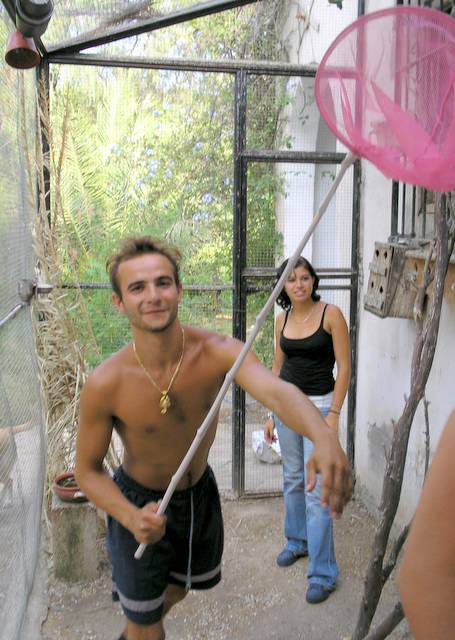
I was raised on the fine novels of H. Rider Haggard with his heroes like Alan Quartermain and The Elephant Hunter. Here we see an example of such an intrepid person as he pursues the common sparrow, a regular invader of our birdcage.The sparrows somehow get in, and make themselves at home. The regular tenants, the lovebirds, aren’t too taken by this invasion of gatecrashers. Step forward – the Great White Sparrow Hunter.

Note: no sparrows were hurt in the making of this photograph

Concert in Cartagena


Without doubt, it’s the oddest city on the Spanish mainland. Cartagena (New Carthage, Cartago Novo) is a navy city about 60 kms from Murcia.
Imagine two mountains, with the sea flowing in between them. A third mountain stops the sea’s progress further inland. This third mount has massive fortifications and is topped by a castle. Around and behind, the city stretches, in most cases old, bombed out, collapsed. Narrow streets with boarded up shops and ornate nineteenth century fronts held up by builders’ supports. Old bars – the type that looks like a garage, you can pee out the back. Arab tea-rooms (no booze, but good lamb dishes). The occasional massive colonial structure or military barracks in mothballs. We walked down one narrow street (in the Arab quarter) which decanted apologetically into the ground floor of a ruined house. Wire on the left held us from a crag with a tower on it. The track continued through the wall of a vestibule straight into a small room with a virgen in it and a dozen lit candles, and out, left, into the sunlight again.

Cartagena has a political party (currently just one councillor in the ayuntamiento) which wants independence from Spain. In 1873, The city not only had a majority for the Partido Cantonal, it actually declared UDI and, worse still, declared war on the rest of Spain. It took an incredible six months before Spain’s forces could overrun the rebel city (in January 1874). These days, they talk about leaving Murcia as, perhaps, a good place to start.
The city was an important naval port. With the end of conscription and a new professional navy on the passing of Francoism, Cartagena went downhill. Never a pretty place, with the money turned off the city took a powder. Today, European funding appears to be re-awakening the ancient city from its recent slumbers and a new (and apparently pointless) toll route is being built between Cartagena and Vera.

We were there for a concert. To get to the castle, you have to walk around the mountain from the main avenida, then, you can only climb the hill by taking a ho, in your face, modern glass zippy-lift up to the top, then along a stainless steel structure with lights… onto the castle forecourt. Dozens of peacocks were sleeping there, perched high in the pine trees or on ornamental bridges. The port far below between those two mountains, illuminated by the full moon.
The concert tonight was Abdullah Ibrahim (as Dollar Brand calls himself now). Dollar Brand – I knew him back in 1975 – is a wonderful pianist from South Africa. He led a trio with a two-hour concert in front of a narrow tower up on the high mountain. Just a piano, a double bass and percussion. And the odd cry from the peacocks…

The walk back was spooky. No one on the streets. Hardly any lights.
The hotel was modern and ho-hum. The air conditioning leaked drip, drip, every second or two. It was their carpet.

Sunday, July 02, 2006

Oldies but Goodies


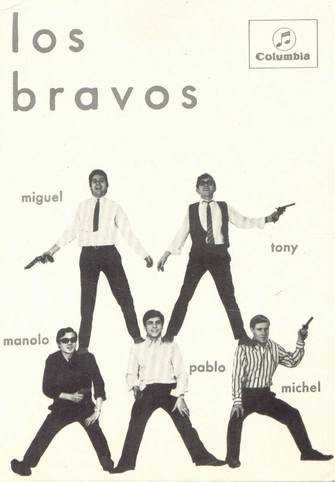
I’ve got the record somewhere, featuring that song which goes ‘black ees black, I wonn my babi back’, the smash hit for Los Bravos in 1966. Not bad, that, as it was a rare foreign pop group that made the US charts (Nº 4 in the top 100) and the Brits (Nº 2 in the fab fifty, our pop songs always being worth twice as much was theirs). Los Bravos had a German singer, little Micky from Berlin, but the rest came from Spain. Micky was the youngest, born in 1945. He’d be 61 now.
Los Bravos are coming to play a concert in Vera on August 11th. I hope that the concert hall is wheelchair accessible.
Better still, Los Puntos are also billed for the occasion. Los Puntos were a band that produced an endless supply of Beatles-like smasheroos in the mid to late sixties. They came from Cuevas (the next door town to Vera) and still perform on occasion. Pepe Grano de Oro wrote a song (anthem) for Mojácar a few years back.
About ten years ago, while enjoying a rare holiday, I saw Wayne Fontana and the Mindbenders on a cruise ship. I think the bassist was a replacement (he still had all his hair), but the rest were very much the original line-up. Wayne wore a hat.
Typically, the group would perform one of their hits (Groovy Kind of Love, The Game of Love and so on...) and then, at its conclusion, would hold on to their instruments for mutual support and attempt to recover their breath. Whoo! Thank goodness songs were only three minutes long in those days! Wayne would tell a joke as the others took their pills. We didn’t care, we knew what it’s like to pant and wheeze.
I hope little Micky from Berlin will be OK up there on the Vera stage, as concerts here tend to start rather late. Los Bravos might be on last, after Jeanette, Tony Ronald, Los Puntos and the rest of them.
Vera August 11th Oldies Concert. Vera bullring from 11.30pm

Friday, June 23, 2006

I used to be a Linesman

I’m obliged to balance my life around football this month – as if the last eight months had never happened. The endlessly televised sweep of a team of over-paid egoists regularly proving to the world that the best thing to do with your head is to beat a ball with it. It certainly beats learning something, even if it’s as ephemeral as the weather program on Channel 87. My associate on the paper is from Valencia, so we have had to close early over the winter and spring on the nights that his team was playing. Or carry on working I suppose at a kind of half-speed. In fact, close early and have a whisky with the Russian girls over the road. It has its positive side.
On football night, the whole town would be quiet, apart from the bellow of a million television screens and the occasional shriek from the viewers along the lines of ‘shoot the ref’ or ‘kill the tropical gentleman playing wing for the other team’. This being a loose translation, but one that, I hope, manages to maintain the sentiment.
Eventually, two things would be bound to happen. The first would be a dozen heavy explosions as Pedro, the town pyrotechnican, blasted skywards a few rockets substantial enough to have given Werner von Braun a flutter of pleasure, regardless of who won as long as somebody did (Werner’s sentiments exactly), and, secondly, the final whistle would invariably presage a great outpouring of voluble football fans into the streets, bars and knock-shops of the community.
But, with Barcelona apparently winning every cup ever cast, plated or pressed, with ‘their foreign team-maters’ beating ‘our foreign team mates’ (assuming you’re a Real Madrid, Valencia or Seville supporter), I had kind of assumed that the whole season was finally washed up for another year. Actually, another three months, but, even that’s a start.
It’s our own fault, of course. The game was invented by the English – apparently as an economical way of keeping warm. It was later introduced by the Scots (who had previously been prospecting in the hills and run out of porridge) into a small mining town in Murcia in the later part of the nineteenth century. In fact, the oldest footie pitch is still there. In Aguilas!
Spain’s most famous commentator is English. He’s called Michael Robinson and he used to play for Osasuna (who did rather well this year). If you know him and David Beckham (who he? – Ed) then you can usually get a drink or two out of it. Of course, if you know Ronaldihno, you might get a full dinner…
Now, to my recent surprise, the world cup has started. Trinidad and Tobago against Finland. Most unfair, Finland should have teamed up with Sweden and given them a good thrashing.
Catalonia wanted to field its own team – after all, in the Reino Unido we have Scotland, Wales, Northern Ireland, England and the Scilly Isles all fighting their corner, so why shouldn’t the really-jolly-nearly independent republic of Catalunia have its own chaps? Spain (or if you prefer – the lumpenspain) is in fact quite in favour of the idea, considering that any Catalonian player found in the Spanish team would probably score an own-goal just out of spite.When another country’s team plays, even if we couldn’t find it on a map, we roar with pleasure or rage. Pathetic. Personally, if Ethiopia beats Cyprus or not, I can truly claim not to care – as long as the office doesn’t close early again.

Sunday, June 18, 2006

I was probably dreaming all along


Two pictures from last night.
The truth is, the first picture is posted here for the pleasure of a ‘statistically appreciable minority’ of those that visit this site – namely, myself.
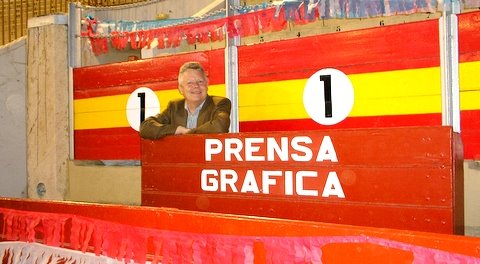
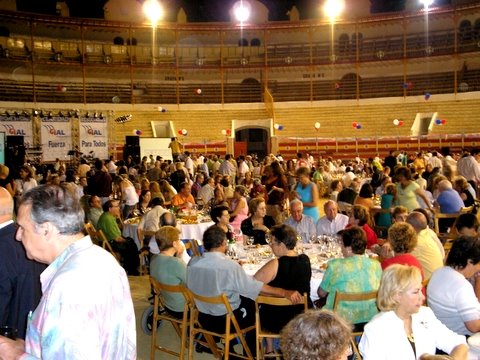
Well, you are welcome to marvel at the picture (a rare portrait of your guide to this site, taken last night in a natural pose in, for some reason, the Almería bull ring, where, as you can see, I was not entirely alone). If there’s a point to this posting, it’s that you can always find something peculiar, interesting, remarkable or unforgettable if you tear yourself away from the television, the football and your English neighbours and go and try something different. That and… it’s best to take a camera.

Thursday, June 15, 2006

No Spitting on the Bus


So, you can see what happens during the World Cup. Between the fans staying either at home, or at least in front of the TV set inside, together with the still far from calm weather (it's mid June and still snowing), there's not much action on the deck.

Today, a number of cars are supporting little flag-poles together with their national emblems stuck to their back windows as they motor past. Quite embarrassing for the ordinary folk - especially those who had carefully ordered one from Trinidad and Tobago. In retrospect, it's just as well that they arrived late at the post office...

Meanwhile, as an occasional shriek filters out from the bar inside - either a free kick or one of the Russian girls dropping a beer down the neck of a punter - the terrace is peaceful and calm.

Like the old days...

Saturday, June 10, 2006

Medieval Market in Mojácar


It's a surprisingly overcast weekend, with some rain over Mojácar and lightening up in the hills beyond. This morning, the second day of the three-day Moors and Christians bash, I staggered and wheezed up the hill from the Campo de Fútbol - converted into a parking lot - to have a look at the medieval market and the street musicians.

Nevertheless, in my picture, the new Morales leasure centre and business emporium has stolen into centre-stage (that's the massive crane above the hulk). I'm told they've all got a small hallway each where they will soon be able to sell teeshirts and humorously shaped ashtrays to their heart's content.

The market is fun, with the vendors dressed up in sacks and selling plastic key-chain witches, oulde bed-side lamps and other memorablia from a byegone age. A rather good street-band hops past playing an old Malicorne number on whistles, bagpipes and drums. A Rumanian accordianist twitches into 'O Sole Mio' outside the Indalo to the faint horror of the tourists. Spare a shilling, Guv?

A Mojaquero decides to drive his car through the square and up to his eyrie. Outta the way, he honks at the tourists. It should be fun tonight.

Friday, June 09, 2006

A Trim Little Number in Yellow

The phone rang. One of the kids had been messing with the damn thing so I wasn’t immediately aware what was going on. The CD was belting out some fine blues and there was this thin weepy sound running below, just on this side of conscious. A mild arrhythmia over my heart finally helped me put it together – the damn mobile phone in my shirt was vibrating and… yes… actually crying to be answered.
Which was a relief in one sense, I’m not going to keel over the steering wheel with a cracked pump and disappear with the old banger over the cliff. At least, not today.
Talking on a mobile phone is illegal when you’re driving. Like many other agreeable activities which one can get up to behind the wheel, yes… many agreeable activities (dreams for a moment)… Whoa! I almost left the road there. Jeez – that was close.
So, since I don’t have a chauffer like the head of the traffic department, a political oaf called Pere Navarro, and therefore can’t answer the phone and plan my next piece of business; and, unlike Mr Navarro, who is concerned about the heady mixture of saving lives, pissing people off and furthering his brilliant career in the PSOE, I just want to sell another set of encyclopaedias… Shit! I'll have to pull off the road.
There’s a handy lip on our roads, called the arcén. That’s where you go when you need to stop the car and do something else. You don’t want to spend too long on the arcén as it can be quite dangerous, with truck drivers thundering past your narrow ledge of safety or perhaps, nodding off as the tachometer clicks into the red, they drive straight in, through and over you. The sod never even noticed.
Then, there’s the road-cops, los primos. The cousins.
You can’t loiter with your vehicle on the arcén unless you have your emergency lights on, are wearing a kind of psychedelic pyjama top and have placed your warning triangles both fifty metres before and behind.
Unless it’s a motor-bike. They haven’t figured out where you can carry the triangles yet.
If they show, the cops are going to want to see if you carry spare light bulbs, a driving licence and the rest of it – and they will be looking for illegal immigrants hiding under the spare wheel, traces of narcotics in the ashtray and an illegal radar trap apparatus stuffed down your jumper.
Pere Navarro has introduced the ‘points system’ now. You start with twelve on your licence and the police are under instruction to start the carving. Aggressively. They take any more and, shit, I’m walking home. It’s all right for Pere, he can always get another chauffer.
All this to answer the phone, which has stopped ringing by now anyway.
So, I pull the stupid yellow day-glo number on, over my head. The price tag is flapping on my chest so I wrench it off and (no one looking) throw the bloody thing into the undergrowth.
To the boot of the car to get the triangles. You need to carry two of them – one for ahead and the other for behind. They had better not blow over, the cops might think I just threw them onto the road in a petulant rage.
I take the first one up the road and pace out fifty metres, forty-nine, fifty. Then back to the car and repeat the same process the other way. I will have walked over a quarter of a kilometre by the time I'm through with this but, anyway, I’ve dumped the second warning sign on the ground here on the curve and I've brought the phone and am now gonna…
-Eh Oiga!
There’s some bloke up-road from me. He’s standing a hundred metres away, just by my front triangle. It trembles in the slight wind. –You wanna buy this thing off me, he shouts.
-You fuck the fuck off, bastard! A huge trailer rumbles past and the triangle, grateful for the distraction, is blown off the border and flitters down into the valley below.
I’ve picked at the phone now for the re-dial and am walking back to the car, one eye on the gypsy and the other out for the cops. I’ve got my surviving triangle tucked under my arm where it gently rips my pyjama top.
It was a wrong fucking number. But you knew that.

Thursday, June 08, 2006

Los Moros y Cristianos

The Moors and Christians is a fine old traditional fiesta which dates all the way back to 1988 when somebody decided to dress up as a Moor – a north African warrior – and following this sartorial decision went on a three day bender in Mojácar, finally waking up in the holding cell of the Almería immigration Police where only a bent and slightly moist Spanish identity card stood between the hung-over celebrant and a one-way trip to Casablanca.
His shoe-prints can still be found on the inside back door of the Mojácar paddy-wagon, next to the dent caused by Peter Honey’s head as he engineered his daring escape on a steep hill approaching the Huercal Overa hospital after being taken, unconscious and just in time, from the gentlemen’s lavatory located, vaguely speaking, somewhere behind the Bar Indalo.
Times change, and now thousands of people will dress up as Moors (a sheet, a pair of slippers and a readily available ID card being the main features) or as Christians, where an all-weather suit, an orange tie, brogues and a trilby hat is the obligatory dress. It's theoretically the celebration of an agreement made over a glass of blackberry juice in 1488 by the local mayor (a Moor) and the leader of the besieging Christian forces who was anxious to carry on towards Granada (where you could get a decent beer).
The three-day jag ends on Sunday afternoon (June 11th) with an endless procession through the main square of our town and off, away down the hill to the awaiting busses below. Six well-represented guilds, in full and exquisite costume, will make the march-past, with a ambulatory band between each one to keep the peace and provide musical refreshment for those onlookers too foolish to have found shade and shelter in one of our agreeable if slightly over-priced bars. Although no tomatoes are thrown, no bulls are loosed and the paella has usually all gone by the time you’ve found a plastic plate and scraped it clean, the Moors and Christians is a festival that is certainly worth visiting.
Tell them I sent you.

Friday, June 02, 2006

One of those Concerned Citizen articles


This is a picture of a bit of road. Yes, yes - prize winning stuff. This portrait of a piece of the King's highway is just below the Mojácar fuente and is taken on the first bend going towards Turre. It's a highly travelled road, with the one-way traffic through the pueblo returning on this section, plus the through traffic going both ways. It's serpentine, narrow... and is heavily used by pedestrians who live in the barrio down below, or who are walking to and from the cemetery, preferably dressed in black. There's never been a side-walk here, but there used to be a kind of narrow way for walkers which, with the nice new metal traffic-guards, has now been made redundant.

Previously, you would merely fall to safety if a bus was coming up behind you or, at a pinch, you could tangle yourself with a cyclist panting up the rise in his purple acrylic outfit and silly hat. Now, to avoid the increasingly speedy and dense traffic, a pedestrian needs to be able to - hop - leap over the balustrade before dropping several metres to safety.

It's not that easy, says the town hall. The road belongs to the diputacíon - the county council. They won't consider a side-walk here (until somebody presumably kicks up a stink). However, the town could incorporate this stretch of road (it's within existing city limits) and create a pavement, probably at the cost of some minor expropriation.

Or, how about this. They could put up a 30kms speed sign...

Friday, May 26, 2006

The Cold Cut

I was in Pamplona last summer when I was suddenly taken short by an urge for a haircut. You know how it is – by this time of life, you are not too keen on being wrapped in a sheet and seated in front of a huge mirror for twenty minutes contemplating your fallen chin while a flunky clips away at your head, but, on the other hand, you’ve just broken (or mislaid) your comb.
The somewhat gabby hairdresser lady established that I was a tourist, had once ‘run the bulls’ (madness!), loved to eat fish à la Navarro and pointed out that there was nothing like a trip to the ‘pelu’, the hairdresser, to pass some time. She motioned to Brad Pitt on the wall behind her and we agreed that, yes, I’d like to look exactly like him.
I had a ‘Number Four’. An electric clipper thing with a bit extra on the top (in case a future barber or member of Brad Pitt’s family reads this).
There’s a lady in Mojacar who seems OK. She looks like Lisa Minelli. She runs a hairdresser just downstairs from the office. I sometimes belch, break wind, sneeze, hoot or yap as I pass her office. It’s nothing personal, it’s just next door to a popular bar. Sometimes I inadvertently surprise her as I groan from a cold beer or snort from some minor blockage caused by a shrimp. It has occurred to me to be embarrassed by these small yet regular dramas, but I reckon it’s her move first.
Lisa once cut my hair, in the days before I knew about choosing a number for my grooming pleasure – now that I come to think of it, a convenience similar to dining at the Chinese (Numbah Foll - and easy on the MSG).
Normally though, I go over the way to this gloomy fellow called Pedro. The idea will come to me (must cut hair) as I pass his shop and, if it’s empty and Pedro is evidently immersed in his newspaper, I’ll go in.
Numero Cuatro I told him today. Easy on the top.
Walking back to the office, surrounded by flies attracted, I suspect, to the hair-gel that Pedro has slapped onto my head, I was visited by a violent sneeze. The kind that shrieks. Yaaahhh!
Just at that moment, as a bullet of snot ricocheted across the empty walkway, I saw a startled looking Lisa Minelli having a smoke on the terrace. I’m not sure, but I don’t think she was very impressed.