Sunday, February 26, 2006


Friday, February 24, 2006
Mojácar's Ten Parties. That's Democracy!
Mojácar managed nine (PP, PSOE, IU, ASIZ, GIAL, PA, NGM, Mojacar 2000 and PSA - the last two not getting any councillors) and, with the (inevitable) coup d'étât held in 2005 (the four parties in power were dislodged after one member of the PA was persuaded to 'cross the floor' and seek his fortune elsewhere), we now have the curious mixture of 2 socialist PSOE (not supported by their own party secretariat) running the town hall and supported by 4 PP conservatives (the leader of which had earlier been in the PSOE and was instrumental in another coup) plus, of course, the turncoat ('transfuga') now in the 'non-aligned' or Grupo Mixto party. Which makes ten.
Meanwhile, one of the PP has died, and the ex-mayor (ASIZ communist, allied with the Right Wing GIAL, the NGM and the nationalist PA), right after announcing he was joining the PSA... has been forced through ill health to abandon politics.
So now the PSOE mayor (supported by the PP, although the pact has not received support from the Almerian PP - understandably) is coming up to a year in power. There's one final year to go in this legislature and, one can't help but wonder...
Will the PP leader be given her chance to be mayoress?
Certainly, few of the above worthies will have much more active politics left in their futures... One can only hope they have other plans...
What will happen, too, when the foreigners decide to vote conscientiously? In Mojacar, better than half the potential voters in the local 2007 elections will be British residents. Assuming the padrón (from which comes the voting list) isn't re-examined...
Say again, what will happen if the Rumanians get the vote?
Tuesday, February 21, 2006
Close Call - and me so young...
As some bastard failed to do to me this afternoon, missing the front of my old banger by an inch. Quite a shock. I’m gonna have a drink now. And then go driving…
Sunday, February 12, 2006
The Road to Mojacar
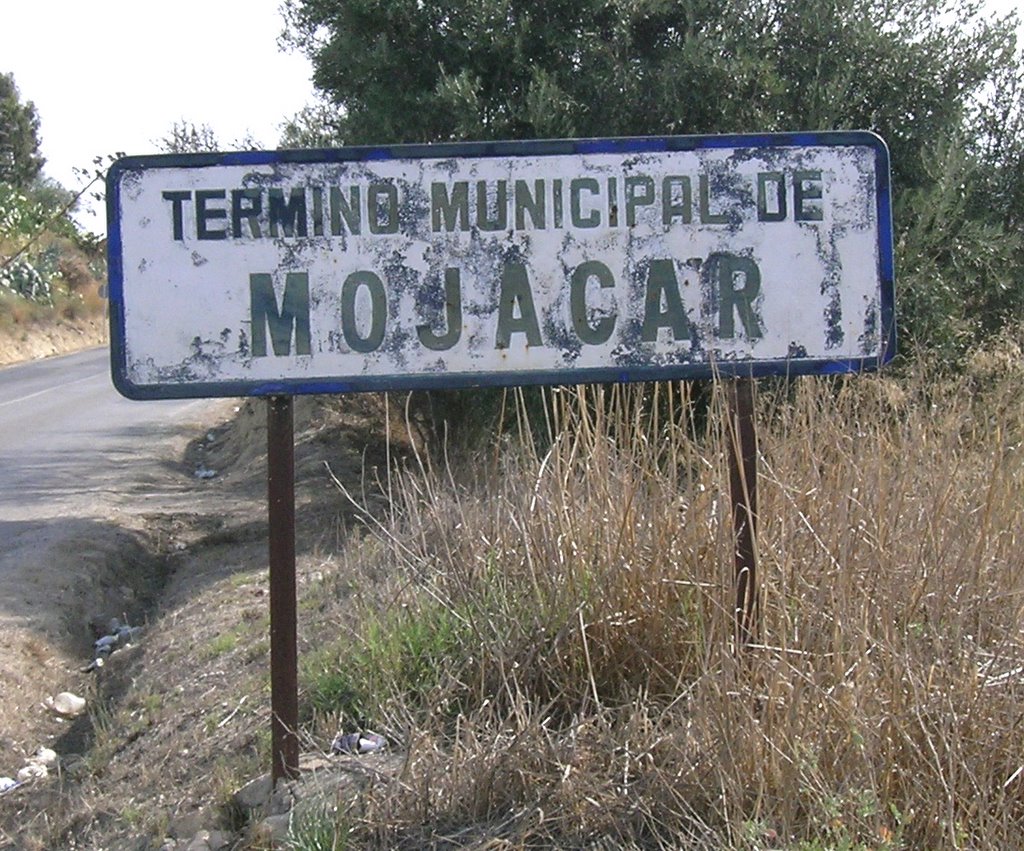
Welcome to Mojácar. You have just left (the quite simply glorious) municipality of Turre and are heading towards the coast. The road is full of pot-holes and curves, but, in a few kilometres, you will arrive at the fuente where you can turn left towards the playa or right towards the pueblo.
The road was built in 1950 and has received little attention since. It is narrow and dangerous. The last bit goes through a populated area where the huertas are and this final half kilometre or so is heavily used by pedestrians. There is no pavement and a cliff on one side and a drop on the other make it an alarming place to walk, especially if you are dressed in black and on your way to the cemeterio on a visit.
The fuente junction features two zebra crossings, a blind corner and a bus stop. Right on the road. There's nowhere to pull off. This is also the location for the Sunday flea-market where parking is chaotic. The current plan is to make a rather small and cramped roundabout here.
The road is heavily used as it takes both the Turre traffic and also completes the one-way system through the pueblo. The pot-holed, narrow and serpentine road is not safe and the diputación (county council) seems to lack interest in widening it and building either a pavement or an alameda (a separate pedestrian pathway). They have, however, fixed the Turre high-street so one can always live in hope.
It falls to the Mojácar ayuntamiento however to solve this problem. They can either oblige the diputación to come in or they can incorporate the road, or at least the last bit of it, and make the necessary repairs themselves. The money (our money) is certainly there, but appears to be earmarked for rather more exotic use: like attracting visitors rather than attending to friends.
Animo: Charity-work in Spain
Back in around 1988 here in Spain, she introduced hippotherapy to the country, which responded by attending her seminars in Mojácar, following her ideas at her centre ‘Animo’, which had around forty volunteers and as many ‘students’ (no charge). She was fêted by the charities here in Spain, particularly those in Almeria City, who promptly followed her ideas, copied them, and re-tabled them as their own (one charity taking 90,000 euros from the government for a proposal based on Barbara’s work).
She kept eight horses, four donkeys, wild boar, sheep and goodness knows what else. She travelled to Madrid, Barcelona, Albacete, France, Switzerland and Germany to give speeches and attend international conferences with, for example, the FRDI (International Riding for the Disabled Foundation). There wasn’t any official help for these activities, and someone stole the tins we left in the bars.
Many charities in Spain enjoy a sinecure, a position which provides jobs and security, and for the senior staffers and wise old-timers, a new car every couple of years, position, notoriety and wealth. Not much work, necessarily, but a steady income and few criticisms. Even when they swipe things. We know of:
A charity which places jobs for the disabled, and takes 20% from the employee – for the life of the job.
A national charity which sells off properties and pinches the money.
A national charity that forces another national charity to close down part of its operations.
A charity which works with wheelchair users on the second floor of an office-block. No lift.
A charity which takes children from the Sahara, only to return them as the accountant has walloped all the money.
A charity that doesn’t use trained personnel.
And so on.
Of course, there’s more to it than that. Collecting money in government grants is time-consuming, competitive and labour intensive. The nation is partial to its paperwork, and no where truer than in the search for funding.
There are agents who will do it for you – for 20% of the pot!
There are, of course, many wonderful people to be found in this field, selfless and extraordinary people working in fine organisations. Médicos sin Frontera, Sac Xiroi and Asprodalba (Vera) being just three very different but entirely magnificent examples.
However, a few bad apples…
Barbara doesn’t write about that stuff on her site, she prefers to concentrate on how animal assisted therapies can work, for whom, how to do it right, the dangers and the triumphs. Find her site at http://animospain.blogspot.com/
Wednesday, February 01, 2006
Almería: So many Houses
Planning or building should never be a haphazard affair, and town halls are meant to produce a General Plan to drive the municipality forward for the life of the plan, which is for eight years. Since General Plans tend to ‘lock in’ the way forward for the urbanisers, these documents are hard to reach consensus, and many a town hall has ‘fallen’ before these agreements can be ratified and cast in stone – or, rather, concrete (viz. Mojácar three times in the past 20 years).
These plans, once thrashed out by the Good Ole Boys, are then sent to Almería for approval, or redesign.
Imagine if the town hall plans -the PGOU’s - for the entire province of Almería were accepted by the provincial representative of the Junta de Andalucía. We would have – instead of the current 600,000 inhabitants, somewhere around 7,600,000 of us by 2013. Here are the proposed populations (gleaming in the developers’ eyes) in eight years time for a few of our local dusty, dry and sleepy villages.
Cuevas, 500,000. Vera, 400,000. Antas, 200,000. Mojácar, 110,000 (no roads of course...). Bedar, 20,000 and Los Gallardos 25,000. Albox 50,000 and Arboleas 40,000. No doubt, our local friends all plan to have large families in the next few years. Either that, or they hope to sell everything to the foreigners.
There is a debate going on in the province at the moment as to the advisability of building so many ‘homes’. A debate between politicians and builders, urbanisers and property owners: in other words, an excellent cross-section of our community!
Almería is already the fastest growing province in Spain, with 44 new houses per thousand population built in 2005 (compare the second ‘fastest’ province, Guadalajara, at 19 per 1000).
While the residents currently living in those communities are, presumably, reasonably content as things go, increasing the numbers of neighbours by a factor of twenty is not going to improve the quality of life of those who have chosen this province to live their days in, nor, indeed, the quality and quantity of their water, their views, their safety and their society.
Those residents who fail to register themselves on the padrón – the town hall register – are partly responsible for the lack of existing services, whether taxis, policemen, doctors, teachers or – in point of fact – English-speaking personnel (or even, blow me down, British-born personnel) working in the public sector.
The padrón accounts for the number of population. Each person counted allows some small extra funding to the municipality from the government. There is more road-works for the ‘larger’ towns, more help, promotion, more aid and importance for those communities.
A ‘tourist town’ always suffers in some degree from having its population numbers (and therefore its services and funding) being rather lower than the reality. By having a number of residents not bothering to support their community – to their own disadvantage – the problem is shamefully compounded.
In Almería, there are officially 9,800 Brits. The British consul, on the other hand, reckons there are 25,000. That’s better than half of all the British citizens living here not bothering to support passively their adopted communities.
To register on the padrón, just go to your town hall with a copy of your passport, and your escritura or a long-term rental contract. The information is not passed to the tax authorities. Repeat: ‘not’!
Finally, if you are worried about your town growing into a giant residential monster in the years to come, you could be re-assured by being on the padrón, as this puts you (if you are European) onto the voting register: and there are local elections in 2007.You could vote for moderation.
Monday, January 30, 2006
Red Letter Day
This month, so far, two other letters are on my desk for inclusion which accuse me, I suppose, of the same thing. Being right-wing that is. One deals with an editorial I ran in January about the Catalonian ‘estatut’, a translation of a very funny piece from Angel Medina, while the other letter throbs with indecent rage about Peter Gooch’s regular political articles.
Peter Gooch, in fact, gets more ‘fan-mail’ (in the form of comments from John Q. Public) than the rest of us put together. About three quarters of them are favourable. The other most assuredly aren’t. His articles are certainly anti-government and anti Zapatero, but this doesn’t make them rabidly right-wing – just ‘sensible’.
Both papers operate on a ‘as long as its well-written’ basis and we have never taken the Partido Popular shilling (supposing they were to offer it).
Some of our writers are leftist, some are rightist. It makes no odds.
At least we get letters, for which I am grateful. Generally, I try not to answer them in print, leaving the letter-writer with ‘the last word’. After all, the letter is commenting on an article. The writer of that article has already said his piece…
Like classified adverts, letters are a proof that there is a reaction from the street. People evidently read our newspapers, and they use them to communicate between one another, through those two services, small adverts and (usually) indignant letters to the editor. Me!
A newspaper or magazine with no letters or private adverts is, at the very least, a bit lightweight, don’t you think?
To make a paper interesting, to generate some reaction from the readers, one needs to sometimes climb over the top with fixed bayonets. It’s more of a trick that a reality. Otherwise, editors would choose cereal-packet journalism.
Come to think of it, some of them do.
Saturday, January 28, 2006
Watch Your Language
Now, this doesn’t matter if the quiet language there underneath is Inuit, but it’s a bloody nuisance when it’s English, because you can understand the underlay, you can understand (espero) the overlay… but you can’t understand a bloody word when they are both going - more or less - simultaneously.
The Spanish rule on dubbing is easy enough. You name it – they dub it. In films, they turn the original soundtrack off completely and let the dubbers do their worst. The exception to this – in most but not all cases – is when the singalong arrives. Here, the song is left in the original, with subtitles added. These can be quite useful if you never understood the words of the song in the first place (ejem. The Singing Postman).
On Spanish satellite telly (which I hope you have at home), there’s a facility for watching the show in its original language, which makes sense in a place like Europe. They will, since being European is no threat, also show films made by the French. Who are masters of the ‘Seventh Art’. Of course, the original version, as supplied by a button on your remote control, will be in français, but you can always watch it in Spanish…
With this idea - original language at the touch of a button, there would seem to be little reason why much original material, whether comedy shows or BBC documentaries, suffer having the original language wiped. It happens. I watched a BBC film about Sam Cooke the other day – in Spanish, followed by another music documentary – this time about Queen – in English.
Dubbing was an invention of the bad old Franco years. Only Spanish to be spoken, gracias. It is a good way to lightly censor films, helps our less literate members of society with the longer words and… keeps about ten people in the style to which they have become accustomed.
Thursday, January 26, 2006
Wipe away a tear for the Catalonian flag
Over the past hundred years or so (and perhaps before), the Andalucians have thought of Catalonia as a place to go to get a better paying job. Not surprising, really. Catalonia is the wealthiest part of Spain. I don’t think that the Andaluces – or any other immigrants to that area – are particularly concerned about the politics as long as it doesn’t affect them much. Catalonia’s plan to become its own nation, however, supposes a couple of things that fly in the face of the rest of the country.
Firstly, the insistence of the Catalonians on speaking (and forcing everyone else to speak) their own patois, a language which may have some cultural consolation for the Catalonians, may be natural to speak at home or amongst one’s own, but is in international or commercial terms, a dead duck. There are no institutes elsewhere in Spain that offer catalán as a course, and, there’s no one who would want to learn it anyway.
By insisting on the use of this language, it divides Spaniards living in Catalonia into first and second-class citizens. By using it in public pronouncements (when everyone knows that the speaker can just as easily say it in Spanish), the rest of the country feels provoked.
Spanish, or rather ‘Castillian’, is the third (or second) most used language in the world. Celebrated in 2005 as the language of Cervantes… and yet, there’s a part of Spain which wants to use another… patently useless language.
I think that this is the issue that most bothers the Spanish.
The Catalonian claim on retaining half their taxes, if spread to the rest of Spain, make an imbalance more acute. Other parts of Spain receive less as things go, and with the national government releasing funds to the richest part of the country, and promising further and extra investment in Catalonia – for purely political reasons (the PSOE government is in Madrid with the support of sundry minority nationalist parties) – the rest of Spain is becoming indignant. Even ‘barons’ of the PSOE, like Ibarra and Bono – and even to a degree Chaves, together with Felipe Gonzalez and others – are in disagreement.
Spain is in danger, so it appears, of being broken up. Spain, the country of Una, Grande y Libre, may soon become a country of cantons and mini-nations. If Catalonia is allowed to declare itself ‘a nation’ (supposing immediately that any control from Madrid becomes ‘foreign intervention’ or ‘occupation’), then the Basque Country and Galicia are ready to follow. Even in Andalucia, the junior partner on the left, the Partido Andalucista, is talking of ‘Andalucian nationhood’.
Arrayed against this is the slightly unwilling COPE radio broadcaster. Owned by the Church (loosely speaking), the COPE is under threat from a singular Catalonian institution that exists nowhere else in Europe. This is the CAC, a government controlled body that can fine or close-down any broadcaster that ‘strays from the truth’!. Since no Spanish journalist can call a spade a spade, but must wander past a subject and then rush up from behind and bite it on the ass, this is quite a threat. Since the CAC shares the politics of the Generalitat, it is in an excellent position to close down all the COPE radio stations in Catalonian territory. Some fifty different ‘freedom of speech’ groups from around Europe have so far petitioned the Generalitat to drop the CAC. Impressed, Zapatero is considering introducing a similar body to the rest of the country.
The COPE is Spain’s second largest radio broadcaster (after the SER, owned by a group of socialist millionaires) and, not only uneasy about being taken as the champion of the Right, is now under pressure from Madrid as well (twice in the past few months, a government minister has gone to see the Pope in an effort to persuade the Church to close down the COPE). It has no other products to fall back on, again unlike the SER, which is part of a huge multinational media group with many newspapers, magazines, television and satellite companies in Spain and Latin America.
Catalonian pressures have shaken the rest of Spain in a time when the country wants to move closer to a federal Europe.
Sunday, January 22, 2006
Service cuts in Paradise.
Sevillana, two years ago, stopped sending me a bi-monthly bill. I for my part – did nothing! This lasted for sixteen months (!) until, one day, they came and cut my power because I owed them some 1500 euros. I went to their poxy office in Vera where they explained that they had lost my details (perhaps one of their power cuts had fried their own PCs). My fault? I didn’t think so.
Today, the other service we so enjoy is out of order. This is the water – supplied by Galasa – a company set up by the PSOE in around 1988 or so. They took over the water pipes from El Pinar in Bedar from another company, Servamosa, and failed to pay those, like myself, who had been obliged to buy water shares (at about 400 euros a dotación) to get service. I had eight shares of, apparently, some 10,000 sold. Así es la vida. Now Galasa is faced with supplying water to some twelve towns (and untold numbers of golf courses) and is feeling the strain. The company admits to losing 40% of its product to leaks! No wonder it gets cut, or cuts itself off, every now and again.
So today, a slow winter day in Mojacar. No huge power drain. Not much water being used. But both these services, once again, have been on the fritz.
So, if we were living in some Bohemian community, paying a Shilling for a beer and Sixpence for a plate of beans, then it wouldn’t really matter much if we had the odd cut. Candles, after all, are romantic.
But the prices here are through the roof. And the service sucks.
Just being ‘warm’ isn’t really enough any more.
Thursday, January 19, 2006
Call This Stuff 'Tea'?
Nevertheless, it's still a lot of us and it comes, no doubt, from Spain's many attractions. Unfortunately (perhaps), the Brits like to live in particular areas where there are already fellow-countrymen at hand as most of them find it too hard to learn Spanish (the average age of 'los ingleses' is 57, so they tend to be retired and hoping to take things easy). Here in Almería - there are said to be 25,000 Brits. In Málaga, there are probably 250,000!
Spanish figures just out claim 44 million people here, of which 8.5% (they reckon...) are extranjeros: that's a minimum of 4 million scattered about the country! Mainly Moroccans, followed by Equatorians.. and including large numbers (in order of official numbers) of Rumanians, Columbians, Brits, Argentinians and Germans...
So Spain. There is the 'costa' which is most of the Mediterranean coast, where you can live a type of English-in-the-sun life... and the rest of the country, with its many attractions, and where you can learn/join in the culture and society of España.
Wednesday, January 11, 2006
A Ride in my Car
Sunday, January 08, 2006
Choosing the Firewood
So, now home again and throwing the odd useless family heirloom on the fire to keep warm. Now, what happens if I press this button?
Saturday, January 07, 2006
Checking in and tipping the bellboy
I write about Spain, copiously, on www.theentertaineronline.com with news, commentary and essays based around Mojacar, in Almeria.
I don't immediately expect to write much here, but, check back now and again..