From The Telegraph comes the story 'Outrage as Spain and EU accused of using Brexit to take back Gibraltar, as MPs say Britain will "not be bullied" '.
'Outrage'? Didn't those poor idiots see this coming?
But look on the bright side. There was always the issue of what European language would become the official language of the EU, following the humiliating departure of the UK. It would be silly if it were English, a language officially spoken by no one. But wait, my sorrowful and monolingual friends. Gibraltar Español! So, the future official language of the EU need not change from what it is today since there'll be a bit (a jolly small bit) of the EU wot speaks English.
Or rather, 'Gibraltarian'!
Friday, March 31, 2017
Monday, March 27, 2017
Wednesday, March 15, 2017
Wednesday, March 08, 2017
You Can't Say That!
The freedom of expression –
the First Amendment to the United States Constitution – is the right to say or
write (or sing) what you like. Within civilized limits perhaps? Here in Spain,
we have that freedom; mostly. It was understood that one didn’t insult the
Royal Family (‘lèse-majesté’) or
champion ETA or other forms of terrorism (even though the ETA is a dead duck
these days). It was also understood that one insulted Christianity and Islam at
one’s own risk.
So, we have a number of cases
recently of people being arrested and either threatened with prison or indeed being
condemned for inappropriate songs, posts, tweets and commentary. Some of these
are attracting a lot of attention, while the Courts evidently appear to the
Public Eye to be dealing leniently with white-collar and political crime.
The gay creature that dressed
up as the Virgin Mary and suffers a parody of crucifixion in Las Palmas as part
of the carnivales there being a case
in point. As The Olive Press says:
‘...The performance, by Borja Casillas (aka
Drag Sethlas), has provoked an embittered debate, and at its centre is Bishop
Francisco Casas, who accused Casillas of ‘frivolous blasphemy’...’. A proposal
to investigate the issue further by the Canaries prosecutor has now been
initiated following a complaint by the Christian Lawyers Association, says El Huff Post here.
A Canaries imam says ‘I can’t even imagine what would happen if they tried
something similar with an image of Mohammed’ (here).
Meanwhile, a bus in Madrid,
painted by a far-right Christian group called Hazte Oir, is impounded for
advertising anti transsexual propaganda (‘a boy has a penis, a girl has a
vulva’).
Meanwhile, others are in
deeper water. The current round of arrests began with the titiriteros this time last year, two puppeteers imprisoned
for five days for ‘celebrating terrorism’ in what was described
by one woman who saw the show in Madrid as ‘rather less violent than Spongebob
Squarepants’. They were eventually pardoned. More recently, we have heard of Cesar Strawberry, the punky Marxist singer from
Def Con Dos who faces one year of jail-time for his songs.
This week, six ‘Twitterers’
were condemned
in court for various improper postings on the Twitter platform. They posted
humiliations and pro-terrorist remarks and received anything up to two years
each (the normal limit for not actually going
to jail for a first offence). Another poster, a girl from Murcia, with her joke
about the assassination of Franco’s successor Carrero Blanco, must wait for a
new defence lawyer – her previous one was a great supporter of the Caudillo apparently.
So much for ‘black humour’, she says. The Mallorquín rapper, Valtonyc, now facing three and a half years for two offensive songs, has
one of them on YouTube here. Three hundred thousand people have seen it so far.
A liberal judge says in an interview with El
Diario: ‘Our criminal laws are very harsh with conduct linked to freedom of
expression, as well as the criminalization of poverty. But they are extremely
gentle with political and financial delinquency’. So what to do?
Rather oddly, the Minister
for Justice says this week that ‘in Spain, no one is condemned for their
songs or their opinions’. He blames the courts.
We are left with only this: should
the accent be placed on the content of inappropriate speech – or on a better
education for the speaker?
Monday, March 06, 2017
Vera Bulls
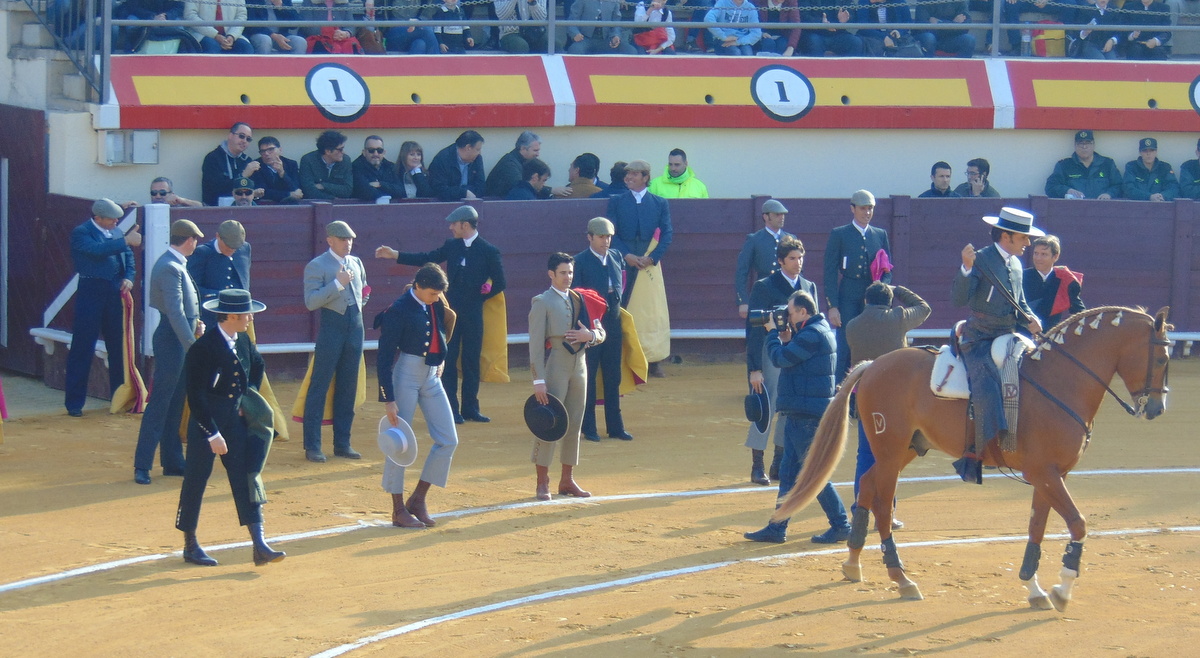
On the last Sunday of February, there was a 'charity' bullfight in Vera. Because this was not a usual traditional corrida, the matadores didn't wear their 'suits of lights', but instead dressed in Andalusian cowboy fashion (picture). The event was significant because five of the six were top-of-the-line names, and the sixth was an up-and-coming Almería novillero.
I wanted in particular to see one of them, a young Peruvian called Andrés Roca Rey, as he has made a name for himself despite his young age (he's now nineteen) and he was unable to attend a fight I had gone to see in Almería City last summer (he'd been gored the week before in Málaga).
The Vera ring is one of seventeen bullrings across the province of Almería (most of 'em still in operation) and this particular one seats 4,800 spectators. They vary in size, with the Roquetas del Mar one holding 8,000 and the Almería City one at 9,800 (the world's largest, in Mexico City, holds 41,300 people).
The Sunday fight began with Diego Ventura, a mounted bullfighter, called a rejoneador. He would switch horses during his faena, and place his barbed banderilleras with skill into the back of the bull, ending his time with a lance through the bull's back and into its heart. At one point, the bull nudged his horse (not good) and he fell off (picture). He was awarded an ear, following lots of white hankie waving from the crowd.
Following Diego, the others were matadores, fighting from the ground. We saw El Córdobes, El Fandi (who also does his own bandilleras) and Cayetano (the bull stepped on his foot at one point). All were good but were unable to make clean kills.
Then came Roca Rey. Who was sublime. He's worth watching on YouTube (here). Here in Vera, he seemed to work at the peak of his talents, and he killed the bull at the 'moment of truth' with a perfect thrust. The crowd stood and roared and he was awarded both ears and the tail by the president.
The sixth and final fighter, Juan Carlos Benitez, was awarded an ear for a clean kill, but I had left by then. You can't improve on perfection.
Friday, February 24, 2017
The Entertainer (Offline)
The Entertainer was a weekly newspaper that started in April 1985. It was a 'free sheet' (as they used to call these things) serving the English-speaking population in Almería. This in the days before desktop publication, the Internet and colour printing. The next year, a second edition for the Costa Blanca, and soon after, a third for the Costa del Sol. Spin-offs included 'Entertainer en Español' - a monthly for Almería, and, briefly, another for Alicante. There was also a radio show called 'The Entertainer Show', broadcast from Radio Indalo, in Mojácar and Radio Marbella on the Costa del Sol.The newspaper was sold in 1999, but, alas, things did not progress smoothly.
I ran a similar-sounding title from November 2003, a monthly called The New Entertainer, with support from a Spanish journalist called Ángel Medina (it ran to sixty issues) while also editing El Indálico (110 issues). I also wrote/write for Actualidad Almanzora, La Opinión de Almería, Almería Hoy, El Mirador, The Reader, The Olive Press and The RTN.
I started The Entertainer Online (a blog) started in September 2002, when the title for the newspaper was substituted by the new owners. It was a advertising-free blog, with additional pages, including a large number of useful links about Spain.
The blog has continued since then, until early in January this year, following attacks from somewhere (let's suppose it was the Russians).
Briefly, another blog - a simpler one - with the GoDaddy people, but now I suppose it's time to give up and concentrate on my other projects.
Business over Tapas: A weekly subscription news service about Spain (Facebook here).
Spanish Shilling: Essays about Spain, since January 2006
...and now, taking over from The Entertainer Online, Lenox Napier: Local news and opinion.
Thursday, February 23, 2017
How Many Foreigners? Who Cares?
No one knows how many Brits live in Europe. Perhaps because we don't have any representation - either with a voice in London or in Brussels. This makes us second-class Europeans (third-class foreigners when the UK finally pulls the plug). How many are we? No one knows, because no one cares. Here in Spain, the number of Brits is figured by a voluntary registration in the town halls (called the 'padrón'). This gives our number at an anal 253,928 (INE statistics office January 2016). But many don't register (and some, if they leave the country, don't remove their names). As above - no one knows because we are not worth the trouble. We need a champion!
Since I have the INE page open, here's some other information:
Almería Brits (Jan 2016): 14,344
Total Almería foreigners: 137,507
Total foreigners Spain: 4,601,272.
The largest groups seem to be Romanian 715,136
Chinese: 199,961
Ecuadoreans: Internet broke down (Thanks Movistar)
Moroccans: 753,425
Since I have the INE page open, here's some other information:
Almería Brits (Jan 2016): 14,344
Total Almería foreigners: 137,507
Total foreigners Spain: 4,601,272.
The largest groups seem to be Romanian 715,136
Chinese: 199,961
Ecuadoreans: Internet broke down (Thanks Movistar)
Moroccans: 753,425
Friday, February 03, 2017
The Palace of Chávarri, Mojácar Playa
The Palace of Cháverri, as it was grandly known, is now the front bit of a huge box-like hotel in Marina de la Torre, run by the Fergus Hotel group and called the Hotel Alegría Palacio. Mojácar has succumbed to cheap all-inclusive tourism.
In another time, the palace was a summer-home owned by a wealthy Madrid family called Garrigues-Walker. Old Dad - Antonio - was the Spanish ambassador to the United States in the early sixties, later moving to a fresh posting at the ambassador's residence at the Vatican. His wife Helen was from Des Moines in Iowa and at least one of their nine children, Joaquín, was a regular visitor to Mojácar who, as a story in the Voz de Almería notes, spent his honeymoon with his wife Mercedes there (pictured here with the staff in attendance).
An American friend called Zach Allen stayed with Joaquín in 1956 and sent me the picture below. He writes: '...Recently, I turned to Google Earth and see some of the changes. The "Palacio" itself was very rudimentary when I was there. But, beautiful. At that time, it was a tomato farm. I have a number of photos showing the house, the fields and the (women mainly) workers who were planting the tomatoes then. It used a gravity fed irrigation system fed from a very large pool, much like a swimming pool, on the hill in back of the house. The view from the stairway, out through the open (not enclosed like today) archway down the road to the beach was stunning...'.
The house was built by the first Marquis de Chávarri (Benigno Chávarri y Salazar), who owned a shipping line. His captains were (apparently) instructed to fire off a cannon salute from their ships as they navigated past the estate on the way to or from the port of Garrucha.
Good times. Mojácar was so far away from the cities, so hard to get to, that many used to come by sea.
In another time, the palace was a summer-home owned by a wealthy Madrid family called Garrigues-Walker. Old Dad - Antonio - was the Spanish ambassador to the United States in the early sixties, later moving to a fresh posting at the ambassador's residence at the Vatican. His wife Helen was from Des Moines in Iowa and at least one of their nine children, Joaquín, was a regular visitor to Mojácar who, as a story in the Voz de Almería notes, spent his honeymoon with his wife Mercedes there (pictured here with the staff in attendance). An American friend called Zach Allen stayed with Joaquín in 1956 and sent me the picture below. He writes: '...Recently, I turned to Google Earth and see some of the changes. The "Palacio" itself was very rudimentary when I was there. But, beautiful. At that time, it was a tomato farm. I have a number of photos showing the house, the fields and the (women mainly) workers who were planting the tomatoes then. It used a gravity fed irrigation system fed from a very large pool, much like a swimming pool, on the hill in back of the house. The view from the stairway, out through the open (not enclosed like today) archway down the road to the beach was stunning...'.
The house was built by the first Marquis de Chávarri (Benigno Chávarri y Salazar), who owned a shipping line. His captains were (apparently) instructed to fire off a cannon salute from their ships as they navigated past the estate on the way to or from the port of Garrucha.
Good times. Mojácar was so far away from the cities, so hard to get to, that many used to come by sea.
Wednesday, January 25, 2017
The Mojácar Story
Mojácar
is a beautiful town located on the coast in the Province of Almería in the
south-east corner of Spain. It is small, relatively unknown and is home to
several thousand northern European and Spanish settlers which, between them,
make up about half of the population. The municipality is said to enjoy a
micro-climate: not too hot in the summer nor too cold in the winter. The
community is traditionally divided into el
pueblo, the upper town; la fuente,
the fountain (the lower reaches of the town) and la playa, the coast, where in fact around 80% of the population
lives. Other quieter areas exist – such as las
huertas (the orchards) and the small hamlets that form part of the 72
square kilometre municipality such as Sopalmo, Agua del Medio, Las Alparatas and
so on. Behind the pueblo, there are
mountains to climb and forgotten sites to see. The beach itself stretches for
around 17 kilometres and has, as might be expected, everything from
full-service well appointed Blue-flag beaches with bars and restaurants,
life-guards and public showers, to quiet empty beaches where the only
interruption comes from a curious seagull.
Mayor
Jacinto Alarcón is remembered as the man who re-invented Mojácar. ‘It’s where
the sun spends the winter’ he said in 1965 with satisfaction, as the first
trickle of tourists began to visit the village. Some of these early visitors
bought houses or land, at what today would be thought of as ludicrously cheap prices.
They stayed and their culture and ideas were somehow assimilated into Mojácar.
The
village grew slowly, as new houses were built. The beach, a little-used area
reserved mainly for the tomato growers, finally became urbanised as well.
Some
of the new settlers were artists. They were attracted by the remarkable
village, built as it were to look like a scattering of sugar lumps on the final
mountain of the Filabres chain, as it plunges from the interior of the province
of Almería into the blue Mediterranean below. It is a harsh beauty: Jacinto had
insisted that all the houses must be painted with whitewash and the dramatic tumble
of flat-roofed white houses with narrow streets adorning a hill some 200 metres
above sea-level, in the most arid surrounding, remains irresistible to artists,
poets and writers.
History
The
hills that today are adorned with the white cubist village have been inhabited
for thousands of years. In nearby Cuevas del Almanzora, Major neolithic remains
were discovered around a hundred years ago by a Belgian archaeologist called
Louis Siret: Mojácar can probably claim a similar longevity. The nearby pyramid
mountain of ‘old Mojácar’, a steep indefensible hill visible from the Mojácar
viewpoint off the Plaza Nueva, may give a clue to Mojácar’s name. The hill
appears to have had a religious significance, and it seems that the Roman name
‘Mons Sacra’, sacred mountain, was later transformed by the Moors who held
Mojácar for many hundreds of years until the end of the XV Century into
‘Muxacra’, and from there, it changed again with Christian tongues into ‘Moxacar’
and eventually Mojácar.
Back
in olden times, the sea was a potential enemy. Pirates could arrive on the
beach at any moment, and villages were generally built away from the immediate
coast, to make it easier for the defenders and correspondingly more difficult
for the pirates – generally issuing from the Barbary Coast in North Africa
(although even the Vikings managed to infiltrate the Mediterranean as far as
Valencia back in the IX Century).
It
was best to keep the settlement hidden, and Mojácar originally grew behind the
hill it now crowns. In the event of an attack, the defenders had the option to
flee inland. Watchtowers along the coast, ready with fire and pitch, would give
first warning of any incursion. Some of these watchtowers and forts, carefully
restored, can be seen today locally, including one of each along the Mojácar
coast to the South.
The
fall of Mojácar to the Christian Kings, los
Reyes Católicos, in 1488 is remembered colourfully in a local festival that
occurs on and around June 12th each year. Mojácar, an important local
Moorish-held town, was on the route that Queen Isabela of Castile and King
Ferdinand of Aragon were taking towards Granada, the final capital of the
Moorish empire in Spain (which fell in 1492, the same year that Columbus
discovered America). The story has it that the interview for the surrender of
Mojácar (to avoid a siege and probable slaughter by the overwhelming Christian
forces) was held at the Fuente (the
Fountain) between Captain Garcilaso for the Christians and the Muslim leader
Alavez who was asked for the surrender of his town. According to legend, this
is his reply:
‘We are as Spanish as you. We have been here
for seven hundred years and now you tell us to leave. We have never raised arms
against the Christians; I think we should be treated like brothers, not like
enemies and we should be allowed to continue to work our land. But know this:
before we surrender like cowards, we will die like Spaniards’. Brave words!
In
1530 Emperor Charles V received such support for the house of Hapsburg from
Mojácar that the city was awarded the coat of arms of a two-headed eagle.
Later, Philip II added the slogan: La muy
noble y muy leal ciudad de Mojácar, llave y amparo del Reino de Granada:
'The very noble and loyal city of Mojácar, key and guardian of the Kingdom of
Granada'.
Mojácar
was important locally during the following centuries and is recorded as reaching
10,000 inhabitants in the XVIII Century. Another source records a population of
6,000 people in 1870.
In
1911, a local census records that Mojácar had 4,979 people on the town hall
register, and the town had just installed public lighting (run on acetylene).
There was a café, a ‘cantina’, two
butchers, a carpenter’s, three food shops, a pharmacy, a post office and a bookshop.
The pueblo
maintained this number of inhabitants until round about 1920 when, slowly, the numbers
began to fall, speeding its descent in the 1930s. Through the various local
vicissitudes of the drop in the local water-table, the end of the local de-forestation
(due to an unexpected lack of trees), a peculiar plague of locusts in 1901, the
end of the local silver, copper and lead mines in the 1920s (run for 40 years
in the surrounding hills mainly by the British) and the troubled times of the
Civil War, the area in general eventually became depopulated with mass
emigrations to Barcelona, Algeria, Germany and even Argentina, and Mojácar
itself began its long descent into what was, by 1960, a moribund village of
just 600 souls.
A
local legend, impossible to prove or otherwise, says that Walt Disney was
either born in Mojácar, or perhaps born in Chicago to a disgraced Mojácar girl,
who fled the town for America around 1899, pregnant and afraid.
Modern
History
By
1960, as the population fell away, there were only a few hundred people left;
but one of them was the irrepressible Jacinto Alarcón, chosen by the provincial
governor as mayor. At the same time, attracted by the light and the views, a
school of Almerian artists called ‘Los Indalianos’ (named after a Spanish
saint) were frequent visitors to the forgotten pueblo.
Happily,
the mayor and the artists welcomed each other. The artists named the local
totem after themselves – the Indalo: a figure of a stick-man that appears to
hold a bow or a canopy over its head as protection. Used in Mojácar for
centuries and previously known as ‘the little Mojácar man’, the totem to be one
day known as the Indalo was painted over the lintels of houses for good
luck.
Jacinto
began to give away houses and land to those who agreed to settle and to invest.
A number of foreigners began to take up his offer and, at one point, a number
of foreign ambassadors owned houses in Mojácar (giving rise to the street
called ‘Calle de los Embajadores’).
Jacinto also managed to contact the minister for tourism in Madrid to ask him
to build a Parador government hotel in Mojácar, which to everyone’s surprise,
was granted.
The
beach, now known as Mojácar Playa,
began to attract home-buyers. Houses and later urbanisations were built. A
hotel chain came to Mojácar in 1975, bringing ‘package tourism’ with them. The
town’s fortunes were guaranteed and Jacinto retired, giving way to the
democratic mayors which followed Franco’s death.
Today,
Mojácar has some eight thousand inhabitants, rising in the summer months to
perhaps as many as twenty five thousand.
Gastronomy
Mojácar
has never truly been famous for its fish and there is no port. Hobby fishing
and, more importantly, the next-door port of Garrucha nevertheless supply
Mojácar with a bounty of fresh fish and molluscs. The traditional Mojácar fare
is based mainly around the pig, with many types of local sausage, and of course
the many products of the fields and orchards. Try the Wednesday market in the
parking area behind the pueblo for
the freshest local produce. For eating out, a number of local bars will offer
tapas, those small nibbles that come with a beer or a glass of wine.
There
are local restaurants which serve delicious meals, whether simple salads and
fish on the hot plate, or chicken, pork and mutton dishes, or of course paella: that famous Spanish rice-dish.
There are other restaurants who favour ‘modern cuisine’, inspired by some of
the World’s greatest chefs, where Spanish ingenuity in the kitchen is a byword.
Then,
we have a plethora of fine foreign restaurants, each anxious for your
patronage. We have food from Germany, Thailand, the Middle East, North Africa,
Argentina, Mexico, China, France, Italy, Ireland, the UK, Holland and India.
Everything from a simple pizza to the best of fine-dining.
Mojácar
Today
With
the arrival of the first foreigners in the sixties, Mojácar’s hidden life was
lost. The village soon had a number of foreign bars and restaurants, and the
silver Indalo medallion was better known in far-off London or New York than was
the province of Almería itself. This helped to make Mojácar a cosmopolitan town
and, as more restaurants, beach bars and hotels sprung up on the beach, the
town became in short order an internationally-known resort. Today, there is a
mixture of local and foreign citizens, with the multicultural junior school as perhaps
a worthy symbol of this high level of integration.
Mojácar,
indescribably beautiful, has been chosen to join the select group of ‘Pueblos más Bonitos de España’, the most
beautiful towns of Spain (there are only six in all Andalucía).
Fiestas
and Attractions
There
is always something going on in Mojácar. Concerts are organised both by the
Culture Department in the Town Hall as well as by the many bars and beach-clubs.
There are more of these during the high season, which stretches from Easter to
late September. Other attractions include art exhibitions (there is a municipal
art gallery and some other commercial ones). There are any number of sports
activities, from aquatic sports to lawn bowls, golf, padel-tennis and
bicycling: clubs and teachers/trainers are easily found. There are also walking
clubs, gyms and yoga groups. There is, of course, any number of boutiques and
shops to suit all tastes.
The
festivals organised by the Town Hall include the Carnival week, a picnic called
‘la Vieja Remanona’ and the Romería de San Isidro. These take place in the
first months of the year. Later come the Easter parades and the colourful and
famous Moors and Christians celebrations in the second week of June. This
festival sees the townsfolk divided into half a dozen different groups, known
as cábilas, and they will dress up in
astonishing period costumes and will party for three days straight. The summer
continues with regular concerts in the Town Square and culminates with the town
fiesta of Saint Agustín on and around the 28th of August. The final dates on
the calendar are the Virgen del Rosario on and around the 7th of October and then
the Christmas, New Year and Twelfth Night celebrations.
How
to Get There
Mojácar
is 13 kilometres off the A7 motorway, leaving either at the Vera or Los
Gallardos exits. The Almería airport is around 50 minutes and the Alicante
airport is about three hours away. Other airports within the region include
Murcia, Granada and Málaga.
Thursday, January 12, 2017
With the Free Press, Someone is Always Paying
Our local free newspaper, The Euro Weekly News (Almería edition), lives from its advertisers. Evidently. It's not a pay-for newspaper with some responsibility to its readership. Thus, its content can sometimes be somewhat partisan, taking the view, above all, of its clients.
Such an example is a recent one-sided report about Mojácar's plans for the beach-bars, which failed to mention the spirited opposition from the general public for the project to extend the beach-promenade at the cost of a number of popular and historic beach bars.
But then, the Town Hall is an enthusiastic advertiser both here and on the local radio (Spectrum). These media live from advertising, not from good-will (check Actualidad Almanzora for better reportage - a medium, incidently, that the Mojácar town hall refuses to consider for either news or advertising).
At the same time, other stories at the Euro Weekly are pushed aside. There was no mention of FITUR in this week's paper (the Golden Indalo?), nor of the sad anniversary of Helen and Len Prior, now living in their garage in Vera for nine years (since January 9th 2008) nor indeed of the recent death of Alan Bishop, one of the founders of The Entertainer (the precursor of the EWN).
The free-sheet gives some useful club and commercial information - but is it enough for one's news-feed?
Thursday, January 05, 2017
Sexist Toys
Spanish toys can be sexist - you know, little fire engines for boys and pink dolls for girls. This naturally can stymie their later intentions to mature naturally and easily into either hetero- or homo-sexuals.
You might think that the foregoing is ridiculous, but the 'Observatorio Andaluz de la Publicidad no Sexista del Instituto Andaluz de la Mujer' evidently doesn't - with its complaint (here) that an unacceptable number of children's adverts on the TV are offensive with a painfully exact 43.27% of ads being deemed 'sexist' and therefore inappropriate.
What, someone has been watching all the children's telly over the season armed only with a red pen and a bottle of tequila?
According to the leader of this alarming group, 'these toys reflect in a very clear way the gender stereotypes that are inculcated on impressionable children and young people, without any consideration of the impact they might have on the conduct of the future adult'.
The next ludicrous campaign, to be seen in a few days, is to switch warlike toys (little plastic guns and the like), for peaceful non-sexist non generic toys or games in non-gender identified colours.
Go!
Anyhow, what's wrong about a tool-set for girls? A pink one, obviously.
Monday, December 26, 2016
Where the Sun Passes the Winter Season
You've seen those endless agony of pictures from the Tourist Office - wide empty beaches, narrow empty streets, the impossibly long empty promenade? Honestly, it's not as bad as that here. There may not be many people around in the winter (the village, frankly, is a mess), but the weather is warm and a few brave restaurants and bars have remained open for the residents.
So, how to promote Mojácar outside of the rather obvious sun, sea and cheap souvenir season?
Well, follow the advice of the old mayor Jacinto, who back in the sixties coined the phrase 'Mojácar, donde el sol pasa el invierno'.
So, how to promote Mojácar outside of the rather obvious sun, sea and cheap souvenir season?
Well, follow the advice of the old mayor Jacinto, who back in the sixties coined the phrase 'Mojácar, donde el sol pasa el invierno'.
Wednesday, December 21, 2016
This Year: Next Year
An interesting year indeed.
In Spain, we managed most of the year without a government, and then got the
one we expected all along. Along the way, the PSOE collapsed into third place
obscurity. In the UK, the appalling Brexit was voted by a small majority and in
the USA, an eccentric anti-establishment candidate took the presidency. How
does all of this have an impact on foreign residents and investors in Spain?
Will the housing market be further affected and could tourist figures stagnate?
Could the British living in Spain find themselves excluded from EU privileges?
Perhaps more worrying still – could the USA go, in some unexpected way, rogue? We
must wait for next year to find out: January 20th is Inauguration Day in the
USA for President Trump (or his replacement) and the end of March seems
to be the final date for the UK’s decision on leaving the EU.
Sometimes, living in the land of the Lotus-Eaters, we hope that none of those earth-changing events happening elsewhere will affect us. Maybe the pound will go up or down a few cents, but we shall soldier on, enjoying (as is our right) a glass of wine on our terrace as the sun gently sets behind the mountains that, in some way, have protected us from the real world for so long.
Maybe things will stay sweet. Maybe if we don't know what's going on, then those things we don't know about won't threaten our way of life here.
Maybe.
Subscribe to:
Posts (Atom)