 We went to see some horses yesterday, at a large lettuce farm between Cuevas and Pulpí. I know the owner from years back and he has - besides any number of thousands of hectares of lettuce - around a dozen Pura Raza Española horses and a donkey. Barbara, who has a blog about horses and riding therapy at Animo, rode a beautiful nine year old mare around the ring, bareback as usual.
Wednesday, October 26, 2011
Horses
We went to see some horses yesterday, at a large lettuce farm between Cuevas and Pulpí. I know the owner from years back and he has - besides any number of thousands of hectares of lettuce - around a dozen Pura Raza Española horses and a donkey. Barbara, who has a blog about horses and riding therapy at Animo, rode a beautiful nine year old mare around the ring, bareback as usual.


Tuesday, October 18, 2011
A Day in Granada, with Friends

 Barbara is now getting the Animo work with hippotherapy going again, and we now have a new therapy horse here in Mojácar (see Animo) . As a small part of this, we went to Granada yesterday to meet a Japanese friend who works in a similar field at the Tokyo University. Aki speaks some English, and his uncle, here on the left of the photo, speaks a bit of Spanish as part of his studies into Flamenco. So, as they had a spare day or two before returning to Madrid (and on to Vienna), the three of them (that's Student Nim in the middle) were able to spend some time with us - which, ineviatably, included a visit to the caves of the Sacromonte to see some real Flamenco.
Sunday, October 16, 2011

Tuesday, October 11, 2011
The Mojácar Square
 This is the square in the old part of Mojácar that is being made-over as an underground car-park. In the picture, taken last Thursday, the square is, for once, without any cars. It looks rather better than usual. Will it look like this (smarter and so on, but similarly spacey) after the work has finished... sometime next Spring?
One must hope for the best, while recognising that our ayuntamiento and its alcaldes have never managed to improve the pueblo in thirty years of attempts (atentados, a good mis-translation) . Much has been written elsewhere about this project (the estación de metro) which has the unqualified support of the local Partido Popular: members, supporters and honorary Romanian Glee-clubbers; with the horrified resistance from everyone else, including those who chose to live in Mojácar because of its beauty, magic and appeal.
Still, they had their chance in the local elections last May.
The house on the right of the picture, with a whimsical no-parking sign in front of it, was our old house, bought new off a very young Juan García in 1966 for the peseta equivalent of 540 euros: two apartments, upstairs and down. I stayed upstairs for the school holidays while my parents were there full-time. Downstairs, a Frenchman called Michel rented for 18 euros a month, which he could rarely afford, preferring to bring along a melon on the first of the month and then stay for dinner.
We eventually sold the place to Joan Noble (an artist type with hair died a fetching shade of blue) and she lived upstairs and rented out the downstairs to a succession of restaurants and bars. The town hall was the final buyer, buying it earlier this year for a fortune, so as to have clear title to knock it down (a figure not reflected in the latest budget for the final tally of the underground car-park).
Behind the now demolished block, is a flash of brickwork. This is the relic from the same Juan García's demolition, as mayor, of an old ruined house there which was built over a narrow street-tunnel - the famous Arco de Luciana, known in English as Lucinda's Arch. Lucy was a Mojácar girl who fell for a Christian prince who died in battle in 1488. She promptly threw herself to her death (or perhaps tripped over the entrance to the tunnel, built in around 1890). Never mind - it was pretty and attracted tourists with their cameras.
After Juan idly had it knocked down, a succession of mayors promised to replace it. Salvador, Carlos, Gabriel and Rosmari. None of them ever did - or ever will. Even - and here's a thought - by putting it somewhere else. Luciana wouldn't mind.
So, as work begins on the upper square, dooming the casco viejo to an eternity as a non-pedestrian village, the mayoress admits in a sparsely attended pleno (there were four of us), that she doesn't like the final plans for the square's embellishments either: stone sails to soar above the streets.
Saturday, October 01, 2011
Food and Some Sex
 At the risk of being thought a bit smutty - here's a picture of a poorly-named restaurant - or maybe 'snack-house' might be better - which adjoins onto our local knock-shop, the Hotel Argar on the outskirts (damn, I'm doing it again) of Vera.
The delightful name of this establishment, clearly readable on the photograph, means in Spanish of course 'Eat, Eat'.
But, what is on the fare this evening (after a strenuous session next door)? I don't know what you're having, but I'm winding up my meal with a brandy and, as a special treat, a piece of the tarta de la casa.
Wednesday, September 28, 2011
Mojácar the Beautiful
 Ah - the beauty of Mojácar - sadly beaten down over the years by the speculators and the ignorant, but still a place to enjoy. Here is the magnificent 'Mojácar la Vieja' mountain with an old cortijo in front. A simply stunning... no, wait, hold on... some fucking idiot has gone and painted some crap all over the ruin.
Thursday, September 22, 2011
To Horse!
 That's me riding bareback on a hispano bretonés being led by Trini, a trainer from Barcelona who is here with us for a few days. Trini has brought down two of these enormous and placid horses for Barbara to work with. You'll find more about this at Barbara's site Animo where she writes about therapy horses.
Monday, September 19, 2011
For Life
 It all started, innocently enough, with imitators of servicemen wearing a tattoo on their arm, while some young tourists, inspired by seeing Indian women wearing a small stud in their noses, deciding to do the same. Tattoos and piercing slowly became a queasy but moderately fashionable idea, with young men sporting a modest earring or two and – generally speaking – society’s less-attractive girls found themselves considering a small tattoo on an intimate part of their body, or a ring through their nose or, worse still, their lip. At least the ring could be removed later, probably without leaving a mark.
The first non-regulation tattoo, you might say, that I ever heard of was worn by Erna, an old Danish woman who had been in the French Resistance. She was connected to a group called Les Papillons, and she had a tattoo of that brave collective, put on I hope after the war, high on an inside leg.
Around the same time as Erna, who had merely intended to drive to Lyon but, according to her, had missed the turn-off and not possessing a reverse gear in her ancient Renault, arrived in a cloud of steam in Mojácar, another old-timer called Benjamin Rappaport bought a house here. He too had a wartime memento, this one a number tattooed on his arm in some camp by the Nazis. Later, Sammy, an American pansy, arrived in Mojácar and opened a bar. He had a few blued and faded scrawls on his arms, and in his ear, an ear-ring.
For a while, Mojácar slept in peace. There was a girl with a stud in her nose called ‘Golden Snot’ who caused a small sensation in the eighties, but, in women, piercings and ‘tramp stamps’ were rare and generally un-admired.
But here we come to it: small tattoos and moderate piercing came to the attention of trend-setters, who these days are usually either film stars or football personalities, neither group known for either their intelligence or their humility. Small and coy became large and obvious; self-mutilation became suddenly fashionable.
Tattoos feed on being evident. Their owners choose their site for their visibility, and like to wear a reduced amount of clothing to show off their vanities. Some of these will be tattoos on their neck or forehead, or heavy ear-stretchers, rendering them entirely unemployable. Others, if one is to believe the hype, will have clitoral or penile piercings leaving their friends with the uncomfortable recollection of the story of the two young lovers with dental braces who, in a simpler age, got locked together while kissing.
Some people chose messages in Arabic or Chinese to tattoo across their chest or emblazon on their neck, which may or may not say ‘peace’ in those languages. In fact, they generally say ‘cretin’. Others list their children’s names – or the names of their lovers.
A girl I know has a number of different tattoos, pictures, designs and words inked into her epidermis by a high-speed needle. They hurt, but, she says, there’s a kind of ‘high’ in getting them done. ‘You want more’, she admits.
And in every town, there’s some guy with his equipment, ready to mark you up – for better or for worse – for ever. And with him, his assistant who will pierce your tongue, neck, nose, septum, lip, breast or privates. You may get an infection, but it’ll be worth it. Brad and Angelina both have them.
So, I feel sad for the girls, who have been peer-pressured into having a small ‘thing’ tattooed on their left shoulder, denying them a chance to wear a pretty dress.
For life.
Wednesday, September 07, 2011
Fond Memories
 Going through all the boxes of photographs, we found this one of our son, Daniel, when he was little, posing with a donkey apparently called Bella. For some reason, there was always a number of animals in or around our house (we even have a lavatory still known as 'The Pig's Bathroom'): dogs, cats, tortoises, donkeys, wild boar, chameleons, horses, mules, ducks, chickens, peacocks, pigs, guinea pigs and rabbits. What with attrition, disease and the passing of the years, most of them have now moved on to their Reward.
And there comes a small fear of mine. When I, too, pass off this mortal coil to a Better Place, I can't help but imagine a misty empty field somewhere, a tree or two, perhaps the spirits of a few loved ones close to me... and then, with a drumming of mighty hooves, a hundred, a thousand critters will breast the far-off hill and run towards me, hooting, honking, barking and screeching, mostly (I hope) with a fond look in their eye as I try, against all odds, to remember their names.
Monday, September 05, 2011
Muammar Qadhafi
 From the Washington Post; a full-page advert from Wednesday, October 22, 1980. For some reason, I have this stashed away. Not much to do with Spain (despite his properties in Benhavís, Marbella), but maybe of historical interest. Consider: Carter and Reagan and their times have long passed, but a dictator like Gaddafi managed to last rather a longer time (he seized power in 1969). Camping in a truly provocative way with his tent in the Downing Street and Rose gardens... and the Western rulers kissed his hand.
It's worth reading - Gaddafi makes some good points. I'm not an apologist, but doesn't his country have rather a lot of oil?
Sunday, August 21, 2011
Bédar 1966
Bédar is a small white village in the high hills of the Sierra de los Filabres, overlooking the wide plain of Los Gallardos, Antas and Turre which is rimmed on the other side by the concurrence of a few descending mountains, the final one covered by the white cubed houses of Mojácar, with the Mediterranean Sea beyond. Bédar was a mining village, peopled in its day by the Moors, and re-discovered by the British in the 1880s when they set about opening up a number of hills between Águilas and Bédar looking for iron, copper, silver and other minerals.
By 1966, when we drove up the dusty track to the cracked and sun-bleached village, overlooking the empty mining buildings abandoned forty years before, there was just a few people left, hanging on with some small agricultural work or merely abandoned and living on smaller pensions while their lungs slowly subsided under the ravages of emphysema.
There was just the one bar, run by Pedro, an old man with a large chin who shuffled about in his carpet slippers and spoke a few words of broken English. That first time my parents and I went up there and had lunch, a paella possibly spiced with cat, washed down by glasses of Green Fish (a popular kind of Spanish gin, made in Murcia) with warm Fanta orange. The mayor happened by and, as far as my father could make out, introduced him to his hermano who may have sold him a line of village houses for 60 pounds. ‘I’ve either bought a house off somebody called Herman,’ my father admitted to his friends in Mojácar later that day, ‘or I had a very expensive lunch in that village up there’, gesturing vaguely towards the hills.
There were a few foreigners living in Bédar at the time, including a Dutchman and his Moroccan wife. The Dutchman collared my father the next time he braved the dusty track up to the small village. ‘You don’t want to live in this place’, he said, ‘there’s this mad Dutchman who has a house here and doesn’t like Englishmen’. ‘How interesting’, said my father, ordering another round of gin, ‘and what a curious accent. Where are you from?’
An elderly British poet called John Roberts lived in a house around the back of the village, in an area known as the Gypsy Quarter, with his mother. At the time of buying his place, he had neglected to buy off all of the family owners, inheritors in equal parts from some old miner, long taken to his reward. This meant that Roberts shared his house not only with his mum, long time suffering from dementia, but with a truculent couple who weren’t clear if they were gypsies or not, but knew that they didn’t like foreigners.
Howard the American hippie lived in the surviving wing of a ruin further round to the left. He smoked dope and lived off provisions he obtained from friends close to the American Forces PX in

A British couple, retired as I remember from a rubber plantation in
‘To my friend Bill Napier, on the occasion of his birthday,
For Jack
Thursday, August 18, 2011
Mojácar Editorialised
Having struggled through the highlights of the Sol Times and the Weenie, I was just preparing to leave the café when the distributor for the local Spanish freebie 'Actualidad Almanzora' showed up. Not as many pages as the other two, but at least the articles are generally interesting (and always about local issues, with no regurgitated news, waffle or tripe).

The page three opinion piece by Savaronola is always worth reading. It's a proper article rather than fifty words lifted from the Daily Mail and this issue deals with Mojácar's woeful attempt at tourism. I'm going to paraphrase his thrust below:
Mayor Jacinto started the ball rolling in the mid sixties with 'residential tourism', where people buy a house, fix it up, buy a car, kitchen goods, furniture, and then keep the local bars and shops busy the year round. This brings in continuous funds to the community and also - to stretch a point - brings in a certain amount of civic pride. The new residents want gardens, clean streets and some culture: theatre, concerts, exhibitions and so on.
But, warns Savaronola, in Mojácar, a few local people, uncultured but drowning in greed, looked for short-term profit and, having wrestled control of the town hall, they soon changed the town's direction towards apartment building (higher profits, although lower full-time occupancy), multiple 'pile 'em high, sell 'em cheap' hotels and a savage drop in the area's reputation abroad. They got their stash ok, those few - giving Mojácar the distinction of having the highest per capita wealth in the whole of Andalucía - if rather unevenly divided, but they never bothered much with improving their knowledge and culture.
Which is why we have padel-tennis competitions, a white-elephant football stadium, hotels at 32 euros with bed and three meals in the middle of August, several dying or dead hotels reduced to hulks (Moresco for example), overflowing sewage systems vented into the sea, and a reputation across Spain for botellónes and stag night parties.
Unsurprisingly, Jacinto's dream (he got us a Parador Hotel) has been betrayed by smaller men.
The editorial compares Mojácar to some other small coastal wonders, like Positano, Capri, Portofino, La Rochelle, Dubrovnik, Santorini, Rhodes and so on, all towns where there is no 'crisis' to worry about, and laments that we were herded into a crashed and ruined Mad Max film-set instead.
So, as we continue to allow our leaders to betray us, with the casco viejo of Mojácar as the next victim, we can turn away our faces from culture, civic pride and harmony, and simply try to sell-up before the whole place collapses in shame and despondency.
When those few miserable mojaqueros, the ones who ruined this area simply to stuff their mattresses with oodles of cash, come to buy our houses and businesses at 10c in the dollar, and we are all cut loose again, where on earth will we go?
Strong stuff? You should read the original!
Wednesday, August 17, 2011
Pizza in the Pueblo
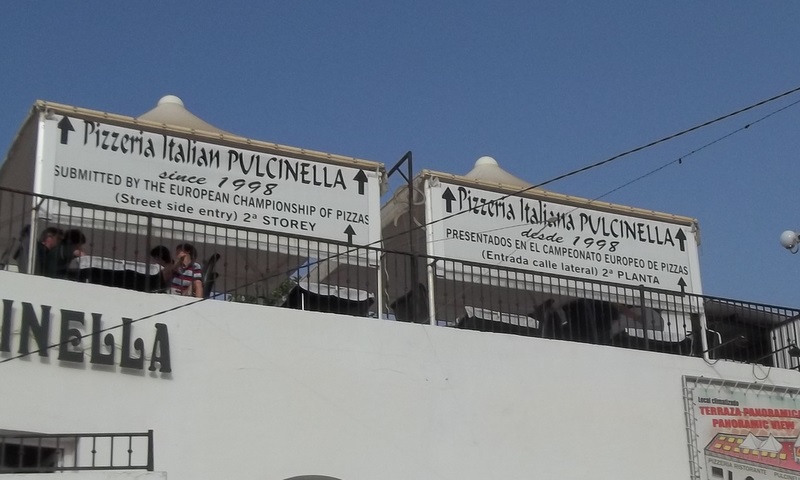 We had dinner in the Pulcinella the other night: four adults and two small kids. Basic spaghetti and pizza. The roof-terrace was packed and business must be good. They have a chap down in the street who approaches you as you arrive in the Plaza Nueva to send you upstairs. They also have a large sign in Spanish overlooking the Square, with a second, roughly translated into English. It would more likely read: 'Presented at the European Pizza Championships' (rather than submitted by).
Like many businesses here, they may not wish to consider employing a Briton for their occasional English posters and menus, but they seem happy enough when the shoe is on the other foot.
Wednesday, August 10, 2011
Making an Entrance
 Here's the thing. When you have parked your car in the 'Campo de Fútbol', you must then walk up the Avenida de Paris to get to the centre of Mojácar. You will be sharing this narrow bit of pavement with everybody else, coming and going.
It's not quite one metre wide.
Saturday, August 06, 2011
Plague
In our small corner of enchantment, we are accustomed to occasional swells and troughs in the local population of varmints. An English-language newspaper recently mentioned the plague of flies which had swarmed out of nowhere, covering the outside in unbelievable numbers. Yet, by the time the report came out, the mass of flies had gone, returning to the usual status quo, which is a nuisance rather than a serious bother. Where did they all go to? Unlike the Chinese, who were reputedly told to kill a hundred a day, no doubt on pain of having their own wings pulled off, we manage to avoid keeping tally, relying on an aerosol spray to do the job.
I once bought a trap for flies, a plastic pack crowned with a hook and a cardboard landing area and with a small lump of damp rhinoceros shit secreted in the bowels of the package. A sure-fly success with the moscas. Within days I had about a kilo of dead and rotting flies in my swollen bag, hanging in the arbour. I had to bury the whole stinking mess at the bottom of the garden. A few grasshoppers came along to mourn.
One summer we have a plague of mosquitoes; another time – as this year – there don’t seem to be any. We may have locusts, a plague of them stripped Mojácar in 1906 causing a catastrophic famine here, or it may be a simple swelling in the population of fleas, or scorpions, or mice. This comes about either because the particular thing which eats them happens to be in a decline that year, or because the particular thing which the plague eats, happens to be in abundance. Nature will eventually balance things out, saving the environmentalists or the household bottle of insecticide the trouble. Our current problem with the palm tree beetle is that, because it comes from foreign parts, there is no local creature that likes to snack on it. Give it time.
At the moment, in our neighbourhood, we are troubled by ants. They are those little ones which like sweet things and, as we found out yesterday, they have a particular regard for Sugar Puffs. A long line of them crossed the floor of the kitchen, headed for the larder. Meanwhile, a rather more obvious line of pieces of cereal was jauntily marching along the other way, out the door and down a hole on the terrace.
We are also currently blessed with woodlice: also apparently known as ‘roly polies’. The Spanish ones are nevertheless rarely able to roll into a ball, and prefer to lie on their backs with all of their legs waving futilely in the air as they wait for someone, unknowingly, to pass by and grant them release from this vale of tears. ‘Crunch, crunch yuck!’ as one of the kids said with disgust last time we had the problem with this particularly pointless pest, around twenty-five years ago.
But plagues are always a short-term problem, controlled by the natural rhythm of the seasons. With a little patience on our part, we know that even the tourists will soon be gone and we will once again be able to enjoy our evenings without being obliged to wear some repellent.
Saturday, July 30, 2011
Miguel Angel Gallery
 My picture shows Félix Clemente Gerez, currently exhibiting at the Miguel Angel Gallery on Mojácar Playa, posing with visiting American artist Lynette Lombard. The exhibition continues through August 30th and is of a very high quality.
Saturday, July 23, 2011
Sex Talk

In a country like Spain, where there are brothels on the outskirts of most towns - large bars or hotels with names like ‘Club Los Angeles’ decorated outside with bright coloured lights, sex is no big deal. So, the girls inside might be drugged and under a 24-hour watch. They’ll have their passports kept by the brothel owners and they will have to perform a number of times a day to pay for their room. The police will not usually intercede and the city fathers – as often as not enthusiastic customers during the early evening – will turn a blind eye.
Almería is said to have over a hundred of these jolly clubs, with one of the nearest for Mojácar party-goers located on the outskirts of Vera slap-bang next to a snack bar with the rather unfortunate name of ‘Come, Come’ (it means ‘Eat, Eat’ in Spanish, nothing tawdry here. Move on people). Actually, there are some puticlubs nearer to home, usually apartments or villas hired by strange people from foreign parts, who, now and again, get arrested or deported.
The usual brothel has a number of girls floating around, in various stages of dishabille, bothering or chatting you up (you decide) as you order an overpriced drink from the waiter and nod politely at the mayor sat on the next barstool but one. In fact, many Spaniards use these larger places more for a ‘slap and tickle’ than a fully fledged ‘poke, rattle and roll’ upstairs for a reasonable price (it used to be sixty euros plus a shilling for the maid, last time I asked).
Sex used to be dodgy in the old days of Franco, although
We have sex workers, tarts or what have you; boys in hot pants and transvestites too; all cruising up and down the streets in certain areas, or in the town park, or on the highway. Now the Catalonians want them to wear fluorescent jackets so as not to be run over. That will be fun – makes them easier to spot, anyway.
Sex is also in evidence in shops and petrol stations, where the XXX videos are on the shelf next to the sales-clerk (and often next to a sellotaped picture of the girl with her boyfriend smiling innocently at the camera). How on earth do you sell those things, I asked the girl at the Mojácar gas station. Well, we have a number of customers who don’t want to miss any on them, she laughed.
The videos are frank and extremely self evident. ‘Let’s Fuck’ would be a rather humdrum title for one of them these days.
No one seems to mind.
We have Internet sex of all sizes, types and description, which is either viewed or not, depending on the inclination of the surfer. We have sex on TV, especially after
But now the bluestockings in the Government, aghast at any sexual inequality, want to put an end to all this fucking. Stage One is to pull prostitute’s adverts from the classified pages of the newspapers. Here’s the kind of thing they mean: ‘Mulata transformist, Miranda, new stunning 23cms. Loaded milk bottle. Private. Discretion. Very feminine. I dress as a woman for you…’ (culled from this week’s Weenie).
The proposal, creaking through the Govt, is to change the General Advertising Law - ‘La Ley General de Publicidad’ - to prohibit adverts ‘for sexual favours and for clubs dedicated to prostitution’ in newspapers and their digital editions, if readership is not (somehow) limited to 18 years or older.
Children, put down that paper at once – read the Beano, whydontcha!
Newspapers, of course, thrive on advertising – especially (and rather obviously) free newspapers. So this rule is going to attract some unfavourable press.
Prostitution, according to El País, is worth about 50 million euros a day in
All this fuss comes from the fertile mind of the new Secretary of State for Equality, a chip of a thing called Laura Seara, who says that she is limiting the new rule to the press, but hopes to amplify it to the Internet and the TV, but ‘that will depend on Congress’.
So, is
Thursday, July 21, 2011
A Short Drive in the Car
Spectacles, testicles, wallet and watch, combined and in pantomime, appear to be a way of remembering how to cross oneself successfully. For me, they are a simple mnemonic to remember to leave the house properly equipped. As age creeps up upon me, I find I forget things. Like not doing up my flies or forgetting to brush my hair, or coming out without my glasses. However, there is nothing more irritating than driving down to the shops only to find that I had left my wallet at home. And while it is useful to know what time it is, and therefore if the shops are open or not, I depart from the list by not wearing or indeed owning a watch. One day, when they invent watches that tell us what year it is, then maybe I’ll reconsider.
So, my four stations of the cross have descended into three: zipper, not that this is really my immediate concern - unless of course I am entertaining - spectacles and wallet.
Unfortunately, a knot in a handkerchief won’t do. Firstly, because I would have to remember to carry a hankie, and secondly, because my list of vital things to remember before I leave the property turns out to be rather longer than the t, s and two double-yous mentioned above.
I need two pairs of glasses, one for reading and the other to keep the sun out of my eyes. These sun-glasses, usually originally belonging to somebody else, often tend towards being bent, scratched or hopelessly unfashionable, which explains how I ended up with them; but they are useful in the summer, especially if I find I need a short nap while talking to the vicar.
I like to carry a mobile phone. Mine has a short battery life – a couple of hours or so – and is rarely charged when I am. This makes it an optional item on my list. Keys of course: car-keys, house and that strange one on the key-ring that no one remembers where it came from. I must carry an ID, which these days, and thanks to the polizie, mean both a passport and a letter from immigration saying that they care. So much easier than the old Residents Card which I carried about with me for forty years. They’ll be making us wear a blue triangle embroidered on our shirt next thing we know.
My pockets are filling up. I’ve brushed my hair and had a pee. Shut the dogs away and checked that the door is locked. I’ve got the plastic shopping bag out of the kitchen (no sense in wasting three céntimos), turned the water off in the garden (hah!), put the chicken away in its cage, eaten its egg, checked my pockets again and added the coupon from the supermarket, a pen, a small camera… and am now ready.
But wait, I’ve forgotten where I had planned to go.
Monday, July 18, 2011
Recharging in Granada
 Granada is such an astonishingly beautiful city. Contrasted with the City of Almería, a dump which had its only time in the sun in the early thirteenth century, Granada regains one's faith in the history and culture of Spain. It's not far from where we live, perhaps two and a half hours - supposing we don't stop in Guadix or Purullena (the troglodyte town where they sell pottery) - and it's a manageable size at something under 250,000 souls. But, what's there to see? Suffice to translate the sign above, which reads roughly as:
Give him some coins, Woman
Because there can never be in this life
Anything as hard to bear
as being without sight in Granada.
I'd leave it there, since the best thing is to rush out, now, and buy tickets (or a tank of gas) for Granada and see for yourself, only, I had one more small thing to say, and it needed a second picture.
It's this; they really do seem to care for their city. The streets are clean. Pedestrian streets are for walking around in (and not dodging cars, or having them double parked) and there is a sense of pride evident in the people there.
This is not Almería.
 We stayed in the Hotel Victoria NH which is central and comfortable.
Monday, July 11, 2011
The Fire, Remembered

The brush-fire that burnt 2500 hectares of land in Mojácar two years ago has now been all but forgotten. Several houses were lost, some cars blew up, many trees and gardens went in a moment, animals died and, once again, our town had got itself onto the Front Pages for all the wrong reasons. It wasn’t that the Town Hall hadn’t seen the fire coming, although another fire had burnt much of next door Turre’s Cortijo Cabrera only one week previously, it was their lack of useful reaction which should have peeved the local population.
I say ‘should have’ – people here put up with a lot. There’s no room here for complainers. Not if they ever want to see a job again, at the very least. Anyhow, Mojácar is apparently the richest town per capita (if a trifle undivided) in the whole of Andalucía.
Rather than declare a ‘State of Emergency’, our Mayoress was advised to let a visit by the surprise new (and unelected) President of the Junta de Andalucía José Antonio Griñán, come to see his new possessions, turn into a political opportunity to help our local tourism rather than our locals. Griñán, carefully driven ‘the long way’ to Mojácar Playa from Turre, where the schoolchildren had been lined up to sing him something straight out of Chairman Mao’s Little Red Song-Book, missed the burnt-out hinterland of Mojácar. No soot, dead trees or the smell of charred animals for our leader, but rather a plea to help our hotels (run mainly by Catalonian businessmen and with a staff overwhelmingly drawn from
And that was that.
Here at my home, we lost a number of trees; in fact, their dried-out trunks are still falling in the high-winds (two fell earlier this week), and a few outbuildings. The garage lost its roof and the swimming pool its pump and some of the façade. I’m not complaining – the main house survived.
A surge blew all of our electric equipment. I rang the Sevillana and was given the modern version of the ‘Act of God’ excuse, that the surge was ‘fortuito’ and therefore not their problem. Accidents are so often ‘fortuitous’ these days, don’t you think? Does anyone have a CD player, or a spare amplifier?
The water pipes burnt during the fire, but the swimming pool held enough sooty water to help with the buckets. The roots of some trees burnt for days, and a bucket of water down a smoking hole would elicit a loud steamy whoosh.
The local fauna all died. Almost all were burnt to death, including some small birds we saw, as the fire hit, that flew off with burning wings. Not an image to forget. Other animals, our lazy tree-rats, the wild tortoises, the rabbits and voles all died. The wild boar may have escaped, but there are few foxes around these days. I remember, just two days after the fire, as we were beginning the job of cleaning up the house and charred garden, hearing the hunters out with their shotguns, in case any bird might have survived the cataclysm and was unable to hide behind the naked trees. Bang. Bang.
We had seen the smoke approaching in the high wind. A police car had fired its sirens – ‘run, run now!’ and, with the dog and a single picture wrenched off the wall by the door, we had fled the scene. We had met up with some house owners in the riverbed and watched as the hill between our house and the shocked group had suddenly glowed red. We learnt afterwards that one of our neighbours was just about to get into her car to escape the fire when the vehicle abruptly exploded, burning her legs and arms. She was forced to run back inside her house as the fire, borne on an incredibly strong wind, rushed against her home and around the walls, igniting what could be burnt, leaving everything else to smoke and soot. We found our shocked neighbour later and took her to the medical centre on the beach. A dozen fire-engines arrived that afternoon and worked until late in the evening. It was good to see them. We slept on the beach and drank tea.
The President of our autonomous Region wasn’t the only person who never visited our barrio to see the fire damage. The Mayoress never came by either. Not to do anything much, but to at least look indignant and shocked as we showed her the smoking ruins. I think we could blame the first fire, which was obviously not extinguished properly, and the ‘environmentalists’ who were campaigning at the time to save the dead underbrush, as it provided cover for our local wild tortoises.
What tortoises?
We were asked to report our losses to an office on the beach, itemised and with photographic evidence. A few months later, a letter arrived from
Wild fires are regular occurrences in
So, two years on. The fire cost me a few hundred euros in cleaning up and hiring skips for dead branches and other material, but, as the main damage – several hundred trees destroyed, the stables and store-room contents lost, electrical goods fried and a few domestic birds killed:
Well, put that down to experience.
Subscribe to:
Posts (Atom)