Monday, July 26, 2010

Unbelievable But (Maybe) True

The narrow donkey track - the one that goes up to Tito's and a few other houses in Mojácar pueblo, has been widened to fit a car as seen in this picture. The culprits are the promoters (whose crane has blighted views of Mojácar for the past three years). The plan is to have cars driving up and down this narrow ramp into a parking for the apartments being built there - even though it's on 'relleno', rubble, and looks rather dangerous.
But, how can cars turn upon themselves in a narrow one-way street, the only access to Mojácar? Well, you build a roundabout in front of Zaida and have traffic going counter-current on that section of the road. Then, of course, those cars leaving the narrow ramp, unable to see the road below them to their right at all, will have to pray that no one is coming.
Of course, we'll also lose a few parking spaces along the way...
What does the mayoress and the town hall architect think of this?
It's wonderful. Good for one promoter at the expense of an entire community.
Now that's how we do things around here.
Later: I'm told that the promoter 'misunderstood' the permission and that the Calle San Sebastian will not be open to traffic and furthermore that the town hall has threatened to put a 'no entry' sign there. Well, time will tell...
(Note - I've added the word 'Maybe' to the headline)

Friday, July 23, 2010

This is Not Americaaa...

The following essays which have appeared on this blog have been ordered to be removed or amended by an injunction from the Vera Court!

Removed:
Vulgar Stories From Marbella - March 2010
The Cyber Squatter - September 2009
Title and essay - October 2008
Tits on Page Three - September 2008
Title and essay - February 2006

Edited:
Old Glories, December 2009, was edited to remove any offence to the judge.
Blevins Franks – Independent Financial Adviser - March 2008, was edited to remove any offence to the judge.
The title of an essay written in July 2007 has been changed to ‘A List of Surprising Websites’ and part of the content has been censored to comply with the order from the Vera Court.
Blimey - May 2006 has been edited to comply with the injunction from the Vera Court
The Entertainer, a Couple of Bits – April 2006, was edited to remove any offence to the judge.

Monday: my lawyer has appealed this ruling.


No 'comments' please, but you can write, suggest, ask, inform or advise me on this subject at my email lenoxnapier (at) gmail (dot) com.

Tuesday, July 20, 2010

A Very Visible Complaint

I remember an Iveco truck that used to drive around here years back with a sign painted on the roof air-spoiler which said 'Este camion es una mierda'. This truck is a piece of crap. The sign must have worked as the truck eventually disappeared from the roads and the driver was duly seen with a new one. I hope he preferred it.
Perhaps the owner of this Peugeot has a similar idea. I saw the car parked in Almería on the weekend...

Sunday, July 18, 2010

A New Friend

Hands up anyone who knows what that thing is picking lice out of my hair.

Monday, July 12, 2010

Property in Spain

There has been a certain amount of excitement among the Northern European settlers in Spain after the head-on critical attack on President Zapatero from a rogue MEP during the plenary meeting in Strasbourg to close Spain’s six month presidency of the European Union. The attack came from Marta Andreasen, an MEP for the Euro-sceptic UKIP (an odd party perhaps for Ms Andreasen, a British citizen who lives in Barcelona and who has a marked Argentine accent, but then the Über-Conservative MEP Daniel Hannan was born and raised in Peru and he doesn’t seem to think much of foreign politicians either). Andreasen compared Zapatero’s treatment of the mainly British owners of ‘illegal homes’ as approaching something dreamed up by President Mugabe, the Zimbabwean despot. There’s a video of her comments and Zapatero’s indignant answer here.
This comes after the new housing tsar for Andalucía, the ex IU mayoress for Cordoba Rosa Aguilar, said in a recent meeting in Cadiz that there are 300,000 illegal homes in Andalucía.
And God knows how many more in the rest of Spain.
There are in fact three different problems that home-owners, whether Spanish, European or foreigners must face, although oddly, most of the ‘victims’ of these problems turn out to be Britons. The three (essential) problems, misunderstood unfortunately by both Ms Andreasen and Mr Zapatero (if he cares) are ‘Land Grab’ (a popular concept where property is expropriated and the owner charged for urbanisation costs for his remaining stake, all for publicly sanctioned commercial reasons), ‘Illegal Homes’ (homes are planned, built, marketed and sold – almost always to Northern Europeans - and only then found to be illegal, thus leaving – apparently – hundreds of thousands of property owners in a extended state of doubt, stress and judicial uncertainty) and lastly the ‘Ley de Costas’, the Coastal Law which started out as a military order to allow clear fields of fire on the Nation’s coast and beaches. Now, while no one is clear on the rules (which vary from one municipality, owner, authority and situation, to the next), the Coastal Law can mean that no one can build within a certain, variable, distance from the water-line unless the rules are bent, ignored or, in some cases, satisfied with a fine. The 1988 version of this law will, apparently, be debated in the Spanish parliament this autumn, so maybe some sense will finally be made of it.
But let us return to Andalucía and the housing tsar Rosa Aguilar. Her predecessor, recently removed from his job after masterminding the demolition of one house in Vera, Almería, in 2008 – and causing a hullabaloo across the world (oddly enough, even in Zimbabwe during their elections) – had talked of homes being ‘ilegal’ and ‘legal’ and something very andaluz between these two extremes: ‘alegal’ – which would translate as something like ‘illegalish’. An elegant solution where everyone wanders off and talks about something else. Unfortunately, many of the illegal houses don’t have water or electric connections and, not being registered officially, the owners can’t pay property taxes or, of course, vote.
Rosa Aguilar thinks that the answer might lie in forcing the owners of these properties to pay urbanising costs which, at least in Chiclana where she made the remarks (a town with 15,000 illegal homes or more), costs per household would be in the region of 40,000 euros. Meanwhile, she has set up a Citizens Forum with a number of women’s groups (for some reason) to ‘establish a permanent dialogue between the Andalucian Department for Housing and Public Works and social groups’.

Later (June 20). The consejera Rosa Aguilar was in Albox today and met with members of AUAN and agreed to the association joining the 'Citizens Forum' from September.

Tuesday, July 06, 2010

Communication Breakdown

Our home is in sight of the Moviestar antenna on top of Mojácar’s hill, yet none of our mobile phones work inside the house. Some friend tells me that this is because we live in a Faraday Cage (which is stupid). Nevertheless, whatever the reason, and I’m thinking ghosts, coverage drops down to nothing once inside the house, which causes me all kinds of crackingly amusing little problems as the result of not knowing that someone has just rung, and consequently either missing a call or having to answer them back at a future and sometimes less useful time. The phone I have will, if I get the buttons pressed in the right order, allow me to hear a message but will not retain the number of the caller so, if I don’t write it down on the first instance, it’ll probably be lost. I need to wear glasses to read the little dial on my phone, which takes pictures, movies, emails, games and other obscure services and yet is designed for eagle-eyed boy scouts and won’t work in any meaningful way inside our house.
So, I go outside to dial. This sometimes doesn’t work either and a few people have complained about me walking down the street (of a very quiet unlit neighbourhood I might add) in my underwear while swearing at my mobile phone.
Also, I can climb onto the roof and this sometimes works and, of course, othertimes doesn’t. No, I’m not going to dress to phone – not until I buy one of those Ipods with the little camera in it.
So anyway, I have had three calls in the last couple of days. They were all received while both my useless phone and I were in residence and were therefore not answered. These calls, as the recorded messages leave me to believe, are from a friend who wants to meet me on Friday for dinner. Now, the last call included the information that the local house-phone where my friend is staying was down but that not to worry because the cell-phone number was such and such. That’s right. A ‘cell-phone’. I would have to call an American mobile number just to confirm a chicken n chip night out which was going to cost less than the phone-call itself. So, biting the bullet, I went outside with a pen and my glasses and punched in the one two three messages with the irritating voice (‘you have received a call today, at three thirty five and a half…’) to hear the message again and write down the number. But as usual, and I’ve climbed a tree for this, no coverage at all.
My webpage is bust today as well. I write a blog about Spain and have some interesting points about Zapatero’s summation of his six-month presidency of the European Union and the attack against him delivered by Marta Andreasen (see here) but the page is down. Perhaps Moviestar has bought my Russian server.
God, I hope not.

Thursday, July 01, 2010

A New Indalo for Mojácar

The Indalo is a straight-backed figure with open legs and extended arms holding a half-circle over his head. A totem that started out as a protective agent that kept any bad luck away. Perhaps the half-circle is a rainbow or some kind of umbrella that keeps off the tempest, the thunder and the odd lightning-bolt.
The Indalo has been connected with Mojácar since the dawn of time and is more properly called ‘el pequeño hombrecillo mojaquero’ or ‘the little Mojácar man’. A crude painting over a door or perhaps some stones artfully laid in the ground to create the figure, people used it as decoration and for good luck. It is true that there is a poor copy of the figurine scorched on the wall in an underground grotto together with other cave-man daubs in the mountain village of Vélez Blanco, but our noble totem is clearly older – perhaps a rendition of a visitor – an early tourist perhaps – from another land.
By the 1960’s, re-christened as ‘Indalo’ by a group of Almerian artists based in and inspired by the singular beauty of our pueblo, the figure was easily recognisable across Europe, both as light gold jewellery and as a heavier cast iron decoration, as the Mojácar Man. We had one of the latter type bolted to the grill on our car and another one stood on the chimney of the house – sorting out any bad-tempered demon that dared to come close.
In around 1988, the mayor of Mojácar allowed an advertising agency in Almería to exploit the Indalo for various ends, and a new and somehow more modern version, by now a hump-backed totem twisted by a withered leg – the sort of thing that the Spanish artist Miró would no doubt approve of – soon appeared as the image for the entire province. Mojácar was rewarded with a brand new logo by the agency, a sort of mountain squiggle with a sun above it. Most original in a country like Spain. It didn't last any longer than the next 'moción de censura' when the mayor and his pals were ousted in a 'palace revolution'.
So we returned to the Indalo, unwillingly sharing it with the other 102 municipalities in the province, together with the region's tourist board.
But now, a new version has arrived to complement our medieval town with its narrow streets and stark white houses clustered on a steep Moorish hill under the clean blue sky. The entrance to our town has been dignified with a new roundabout crowned with a fresh interpretation of our good-luck totem. A one-legged figure in a permanent state of semi-tumescence.
But, ignore that. Look at its head.
This one makes me think of visitors from the stars. Perhaps that’s what an Indalo really is, a space-suited figure from the Planet Clunk.

Thursday, June 17, 2010

a History of Mojácar

Mojácar comes from the Arab name ‘Muxacra’, which comes from the Roman name ‘Mons Sacra’. This ‘sacred mountain’ refers to a pyramid shaped hill which is just below the current site of the town. The hill, now known as ‘Old Mojácar’, has an Arab water deposit on its summit, innumerable ruins on its approaches, bronze age remnants about its feet and the dry river ‘Aguas’ to its rear. Whether it is in fact the old settlement of Mojácar is perhaps unlikely, as the current location is sited on the front of a range of mountains called the Sierra Filabres which extend way into the interior – a much more defensible site with available water and retreat routes. The town overlooks the Mediterranean at around 400 Metres above sea level and a kilometre inland – making for good defence from corsairs. Settlement here can be traced back to the beginning of history, and include Phoenicians, Greeks, Trojans and the Icini (the original ‘Beaker People’).
Mojácar was a fortified town in the Moorish era, and fell to the Christian Kings – Isabel and Ferdinand – in 1488. Everyone was promptly slaughtered. Or left in peace, if you believe the plaque located at the ‘Moorish fountain’ (built in 1930 with channelled water from a fountain behind the town). The town regained its strength during the following centuries, after being re-populated with Christians from nearby Lorca, and became the local capital during the following centuries. The town, according to a 1912 encyclopaedia, had a ‘castillo inmutable’, which means an un-knockdownable castle, and a population for the 1910 census of 6,000 souls. By 1960, the population has dwindled to 600, and consideration was underway to absorb Mojácar into the municipality of Carboneras. Worse still, somebody had knocked down the castle.
The Civil War had undoubtedly taken its toll, Mojácar being enthusiastically ‘Red’, and many had been obliged to take off for foreign climes after the Nationalist victory. The water table had also fallen after strip farming practices in the hills had removed all the vegetation. By the early sixties, there was some tomato plantations on the beach, and little else.
Mining in the Bédar hills had been re-introduced by the British in the late 19th century – mainly iron and copper – and some small industry had made its way seawards, with a rail-head in next door Garrucha, and heavy strip mining further along in Cuevas. A small community of Europeans had settled locally, and Garrucha – essentially the only way in or out, as there was no roads in to the area – became the foreigners’ capital. By 1930, there were even Dutch, German and British consuls in the port town.
Mojácar passed much of this by, although in 1915, a British citizen in Garrucha bought and piped much of Mojácar’s fresh water over to Garrucha, where he sold it to the townsfolk. Mojácar’s main claim to history during this period was the birth on December 5th 1901 of José Guirao Zamora to a local ‘loose woman’ in the small and nearby farming hamlet of Campamento. The father was a local gad-about and future solid citizen, sewing his wild oats. The child was taken to Chicago by the mother, and adopted by the Disney family. You’ll know him as Walt. Well, so the story goes. Another story, perhaps with more bases in fact, was the departure of Pascual Artero from Aguas Enmedio (another local hamlet) in the 1930s to the Pacific island of Guam, where he provisioned the American army during the Second World War and inherited the nickname of ‘The King of Guam’. Luis Siret, a Belgian archaeologist operating in the area during the twenties, is credited with ‘discovering’ the local totem – the Indalo – amongst prehistoric drawings in a cave in Vélez Blanco. The name comes from the first bishop of Alméria, Indalecio. The totem however – a stick figure holding a serpent over his head – can be traced back in Mojácar at least as far back as the sixteenth century, and it was known as the ‘hombrecillo mojaquero’. It’s probably a fertility goddess, but who knows.
In the early sixties, the provincial ‘Gobernador Civil’ promoted a local man, Jacinto Alarcón, to be mayor. Jacinto managed, with nothing short of genius, to turn the town’s fortunes around. A group of artists (including Canton Checa, Jose Luis Perceval and Rafael Lorente) had ‘discovered’ Mojácar – a brown cubist village in ruins as the 1954 ‘Sierra Maldita’ melodramatic film shows – and founded an art movement named after the Indalo, calling themselves the ‘Indalianos’. Jacinto encouraged their activities, and hit on the idea of giving away land or ruins to those who were prepared to come and repair or build. By the end of this project, around 1965, many well known characters and wealthy people had taken up the offer, including bullfighter Antonio Bienvenida, diplomat Sir Michael Adeane, actor Charles Baxter and concert pianist Enrique Arias. Soon, others followed, and with prices to laugh at, Mojácar had become a small but well-known bohemian colony by the end of the decade. Future property handouts to various soon-to-be senior socialist politicians, like Julio Feo, Jose Bobadilla and Alfonso Guerra (later vice president of Spain) helped the town’s fortunes.
The crash of two American nuclear armed planes over nearby Palomares in January 1966 brought Manuel Fraga Irribarne, the then tourist minister, to Mojácar, where Jacinto persuaded him to build a Parador hotel and to dub the (by this time painted) town with the ‘White City of the Year’ prize for 1966. A never heard of before or since award. Greed and poor planning by those who followed Jacinto brought the tour operator Horizon to the town, and poor quality hotels, cheap package tourists and get rich quick apartments soon helped Mojácar’s growth while trashing her international status.
Today, Mojácar has around 8,000 full time inhabitants, with perhaps another 15,000 summer visitors. The village remains attractive, with narrow ‘Moorish’ streets, stunning views and cubist architecture: while the beach has expanded into the main business of the community, and stretches as a solid line of hotels and apartment blocks from Garrucha to well past the Hotel Indalo, with new projects being built at Macenas. Some basic infrastructure is now going in, like a ring-road behind the beach urbanisations (well, one day) and some parking for the village. Desultory talk of a theatre (the old one was demolished in the ‘seventies), and a cinema (ditto) may bring culture back to the town. Meanwhile, an art museum and a public sports centre and swimming pool have been completed but remain tantalisingly unopened.
While poor politics (and indifference in civic affairs from the foreigners) has complicated Mojácar’s appeal, the beach, weather, location and social life remain attractive.
English is the most spoken language of Mojácar today, followed by ‘mojaquero’ (an impenetrable form of Spanish). The local school is about 50% foreign. Finding work as a foreigner is hard, much beyond house-cleaning and bar work, although many set up their own businesses. Spaniards don’t generally patronize foreign business, and rarely employ foreigners. It’s best to live here on income from abroad. There are many ex-pat clubs, theatre groups and associations here, and making friends is easy. There is not much inter-cultural strife, and the warm weather and easy going lifestyle soon soothe away any anxieties.

Friday, June 11, 2010

The Lord of the Flies

The weather has been strange this year, with more rain falling here since Christmas than you could experience on a long Irish weekend. It’s either something fairly terminal to do with the global warming or, just possibly, a situation caused by my own foolishness. A few months ago I finally installed an automatic drip system in the garden. It’s rained off and on ever since.
Whatever the cause of all the rain, the result is the same: more mosquitoes than ever. The town hall claims that they have been out spraying with some miracle product but, as anyone could tell them, if it’s available, it won’t work. You might kill the odd fritillary, causing the Green Party to swell its ranks to unseasonable levels; thus propelling ever more eccentric rules through Brussels and bringing down the World As We Know It. The mosquitoes, though, are impervious.
Anyway, the last few days have been hot, too hot to mess about with spraying.
The mosquitoes approach, whine briefly about your head for entirely dramatic reasons, and then settle on an exposed bit of skin. Fifteen minutes of itching being quite enough to keep one awake – anticipating the next bite.
I use a plug-in device called Fogo which more or less keeps them down, apart of course from the gung-ho types that thunder determinedly through the window, without a word of advice, and manage a quick meal before the cloud of blue gas whacks them. How bad it may be for humans is a question for another day, although it’s rumoured to be made out of the same stuff that Saddam was meant to be hiding in his umbrella tips. The dog has certainly developed a nasty cough and now sleeps upside-down on the ceiling.
This aromatic insecticide doesn’t stop flies though. Nothing, during daylight hours, stops flies. They seem to take over duty from the mosquitoes while managing, somehow, to be even more irritating. The mosquito, dispensing vile and fatal disease with every bite, at least has a point to it. You can look on it fondly as a kind of tax for the thousands of benefits of living in southern Spain. A shot of blood in payment for the good life. The fly though, has no reason at all. It doesn’t eat any of your spare bits, unless you happen to be seriously considering death. It just likes to sit on you and brush its feet. Which – as it must know - is very irritating. There is never two of them brushing away on your nose, always just the one. If you manage to flatten it, which takes reactions on a level with Schumacher’s, then the next one will come along and do duty. Why not two today in exchange for none tomorrow?
The Chinese are well known for killing flies with their trusty Mao-swats. Ten flies a day or a spot of re-education, was, I understand, the rule for many years. It must have been fun: ‘I saw it first, Mrs Lo’. Fly-swats are immensely satisfying things, after all, except for the mess they leave: and the fact that, until October, it’s Too Bloody Hot to go whacking away at flies…
There was once a rather graphic campaign about cleanliness in restaurants, which went something like ‘…and the fly lands on the food and regurgitates a small dollop of its stomach full of digestive enzymes onto the meat to liquefy it. It stamps the vomit well into its food before sucking up the resulting cocktail back inside with its proboscis. Bliss! Then it's your turn…’.
So the only thing to do is to wish upon a star, or rub a bottle with a genie in it. Please Mr Fairy, make all the flies go away. I don’t care about those beautiful creatures that rely for their survival on flies, like swallows, trout, lizards, frogs and fly-swat salesmen, it’ll be worth their passing into history just to see the flies go.
You have to be a bit careful with genies, of course. I saw a fellow yesterday who had had a run-in with one. He had obviously asked for gold. He was wearing two ear-rings, a heavy necklace, bracelets, rings, all made from gold, plus a Rolex watch. He was standing in front of me in the supermarket, bare-chested and with a rather droopy looking family. Perhaps he was happy, although his wife was staying carefully just out of reach. She had a slightly glazed look of approaching panic about her.
Flies are the most wretched of creatures. They are the Volkswagens of the insect world, boring, ubiquitous and charmless. I recently found a giant moth on the terrace, about three inches long, black and brown and with a death’s head design on the top of its thorax. This particular strain is the largest moth in Europe. If you pick one up, it will let out a tiny scream. I showed it to the children who were all captivated apart from one lout who kept a respectable distance and said, ‘does it bite?’. A moth? It sucks nectar down its long hollow tongue while flying in front of a flower (it weighs too much to settle). A few years ago, there was a ‘plague’ of these giant moths in some town in the interior of Almería. The newspaper write-up on the event was entitled ‘The curse of the monster flies’.
Flies in ancient times materialised from thin air. They popped into existence, jus’likethat. The Lord of the Flies, Beelzebub, another name for the devil, was responsible for them.
So I am getting tired… but I must wait until dark… and the arrival of the mosquitoes, the night-children.

Sunday, June 06, 2010

A Few Friends

I’m sat in our office, a converted bedroom I suppose in our rather large house. It’s the kind of house that wanders slightly, one room decants indecently into another. Small windows and thick walls keep it cool. There was never any architect involved with this house, so the ceilings are a bit too high and no one can say for sure just how many bedrooms there are.
Which is why it was easy making this particular one into an office. There’s even a single bed in here in case I get lost and need a rest.
Only, the dog usually gets there first.
The walls of this room are heavily decorated by paintings, as is most of the rest of the house, even the kitchen, as artists have always been welcome here. Paintings are useful to cover the walls and add a mood to a room, but an old farmhouse in the campo has another secret reason for hanging posters, canvases and sundry other memorabilia on the heavy walls. This is to do with the small creatures that live behind the paintings, scampering sure-footedly from one to another or calling for a mate with a small series of amorous belches.
The local Spanish think that they are dangerous in some obscure way and have little time for them, but the ‘salamanquesas’ or geckoes are fine little fellows. They eat the flies and the mosquitoes. One has just galloped along the wall in front of me, ignoring the fact that it’s vertical, and has harvested a slightly surprised looking daddy-long-legs.
Sometimes they attract the attention of the cats, or one of the two duendes that live in the secret spaces between the walls of this house. The duendes are the ‘little folk’ that torment the innocent. We leave bits of bread and milk out for them and they generally leave us alone. When a gecko is faced with real danger, he will release muscles in his tail which will obligingly fall off and wriggle for a while, allowing – with luck – the more important bit of the creature to scamper back behind a handy landscape. So, some of our lizards have a missing tail, or are in the process of growing another one.
So, the geckoes and I help each other out. I attract the mosquitoes and they keep the duendes amused.

Tuesday, June 01, 2010

The Red Palm Weevil

According to the ever-faithful Wikipedia, 'The red palm weevil, Rhynchophorus ferrugineus, is a species of beetle. It is relatively large, between two and five centimeters long, and a rusty red colour. Its larvae excavate holes up to a metre long in the trunk of palm trees, and can kill the host plant.'
This nasty beetle comes from Asia and has been working its way towards Mojácar since the eighties. Well, here's one that made it here this morning. It is about an inch long and was marching up our palm tree with a hungry glint in its eye. It flew off after having its picture taken, but it got a snoot-full of bug spray before the photo-shoot so its mischief should be at an end.

Monday, May 31, 2010

Where is Pamplona?

Over the last few years I have sometimes had reason to visit Pamplona (or ‘Iruña’ as it is in Euskera). Signs in Spanish to this city going through the Basque Country are non-existent (for reasons one can only imagine). But I now know the way (essentially – head for France and turn right – or, if you get really lost – ask a gendarme).
Pamplona, by the way, is considered by the heavier members of the Basque independents as being the capital of Euskadi even though it’s in Navarra - a province (and one-stop autonomy) that stands on its own. Euskera is the second official language (anecdotal note).
I was in Pamplona in a cyber-café, full of young Turks bashing away at the keys, passing the time by writing a letter to The Diario de Navarra – a rather staid and boring daily from the Correo group.
‘Does anyone here know how to say ‘where’ in Basque?’ I asked. No, they didn’t. ‘Guys, I’m writing a funny letter to the Diario. I got lost in Vitoria and asked someone how to get to Pamplona – so, I need to say ‘¿donde está Iruña?’ to make my point. Now, I’m not a linguist, but I can say ‘donde’ in Italian, German, French, Greek, Portugee, Spanish and English. So, since you lot (there was about twenty people in the shop), since you lot, I say, are in a bi-fuckin’-lingual province, how do you say ‘donde’ in Basque?’.
Somebody took pity on me – ‘In Navarra, no one speaks Euskera outside of the mountains’, I was told.
Can you imagine such a conversation going on in Catalonia?

Thursday, May 27, 2010

Lunchtime Blues

There’s something queer about the food these days. You go to a restaurant to eat and half of the menu is designed for some kind of wedding feast. It’s all got fancy-dancy for some reason. Perhaps the Michelin Man is seated at table number seven. What’s wrong with ‘sat’?
In the good ol’ days, food was food. No cream doodah then, no fennel sauces or roasted swedes. Simple stuff. A salad was lettuce, sliced onions and tomatoes with a heavy and oily aliño; now it’s got enough different kind of vegetables rattling around the plate to make a rabbit blanch. The main course used to be a plate of what one hoped were mutton chops (or were they perhaps goat?) or slices of pork (known collectively in our area by the foreign contingent as ‘crotchmeat’) or perhaps a plate of chicken knuckles with chips.
How to prepare chicken knuckles. Take one chicken, have at it with an axe, then drop result into a sartén with plenty of oil and garlic. Fry to taste. Riquísimo.
All the best crotcheramas (as we called them) could manage this simple fare, and with a bottle of really quite nasty wine, the whole thing, plus pan, came to around sixty Pesetas a head. Now, what’s wrong with that?
There was no menu and no price list. If you didn’t know what you wanted, or couldn’t understand the waiter, you wandered into the kitchen and pointed.
In those days, if we wanted a decent roast, we’d have to drive to the nearest butcher. He was a blood-spattered German trading six hours down the coast in the Calle San Miguel, Torremolinos’ high street. We’d fill up the plastic freezer box, spend the night on the piss, and head home with a headache the following day.
The twenty or so who made up the foreign community in the village in those days would be waiting for us on our doorstep when we returned. One of them was a retired air vice-marshal with a plummy accent called ‘Tabs’. My parents had left the door ajar one particular evening and had gone round the corner to the first and only foreign bar for a nip while the roast roasted. Tabs, on his way up the hill for a pink gin, smelt the rich smell of the roast waftin’ on the evening air and stopped by the house to invite himself to dinner. He went in and found no one around, so he checked inside the oven – as one does - to have a look at his potential dinner. Satisfied, he carried on to the pub for a large one and to obtain an invitation from my mother, in which he was successful.
Now our oven was one of those old Butano three burner ones with a lid and a slight wobble. When the hungry party returned an hour later to check on the roast’s progress my mother found that Tab’s tour of inspection had, by briefly opening the oven door, put out the gas. Tabs later recalled that ‘no one from the lower ranks had ever talked to him like that before’.
The milk in those days was undrinkable. It came in two litre glass bottles with a thin neck. There was a slightly blue cast to it due to the fact that the manufacturer had substituted the cream for pork grease and added formaldehyde to keep it stable. This baby could sit in the sun all day. Tea, if we could get it, came in teabags brought out from England loose in people’s luggage, wrapped around the socks. Eggs and chips were the standby at home, and cocido in the restaurant in the square. Tabs would insist on the plates being warmed, without much success from the kitchen-wallah, so he would usually place his plate under his shirt for a few minutes to do the job. ‘Under trying circumstances’, he would say, ‘one must keep up appearances’.
Another dish of the time remains to this day a favourite of mine, although it is now extremely hard to find. You see, it’s too cheap. This is ‘Huevos a la Flamenca’, a small earthen dish with ham or some kind of donkey-sausage served with peas, peppers and a fried egg. The whole, cooked in tomato paste. I happened across one the other day outside Granada: delicious!
Food, back in those days, was scarce and no one was going to mess around with sauces. Actually, come to think of it, it may have been because you couldn’t get cream. Eggs, tomatoes, potatoes, peppers, salchichón, chicken and pork was about your lot. The local grocers, known in a gesture of Spanglish relations as ‘The Foodings’ had a few tins on the shelves plus ‘Spanish’ bread, truly awful chocolate, some rather nasty looking sardines and a rack of wine in returnable bottles (two Pesetas back). They’ve still got the chocolate. Credit was extended to favoured customers; a dried lima bean went into your jar for each five peseta 'duro' owed. This system was eventually overturned – literally – by an escaped chicken that broke into the store one night. Reportedly, it ate most of the evidence.
Tapas, even more than today, were the solution. You used to get a bloody good tapa in Andalucía with your quinto or your tinto. A piece of magra, lean pork, with some chips and bread. Two fried cordoñíz eggs on toast. A ham, cheese and alioli cherigan. A small plate of whitebait... a fat chunk of tortilla de guisantes... home made potato crisps (when was the last time?)... a few of those would set you up nicely.
So these days it’s all la-di-dah. The menu’s in English (and Spanish, and French, and Italian, and German...), the food is all poncy, the wine list is exhaustive (and exorbitant), the postres all come from those fine people at Frigo and, worst of all, You Can’t Get Huevos A La Flamenca.

Thursday, May 20, 2010

A Rare Marble Bath

This hand-carved marble bath comes from the old balneario behind Cuevas. It'll be around a hundred years old. We've had it in our garden in Mojácar as a planter for the past forty years and we wondered if you would like it in yours.
It's 6'3" long, by 2'5" wide by about 1'10" high. So, about 1.90ms long.
Priced to go: 2000€ (Going once... going twice...).

Sunday, May 16, 2010

Naked and Proud

Recently, a gentleman decided to walk from Land’s End to John O’ Groats, a journey of around a thousand miles. It’s a pleasant enough route, I once did it on a bicycle. The news, of course, isn’t the peregrination of this fellow per se, so much as in the way he was dressed. Or rather, wasn’t. The first time I read about him, in a copy of an unsuccessful magazine called ‘News from Home’, I thought it said that he was a ‘naturalist’ and that he was one of those bearded people who wanders about clutching binoculars and wittering on about the sexual habits of rabbits (which I suspect are pretty straightforward) and followed by a patient, philosophical and faceless cameraman whose main job is to not get noticed, leap-frog in front of our hero, and watch for his shadow in the action shots. However on examining the photograph, and re-reading the piece, I found that the ambler was a rucksack-toting ‘naturist’, or one of those people who enjoys wandering about nude in public.
I once got to know another example of this tendency in Mexico. This chap, mad as a rat, enjoyed diving in the warm Pacific waters in search of lunch. He also favoured relative nudity. He would wear an oxygen tank, a mask, a wheezer, a vest full of handy pockets, a waterproof watch (good to five hundred metres), a weight belt, fins and a large knife strapped to his right leg. Practically the only part of his body visible to the onlooker was his knob.
And here we find the difference between nudists and what are apparently known in Spain as ‘textiles’. A nudist is not interested in ‘going as he was born’, but to leave uncovered the parts which are normally covered.
You can say that someone wearing underpants is dressed, whereas someone who is covered everywhere except for his genitalia is either a pervert or a ‘naturist’. I wouldn’t want to mix the two concepts; perhaps the difference is in the presence or otherwise of a mackintosh.
The consideration of the nude body, away from the sexual angle, offends nobody. In fact, the reverse. Michelangelo’s David is one of the most sublime examples of art in the world. There is no championship of the sexual organs: he’s just young, brave and inspirational. The same effect would not have been reached by the sculptor if he’d chosen a fat old gentleman with a pot.
If you want sex, there’s the incoherent Britney Spears for example. I’m sure that she would be delightful in the nude, but wearing just a pair of white cotton panties would even be preferable, as any girl knows.
Goodness knows, there is nothing wrong with wandering around naked in your own house or in other private places knowing that you are not going to be seen by unknown people. Nudity bothers no one in a controlled environment. But here’s the rub about naturism: the entire group (they insist on wandering about in gangs) knows that they are a herd of people highly conscious of the fact that they disturb the majority of society – not in small part due to the evidence of their small parts. Sadly, few of them look like David or Britney, and rather incline us to think of a brisk session on an ironing board. It’s in your face, but it’s not esthetic.
‘Ah, but we don’t look’, they say.
Yeah, yeah.
Naturists say that ‘clothes don’t make the person’ and that they can liberate themselves from the mundane competition of appearance. Unless they’ve forgotten to take off their Cartier or Rolex, it’s true that they can successfully manage to hide their position in society. Like anyone cares.
But, everything in its place, as the saying goes. During the eleven and a half months of the warm season, the shops and banks are filled with half-dressed Englishmen, in socks and y-fronts, standing patiently in queues or pushing trolleys full of beers, whisky and digestive biscuits. I’m usually obliged to pretend that I’m Swedish or from Iceland. That overweight fellow over there sweating into the lettuces isn’t one of ours, and, no Señora, I don’t even speak his language. Actually, he probably feels overdressed, why, just last week he streaked – or at least waddled – across a football game.
But that’s my own particular Calvary. I don’t happen to live in a nudist colony and I certainly can’t imagine, as the joke goes, where they keep their money.
For practical reasons, when the weather is hot, I’ll grant that you have to remove some clothing (with the local social limits in mind), but, when it gets cold, I reach for a sweater. No worries. But them?
They eat.
A few years ago, my accountant invited me for lunch at a naturist restaurant on the beach. Despite recommendations to the contrary from the specialized magazines on the subject, I didn’t feel entirely comfortable in the beach-bar, clothed and surrounded by naked Germans tucking into their paella and chips. I hadn’t the least desire to take off my apparel. Apart, that is, for my shirt which I had inadvertently stained with tomato sauce. Everybody was staring at me as if I was the nutter. We were sat – or in some cases fastened – to metal chairs. Yes, there were a couple of girls at other tables who weren’t bad, but we were eating, for chrissake (the moment when I first managed to raise my eyes and see them was, coincidentally, the moment I had the accident with the tomato sauce). Two hundred people staring at me like I’m peculiar and I don’t think it was down to the cigarette handily wedged behind my right ear. Then, during the pudding, a man from the next table suddenly rose to his feet in an evident state of excitability. Jaysus, gimme a light...
I changed my accountant the following day for an Argentinean one. A dressed one. I believe he even wore a tie. Perfecto.
Unfortunately, he soon stole everything I owned, including my clothes.
Which explains why I go around this way. It’s not because I like it, see, it’s because I have to.

Friday, May 14, 2010

The Mojácar Protest

The protest against the mayoress' plan for a small underground carpark next to the church duly occured this morning in Mojácar. A carpark for forty cars, by the way and to state the obvious, doesn't cost half as much as one for eighty, since half of an underground carpark is ramps and passageways and turn-arounds and support posts. They aren't cheap. The answer to the Mojácar village parking is (and has always been) a huge great extension of the village on the side by the Pavana. The bigger the better. Make it look like the village (i.e. employ a proper architect) and put in shops and a hotel and whatever seems appropriate... but put in a lot of parking spaces.
Anyhow, todays protest was a slight rag-bag of groups, the ACEM, the PSOE, a couple of opposition politicians (Gabriel Flores, Diego García (the Gasolinero), Pedro Morales and Albert Schröter - in fact - almost all the opposition councillors), the Mojácar se Mueve group, the Plataforma Mojácar Peatonal (I seem to be wearing one of their stickers), the Mojácar Positiva (the 'let's swamp us in tourists' group) and some non-aligned protestors.
Unlike the last time we had a public protest about town hall plans when only foreigners demonstrated and got beaten up by the local mojaqueros for their presumption (Bartolo's rape of the Fuente back in 1986), there was on this occasion a mixture of around 200 local foreigners, Spaniards and mojaqueros. I think there might have been more if the protest was advertised a bit better (not a word in the Weenie and friends) and if it had of been on a Saturday and perhaps a bit later in the day...
The municipal police apparently took photos... so there goes my building licence!!
The crowd marched through the Plaza Nueva, up the M30 (as the street past the church will one day be renamed) and away up to the Town Hall's department of Urbanismo (which started out as a school, later, under Rosmari's direction, became a market, and is now our Palace of Urban Planning). From there, with various people whistling and Liberio honking a conch-shell, the crowd continued towards the ayuntamiento where various slogans were chanted, including 'Rosmari, aprende: el pueblo no se vende'. A vocal group under the PSOE banner tried to promote their agenda with 'Rosmarí, dimite' etc...
Finally, someone read out a speech which made a pretty good point: Mojácar is a pueblo de bohemios, he said, and he who forgets his past loses his identity. Our heritage is a cultural concept and not a political one.
Well, let's see what happens next.

Friday, May 07, 2010

Demonstration in Mojácar

Mojácar se Mueve, a citizens group in Mojácar, has called for a demonstration next Friday 14th May from 9.30am against the town hall’s plans for the Plaza de Arbellán, next to the church in the pueblo.
The first stage is to knock down the Loro Azul and the 'schoolmaster's building', currently used as a public lavatory. The Loro Azul fellow has already taken residence in the nearby Budú Bar (which, four mayors back, used to have a little tunnel next to it, the historic Arco de Luciana).
The second stage is to dig in the rock an underground parking space for forty cars - at an estimated 50,000 euros per car. These spaces will be (or are envisaged to be) for residents only – although paid, at least in part, with public money.
In stage three, a new town hall will be built facing you as you come up the street past the church, with another building, for an oficina de turismo, slightly to the left and a small square taking up the remaining bit (on the left). In short, the pueblo should be pedestrian (as far as possible) and the narrow street past the church should not become a two-way traffic artery. Furthermore, digging this underground carpark (the smaller they are, the more expensive 'per car') in solid rock will keep the barrio in acute discomfort for a year and may weaken the church itself. Madness!
Finally, the thought of a town hall being built anywhere near where 90% of the mojaqueros live - i.e. on the playa - is not considered as making any sense.
This plan is - apparently - still in an early stage and with enough protest can be stopped.
The money for this project – around six million euros - is to come from public land sold in Macenas a few years back. Don’t we have any better ideas than this?

Mojácar se Mueve: MANIFESTACION, el próximo 14 de mayo, viernes, a las 9 y media de la mañana, se convoca a todo aquel que este en contra del PARKING SUBTERRANEO de la iglesia para que nos manifestemos de manera pacifica, y así hacer notar a nuestros gobernantes que no estamos de acuerdo, y que no se puede hacer lo que se les venga en gana, sin contar con el pueblo.

Saturday, May 01, 2010

Delfos

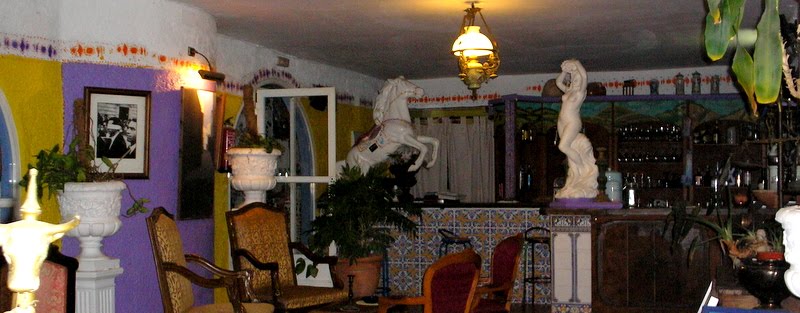
Delfos, an art gallery and bar, is on the road between Mojacar and Turre. It's open every evening from 9.00pm. Mariano, who has a great knowledge about Spanish modern art, will show you around or just pour you a drink as you take it easy. No tapas, no one selling roses and no accordion players.
Mojácar, it is said, is blessed with an enormous number of bars. Most of them being the usual stainless steel dives where a lack of imagination, a reptilian smell of stale sweat and the pounding thump from the music system make the gentle art of conversation as lost as a five cent brandy. The Delfos is an exception to this, with a phenomenal decoration from the last twenty or thirty years of Spanish art peppered with a few foreign masters (that's a Fritz horse in the middle of my picture). It's a different way of looking at life - over a whisky.
The locale is huge, with odd rooms and outside terraces filled with objets, sculptures and paintings. It was designed - and more or less built - by Manuel Coronado (one of Spain's best known modern artists) about twenty years ago. The Mojácar town hall as usual, confronted by the chance to improve its image with an injection of culture and some famous artists, fell over itself to do nothing.
It's not perhaps the kind of place to go drinking, but it's the place you take people to when you want to show off your town. Look, you say, have you ever seen a place like this?

Tuesday, April 27, 2010

Putting Old Cars Through their Paces

I bought my first car from a dealer in Almería. I was eighteen and had recently (that morning, probably) passed the driving test in Huercal Overa. The car was a kind of old Renault van called a 4F with the push-pull gears, but fitted with an Ondine engine rather than the usual 4L couchez-avec egg-beater. This meant that the old girl could thunder along at a rather better speed than suggested by the body and was just the ticket for me. The passenger seat was removable; it merely hooked in at the front, so it offered a rather nasty surprise to anyone sat next to me when I stepped on the brake, but with the seat parked on the tarmac, I had room to stretch out full length on a thin mattress for a snooze. That’s right: my first vehicle was a camper.
I remember belting one day down the wiggly line on the map laughably called a road which connected Mojácar with Murcia and all points north. In those far-off times, roads went through towns, rather than round them, which meant you could stop for a libation every hour or two. Trucks would work their winkers to let you pass. There were no discernable speed limit and no one took any notice of the signs anyway. There were drain-channels across the road which, if hit with sufficient speed, would cause you to leave a dent in your roof as the car dipped and you didn’t. On this occasion I was approaching Murcia at somewhere over a hundred kph when I saw two cops on the side of the road, just at the point where the road itself dropped about six inches and turned into a rutted track. No warning signs, of course. Spoil the fun. There wasn’t time to slow down nor was I inclined to, as the two grinning policemen waved me past, like fans at the track. I think I broke a kind of automotive long-jump record that day.
The car took me to England in about 1972 on an early adventure in my life, the only time I have ever driven from here-to-there, all the way through to Calais and across the channel. Crossing into France caused me some embarrassment as I stopped at the frontier and whipped out my passport at the desk with a merry ‘Bong-jour’ only to see a small package arc across my line of vision. It was a single and rather elderly prophylactic that I had kept in an inner pocket ‘for emergencies’. To my horror, monsieur le flic saw it as well. ‘Is ze engleesh gentleman goin to defloweur one of our fine French beautees?’ he asked kindly, picking it up and returning it to me. Sadly not.
The front axle of my passion-wagon fell off in Norfolk and a mechanic friend of the family told me that it would cost 50 pounds to repair and that the car wasn’t worth it. Yea, right. So, once fixed, and driving back home, again through France and into Spain, the old Renault van proved him wrong. It lasted another couple of years before I sold it to the Bédar town hall.
A few years later, a Spanish friend with an odd sense of humour told our family of how he had just bought a strange foreign car: a brand he couldn’t remember (you could only buy Simcas, Renaults, Citroens and Seats in Spain in those days, peppered vaguely with a few enormous American Dodges and a strange kind of Austin making sure that the British car industry would remain a world power forever). He had left this car, he continued, in Almería, parked on some side-street and the problem was, as he explained to the police, he couldn’t remember where he had left it and, as they attempted to take down some details, he admitted that he had no idea what sort of car it was. Despite this unforgivable lack of crossing one’s tees and dotting one’s ayes, the car was eventually located and returned to its concerned owner… who promptly sold it to my father. It soon became mine. It was a two-tone Karmann Ghia 1500 Special and easily the worst car ever made. It had a rear engine hidden under a false boot and a large and empty space in the front, empty, that is, except for some rust and a sack of cement. Without this aid, the front wheels would lose all contact with the road once you got up to about sixty, which may have helped improve my reaction time and general driving skills but must nevertheless be seen as a major design flaw. Sometime along the way, a school-friend came to stay and asked to borrow the car. He seemed a decent sort, and played a lot of cricket. He wanted to go down to Marbella for some amorous reason. I gave him the keys. I have never heard from him or the car since. I hope he’s all right.
I met my fastest and most terrifying car for the first time when wandering around in Madrid and suddenly saw her sat in the window of a second-hand car studio. This was a red Italian super-car, a 1967 Iso Rivolta with a gigantic American Corvette V8 engine in it, making the car capable of breaking the sound barrier. I was about 30 and in the mood for some muscle and so I bought it from the suspiciously grateful dealer for a million pesetas. The car brought me down to Mojácar in a personal record time, helped by not having any brakes at all. It was quite splendid. It turned out that the car had belonged to a political nutter who had shot some left-wing lawyers dead in a famous attack in Madrid in 1977. He obviously wouldn’t be using it for a while. To give you some idea of how fast this luxury four-seater was, the speedo – while unfortunately broken – went up to 300kph.
But that was then, before they invented air-bags, satellite navigation and eight-track. Today I drive an old Mercedes lovingly made in 1984 which, at a top speed of around 100, is a bit slower than I’ve been used to, but it does mean that the traffic cops and those ugly speed trap gizmos on the motorway will leave me alone as I chug effortlessly past. These days, that’s enough for anyone.

Monday, April 19, 2010

A Licence to Hunt Frogs

In the old days, it was easy enough to find frogs. They would be croaking in some corner of the garden or leaping into a nearby pond. Sometimes there would be hundreds of miniature amphibians, perfect but tiny, wandering around the edge of a pool as if on their first morning stroll. Nice little chaps, frogs.
‘I say waiter, do you have frogs legs’. ‘Oui, monsieur’. ‘Splendid. Hope over the counter, would you, and get me a sandwich’.
I had read in the paper that a large pond in some pueblo in the province was full to bursting of ‘renacuajos’, tadpoles. It would have been what editors call ‘a slow news day’. The reason this interested me was because we have had a lot of mosquitoes lately and if there’s one thing that enjoys a good meal of these horrible insects, it would be frogs. The bugs are out now, and biting. Besides which, the pump in our swimming pool is bust so I can’t empty (and paint) the piscina and I don’t want to get into trouble and be blamed for the clouds of mozzies by the neighbours. I also want to do my bit for the environment, so won’t be buying any nasty sprays. Best thing for everybody would be a shovelful of frogs tossed into the deep-end.
All I needed to make this plan a success was a bucket-load of the little critters collected from the local pond or some handy reserve of stagnant water.
In the old days when I was a boy and first exhibiting an interest in the small animals and insects that surrounded me, I would catch a few sticklebacks with a jam-jar and a bit of string while wearing flannel shorts and Start-rite shoes stuck gamely in some mud. This would be a rather hit or miss affair at best; but now I am glad to say that I am rather more hi-tech in my hunting.
I get my boy to do it.
We are spoilt for choice at the moment, with lakes, ponds, pools, gullies, reservoirs and endless puddles all full from the heavy rains over the past months. This blessing from the skies, apart from causing a welcome surge in the roof-repair business locally, has brought a wondrous crop of wild flowers to stipple the hills and fields with every colour that Nature can imagine, and is now causing the first stirrings of insect-life, bees, butterflies, glow-worms, dragon-flies and, of course, mosquitoes.
It was a warm day and there wasn’t much doing so we went down to the ‘creek’ up past Turre, where the steep and narrow bridge dog-legs over the gulch, at the narrow bit of the Rio Aguas as it splutters its way down from the snowy mountains far inland. There’ll be frogs there. You can park the car off the road at the top in some handy ditch, deep in a patch of wild flowers. The descent to the river-bed is tricky, as it’s all overgrown, but we made it safely to the bottom, jam-jars and bits of string quivering with excitement. Years ago, there used to be small black terrapins living down there and it was worth the odd inconvenience of a shoe full of water to catch them. Now, in a small and localised example of extinction, there’s none left. Just water-boatmen, caddis flies and mosquitoes perched in the branches of the trees. It is a peaceful place down there under the bridge, although something felt wrong, as if we were being watched. A bit creepy. We saw the dried husks of some dead swallows tossed violently around in the undergrowth. There didn’t seem to be any frogs about so, unsettled, we soon left.
We drove back and went down to the riverbed near our house, where the winter rains have collected into what turns out to be quite a large lake. The gravel-grovelers in the rambla appear to have built this for some reason or other with their bulldozers and tractors. There were some large aquatic birds scudding across the surface and I heard the call of a lone bullfrog but we couldn’t find much sign of life once we had climbed down to the edge, apart from the floating body of a dead goldfish. How on earth did that get there?
The town hall will need to spray this expanse of water soon, as the season’s mosquitoes are larger than normal and they are getting hungry. Perhaps the dreaded global warming or something strange in the water is doing it. The story is, and you may have heard this already, the mosquitoes are so big this year that their wings have atrophied and they have lost the power of flight. They are said to run along the ground after their pray, like asthmatic rabbits. Two or three bites from these things can empty a leg.
We return home and I feed the chicken some dog-food (which it seems to prefer over rooting around in the garden). The eggs are a trifle gamey but they are regularly laid and the shell is certainly strong. You have to break them with a hammer.
There’s a pond way up above the pueblo towards the top of the mountain, guarded these days by a chain. No biggy. I go up there with a bit of muslin to scoop out some tadpoles for my jam-jar. This time, I have some success and bring home a smear of wriggling pond-life which I toss into the bottom of the mostly empty swimming pool. There is an odd moment of suspense before the water begins to bubble and churn. To my surprise and horror, I can see the insect larvae eating the unfortunate tadpoles in a feeding frenzy like something out of an old Jaws movie. I go quickly inside and close the windows.
They are climbing out of the pool now. Using the ladder. The sky is empty of birds. I’ve got a tin of spray, a fly-swat, a plug-in with a little blue pellet and a loaded shotgun. We’ve nailed pieces of wood over the shutters and put a chest of drawers in front of the fireplace. A blond American woman is making us a cup of tea in the kitchen as the first exploratory ‘thunks’ and bangs start at the base of the door in the front room. There’s a crash from upstairs. The radio is babbling some nonsense about horse racing at Ascot.
Where is that helicopter from the town hall? We need some insecticide down here!